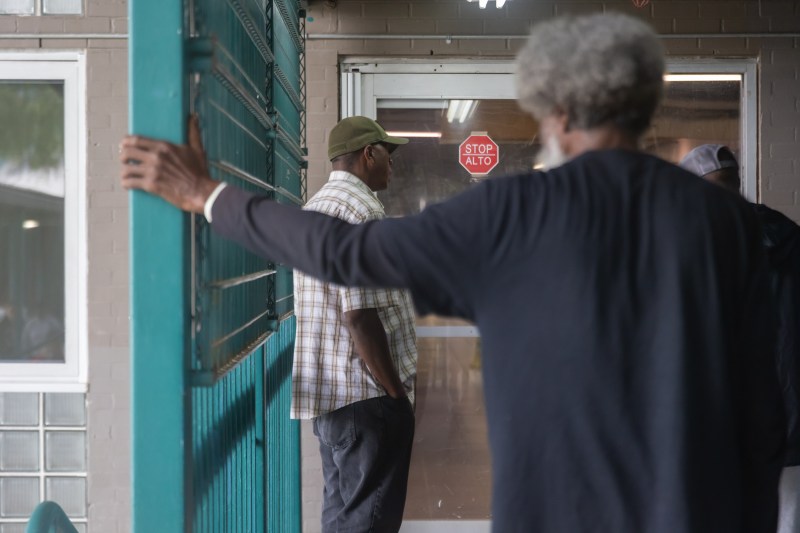
Houston’s new homeless services hub at 419 Emancipation is now open, providing a 24/7 resource center designed to stabilize people experiencing homelessness and connect them with long‑term housing solutions. The facility has 147 residents already inside, according to city officials.
The center is part of a major investment by the City of Houston, which purchased the site for $16 million and approved a $39 million agreement for The Harris Center for Mental Health and IDD to operate it. The 222‑bed transitional facility is expected to cost $10 million to $14 million annually to run.
The building’s layout features a security station at the entrance leading directly into a triage area, a large cafeteria capable of serving three meals a day to more than 220 people, and two stories of residential rooms. Each room contains three beds, a set of lockers, and a bathroom. The capacity could eventually expand from 222 to 320 beds if needed. The building has served in prior lives as a shelter for women and children and, more recently, as a facility for unaccompanied migrant children.
The facility is part of Mayor John Whitmire’s broader plan to end street homelessness in Houston.
Mike Nichols, Director of the City of Houston’s Housing and Community Development Department, says the center fills critical gaps in the region’s homelessness response system, even as Houston has made measurable progress in reducing homelessness over the past decade.
“In 2025, 2,043 people were in transitional or temporary housing, while 1,282 were living unsheltered across Harris, Fort Bend, and Montgomery counties, according to the Coalition for the Homeless of Houston,” Nichols told Courier Texas.
People with mental health and substance-use disorders are more likely to be chronically unhoused , Nichols said, and that’s just who 419 is built for.
Nichols added the facility represents a coordinated, multi‑agency approach. The center accepts individuals through law enforcement drop‑offs, walk‑ins, and outreach referrals. Upon arrival, each person receives a triage assessment to determine immediate needs and the level of care required.
Tiffany Thomas, District F council member, said in a statement the facility reflects a collective commitment to expanding housing opportunities and delivering compassionate, data-informed solutions for those most in need.
“The people are the city, and when we fail to take care of Houstonians, we fail to take care of our city because our success is interconnected,” said Thomas. “While the proposed facility will not solve homelessness citywide, its approval is an important step forward in the right direction. 419 Emancipation will save someone’s life.”
Nichols describes the facility’s workflow as a three‑stage process: triage, to identify immediate needs; treatment, to connect individuals with medical and behavioral health services; and transition, to support long‑term stability through housing placement and continued care.