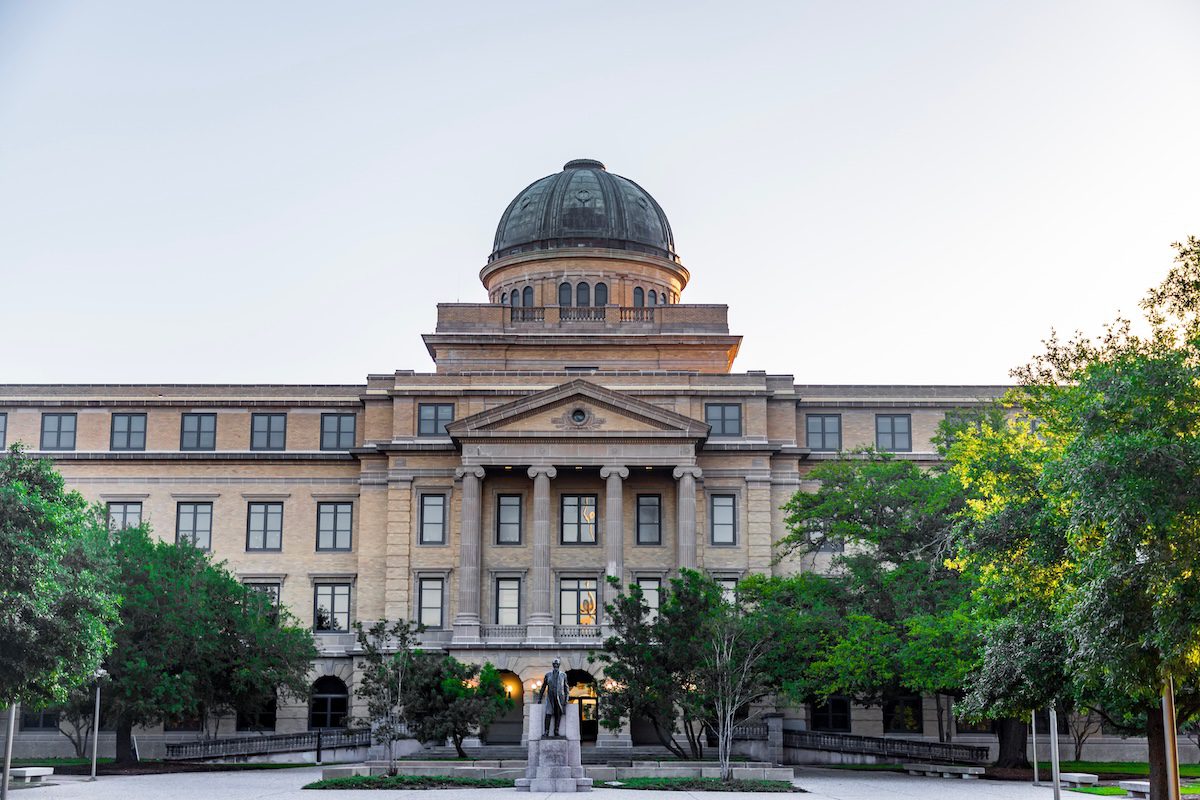
A new policy at Texas A&M restricting how professors teach race and gender was implemented in November. (Photo by Harsha Vardhan Reddy via Shutterstock)
Dr. Leonard Bright’s Ethics and Public Policy course was canceled a few days into the semester. It’s just one in a string of attacks on academic freedom at the university.
Dr. Leonard Bright became a professor for a simple reason: “Teaching is important.”
“We have the ear of the next generation,” Bright, who has taught at Texas A&M University for 15 years, told COURIER Texas. “We are in a place to help mold the future. How we do that will affect democracy itself.”
Bright taught a graduate-level Ethics and Public Policy course at Texas A&M for six years until last week. His class was canceled three days into this semester after the university claimed he did not submit information needed to be exempt from a new policy that bans “advocating for race and gender” in the classroom.
Bright said that claim is “patently false,” and told the Bush School of Government and Public Service that “issues of race, gender, and sexuality are not peripheral, but integral,” to his class.
“This is ethics, how do you talk about ethics and not talk about the characteristics of people? That’s what ethics is about, how we treat people,” he said. “And who are people but our identities? We’re discussing that in class, not changing a student’s viewpoint.”
Bright explained to COURIER Texas that the university wanted to know the exact day in the semester that he would be discussing race and gender in his course.
“It’s everyday,” he said. “I present lectures, students bring up issues, it’s everywhere, and they wanted me to voluntarily limit my class.”
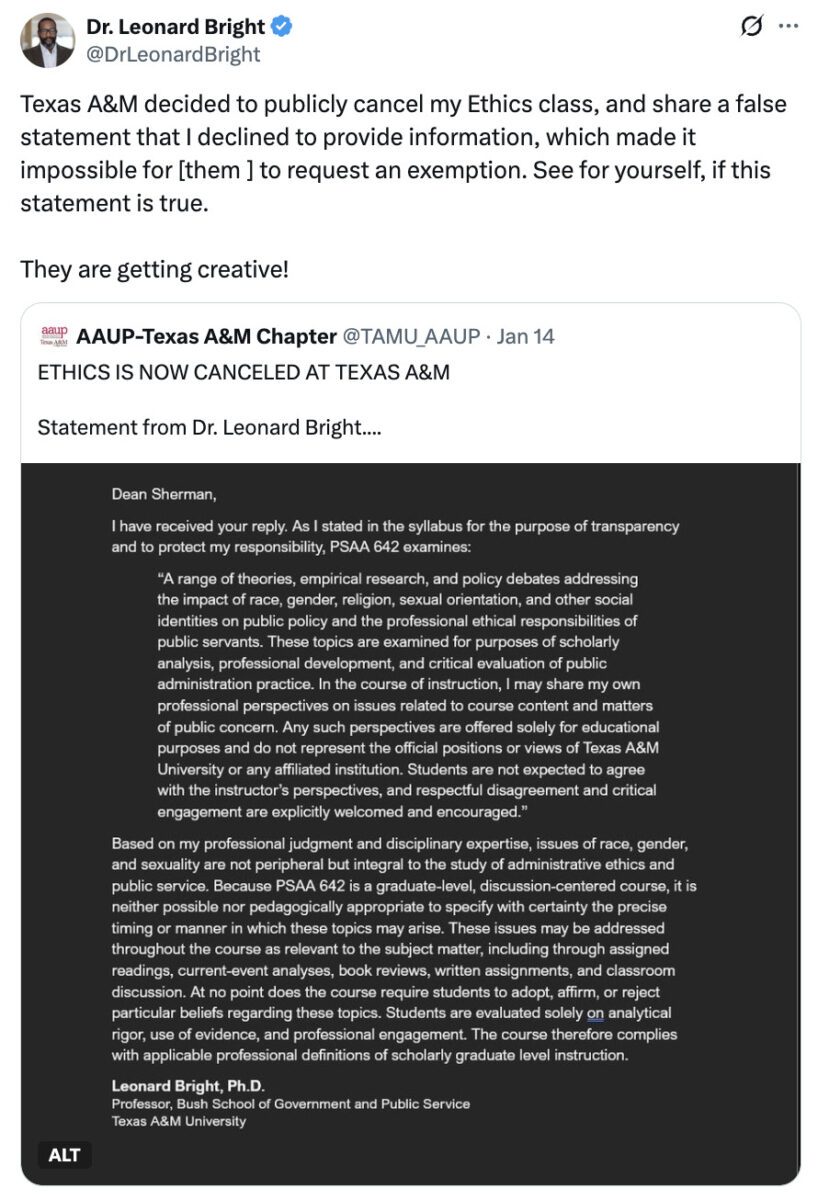 In a school-wide email explaining the decision, John Sherman, dean of the Bush School, said the university system’s new policy required that the class be canceled because Bright did not provide enough information on his planned instruction to receive an exemption to the new guidelines.
But Bright told his department head that he didn’t want an exemption because his class wasn’t advocating for anything, and asking for one would misconstrue the aim of his class.
“I explained, if you want to know what the class is about, here’s my syllabi,” Bright said. “They have access to all the readings, all our assignments, they have access to all of that. So it just seemed to me that they were fishing for something else and wanted me to misrepresent my class.”
Bright’s Ethics and Public Policy course was the only ethics class offered in the Bush School this semester, and 10 students were initially enrolled.
Now that his class is canceled, students are going to “miss the opportunity to deeply dive into the most important topics we see going on today,” he said.
“(My students) are learning about a lot of different skills—how to do a budget, how to fundraise, what does management mean, economic analysis—but the core of this class is how we treat our citizens,” Bright added. “We talk about international policy, environmental policy, global warming—all these things that are so important, and have race and gender implications that run through all of them.”
He explained that when we remove these discussion opportunities from students, we’re creating students who are less prepared for the real world.
‘This was an attempt to damage my reputation’
As attacks on higher education continue to mount at Texas A&M, Bright has been a vocal advocate for free speech and academic freedom.
“Around this time, I’m speaking out about the Plato incident that happened. I’m the AAUP chapter president. I know I have a big target on my back,” Bright said. “I think one of the reasons this happened was to serve me as an example. I think this was an attempt to damage my reputation across the college, and to send a chilling message to others in hopes to not do what I did. Now we’re here, and I don’t have my class.”
Texas A&M’s new gender and race policy was implemented in November.
It was created after State Rep. Brian Harrison urged the university to fire a professor for discussing LGTBQ+ topics in class—a move that created a firestorm of censorship and turmoil across the university system.
After the professor was fired, university President Mark Welsh resigned amid Republican lawmakers’ criticism in not moving quickly enough to fire the professor.
The new policy also set off a rapid course review, and at the start of the new year professors were told that nearly 200 courses could be changed or canceled under the restrictions.
“The policies themselves are so vague and so contradictory,” Bright said. “Each of our colleges are doing something different and Texas A&M is saying that’s because there’s no ‘one-size-fits-all.’”
But Bright said that’s not how you run a university.
“It should be centralized and clear enough that we can all agree and not feel like we are being targeted. Some people have been targeted and others aren’t, and it just looks so inconsistent,” he said.
The university also made national headlines after a professor was told to remove excerpts from Plato from his philosophy course or risk having it canceled because the content discussed more than two biological sexes, and displayed homosexuality in a positive light.
“We’re really playing with democracy itself,” Bright said. “I think this is so deeply troubling. There’s no words to describe the damage that Texas A&M has done to itself.”
Author

Support Our Cause
Thank you for taking the time to read our work. Before you go, we hope you'll consider supporting our values-driven journalism, which has always strived to make clear what's really at stake for Texans and our future.
Since day one, our goal here at COURIER Texas has always been to empower people across the state with fact-based news and information. We believe that when people are armed with knowledge about what's happening in their local, state, and federal governments—including who is working on their behalf and who is actively trying to block efforts aimed at improving the daily lives of Texas families—they will be inspired to become civically engaged.