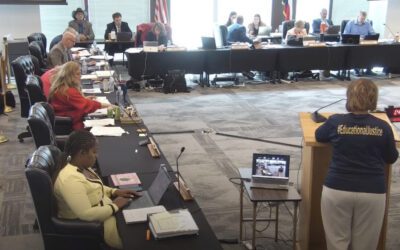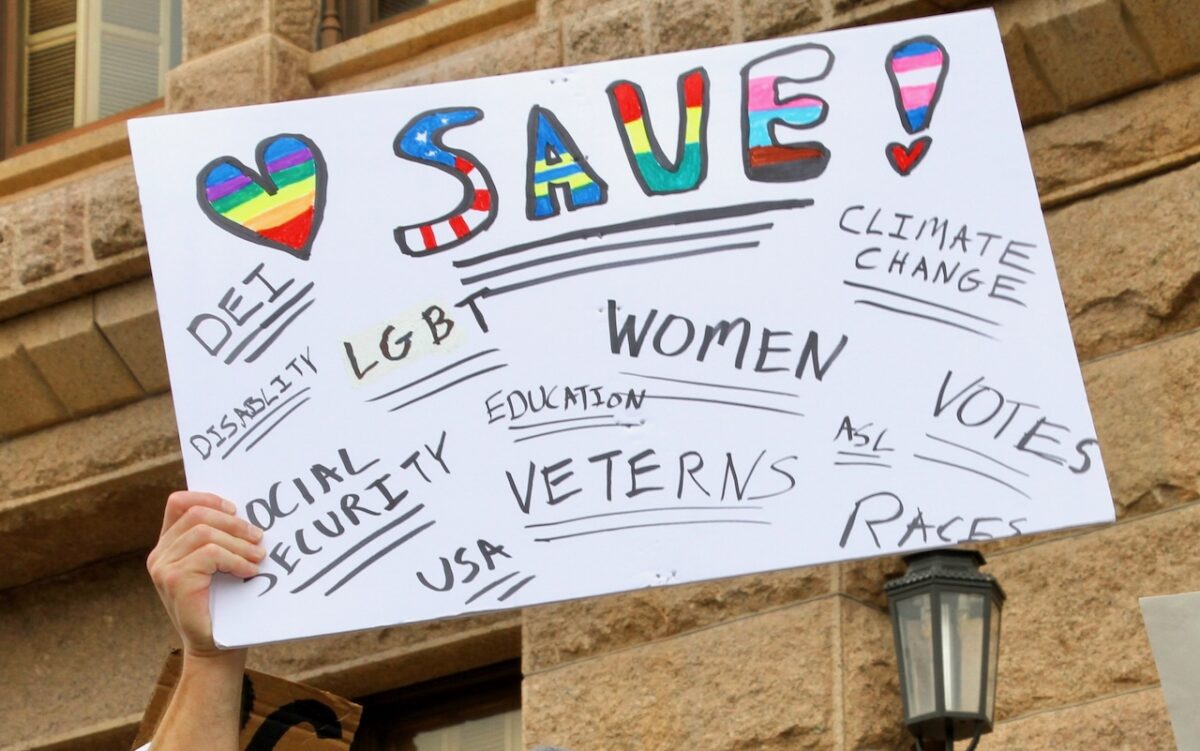
A federal judge ruled that Houston, Katy, and Plano ISDs can’t enforce four sections of the new law. (Photo by Matt Hennie)
Teachers and students in Texas started the 2025-26 school year under a new law that prohibits gender and sexuality alliance clubs at high schools across the state.
A federal judge has temporarily blocked three school districts in Texas from enforcing parts of Senate Bill 12, a new state law that went into effect on Sept. 1 and bans diversity, equity, and inclusion initiatives in K-12 public schools.
In August, the ACLU of Texas, the Transgender Law Center, and Baker McKenzie filed a lawsuit on behalf of the Genders & Sexualities Alliance Network, Students Engaged in Advancing Texas, the Texas American Federation of Teachers, a teacher, and two students, arguing that SB 12 violates the First and Fourteenth Amendments, as well as the Equal Access Act.
The law prohibits school districts from authorizing or sponsoring student clubs based on sexual orientation or gender identity.
It also prohibits teachers from using they/them pronouns and requires that students are only referred to by the name given to them at birth; prevents schools from developing or using policies that reference race, ethnicity, gender identity, or sexual orientation; and bans them from using DEI as a factor in hiring decisions.
In December, the plaintiffs of the case sought a preliminary injunction to block these key aspects of the law from taking effect while their case makes its way through court.
On Friday, US District Judge Charles Eskridge ruled that the three districts named in the lawsuit—Houston, Katy, and Plano ISDs—can’t enforce four sections of the law.
Now, the three districts won’t be able to restrict school-sponsored DEI efforts, prohibit staff from referring to students with names or pronouns that they are not assigned at birth, bar instruction about sexual orientation or gender identity, or ban student clubs based on sexual orientation or gender identity.
“This is a critical victory amidst a surge of state-sponsored discrimination and censorship of vital conversations about race, gender identity, and sexual orientation,” said Brian Klosterboer, senior staff attorney at the ACLU of Texas. “As we continue challenging these harmful provisions of SB 12, we will continue advocating for the rights of every student, parent, and educator in Texas to be able to live and speak freely, authentically, and safely in and surrounding K-12 schools.”
While supporters of the law claim that DEI programs use class time and public funds to promote “political agendas,” opponents say banning these initiatives disproportionately harms marginalized students.
“When students enter their classrooms each day, they deserve a safe and welcoming school environment,” said Cameron Samuels, the executive director of Students Engaged in Advancing Texas and a plaintiff in the case. “While cruel policies like SB 12 have harmed students for years, today’s ruling reminds us that queer and trans students’ resilience and joy are here to stay–and we won’t stop fighting until all Texas students are guaranteed safe and welcoming school environments.”
Although the plaintiffs asked the court to block the four provisions of the law statewide, Eskridge dismissed Texas Education Commissioner Mike Morath as a defendant in the lawsuit, saying the education commissioner did not implement or enforce the challenged provisions of SB 12.
Because of his decision, the temporary measure only applies to the districts named in the lawsuit, not the entire state.
The districts must notify the court by early March if they plan to defend SB 12 in the lawsuit or seek representation from Texas Attorney General Ken Paxton.
Author

Support Our Cause
Thank you for taking the time to read our work. Before you go, we hope you'll consider supporting our values-driven journalism, which has always strived to make clear what's really at stake for Texans and our future.
Since day one, our goal here at COURIER Texas has always been to empower people across the state with fact-based news and information. We believe that when people are armed with knowledge about what's happening in their local, state, and federal governments—including who is working on their behalf and who is actively trying to block efforts aimed at improving the daily lives of Texas families—they will be inspired to become civically engaged.