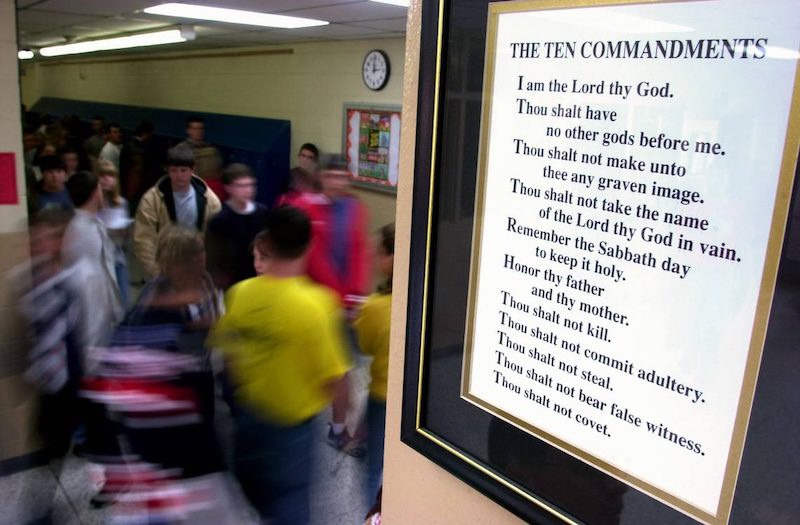
Some Texas teachers are criticizing a new law that mandates the Ten Commandments be displayed in public schools. (Photo by Lexington Herald-Leader/Getty Images)
Students opened the school year with Ten Commandments in classrooms and prayer time, the latest moves by GOP lawmakers to infuse Christianity into public schools.
Public school teachers in Texas are now required to display the Ten Commandments in their classrooms.
Lawmakers passed Senate Bill 10 in May and the new law went into effect on Sept. 1. It requires public schools to display a 16-by-20-inch poster of the Ten Commandments in every classroom.
The move has sparked concerns over violations of students’ First Amendment rights and the freedom of religion.
”When I first heard that it was going to be implemented in schools, I thought ‘This is not right,’” Azeemah Sadiq, a senior at Alief ISD and a senior policy associate at Students Engaged in Advancing Texas, told COURIER Texas.
“They are trying to push a narrative, and agenda of promoting a particular religion, and it begs the question, why don’t we have other foundational principles of other religions being shared? Why a specific religion, and why is it even there at all? It shouldn’t be. Our public schools are supposed to remain secular,” she added.
Teachers are also voicing their frustrations with the new mandate.
“It’s concerning, I know there are some parent advocacy groups within my district who have already stated that they will push back,” said April Jones, an Algebra 1 teacher at Northeast ISD in San Antonio. “Parents are very upset that this has to be posted, and I know a lot of teachers who—even if they are Christian—they’re wondering why they have to hang it in their room. Originally, they told us we shouldn’t be hanging up anything that doesn’t have to do with what we’re teaching.”
“I’m not teaching bible class, so why am I hanging this up?” she added.
Texas followed Louisiana and Arkansas in passing legislation requiring that the Ten Commandments be displayed in classrooms, although a Louisiana federal court ruled that the law violated a constitutionally required separation of church and state and has not been implemented.
In July, the ACLU of Texas and 16 families filed a lawsuit in federal court to block the law. And in August, US District Court Judge Fred Biery issued a temporary injunction, ruling that the law was unconstitutional and interfered with parents’ rights to guide their children’s religious upbringing.
Biery’s order exempted 11 public school districts, including ones in DFW, Austin and Houston, from having to display the religious text for now. Texas Attorney General Ken Paxton appealed the injunction earlier this month.
A designated prayer and religious reading time
Senate Bill 11 also went into effect on Sept. 1, creating a designated prayer and religious reading time during the school day.
The bill has one educator questioning whether lawmakers are trying to infuse more religion into public schools..
“I think Republican lawmakers would like to see public schools either shrink, become like private schools, or become very theocratic,” said Stephen Wright, an AP Government teacher in Houston ISD. “They’ve already banned so many things, so what’s the next step? Are they going to ban any kind of mention of other religions?”
Although SB 11 prohibits the promotion of one religion over another, Paxton not only urged schools to adopt the prayer time, but also told students they should use the time to recite the Lord’s Prayer.
“(SB 11) seems odd because we already have a moment of silence during the Pledge of Allegiance, and I thought that’s what that time was for anyway,” said Andrew Kirk, a ninth grade World Geography teacher in Dallas ISD. “It’s one of those things that’s hard to imagine, at least in Dallas, of making much of an impact.”
Jones echoed Kirk’s sentiment, sharing that some of her students already read the Bible or pray on their own during her school’s moment of silence before the Pledge of Allegiance.
“It just feels more like virtue signaling than anything else,” Wright said. “When Ken Paxton says that about the Lord’s Prayer, I see that as him trying to out flank John Cornyn for the primary battle—who can be the most conservative, who can reach those far right voters, because they know that’s what’s going to get them the election.”
Christopher Wilkins, who taught in Dallas ISD for several years and is now a graduate student at the University of Texas, echoed Wright’s sentiment.
“They are trying to push the agenda of a very small minority of very vocal billionaires,” Wilkins said. “Republicans are doing this virtue signaling to their billionaire backers. It’s an ideological virtue signal in saying, ‘We’re just going to push the bottom line as long as you keep giving us enough money to get reelected. It’s a distraction, but they’re serious about it. Their plan, and they’ve been clear about it, is to get rid of public education, replace it with private education, and replace it with religious education and indoctrination.”
Meanwhile, Texas AFT President Zeph Capo called bills like SB 10 and 11 “intentionally pushing the thumb of government down on the scale in favor of a favored religion.”
“It certainly meets the definition I’ve always learned of violating the Constitution when it comes to separation of church state,” Capo said. “When a government chooses to name a preferred religion and use its position of power to place that in front of the people— that’s exactly what’s happening, and it’s happening in the worst possible way because it’s happening to our most impressionable, our students.”
These bills expand on a conservative push to infuse more Christianity into public schools, as the Texas Board of Education approved Bluebonnect Learning in November. The learning materials for kindergarten through eighth-grade students include a Bible-based curriculum. Nearly half of the public school districts in Texas—595 out of 1,207—will use at least some parts of the curriculum, according to the Texas Tribune.
Author

Support Our Cause
Thank you for taking the time to read our work. Before you go, we hope you'll consider supporting our values-driven journalism, which has always strived to make clear what's really at stake for Texans and our future.
Since day one, our goal here at COURIER Texas has always been to empower people across the state with fact-based news and information. We believe that when people are armed with knowledge about what's happening in their local, state, and federal governments—including who is working on their behalf and who is actively trying to block efforts aimed at improving the daily lives of Texas families—they will be inspired to become civically engaged.