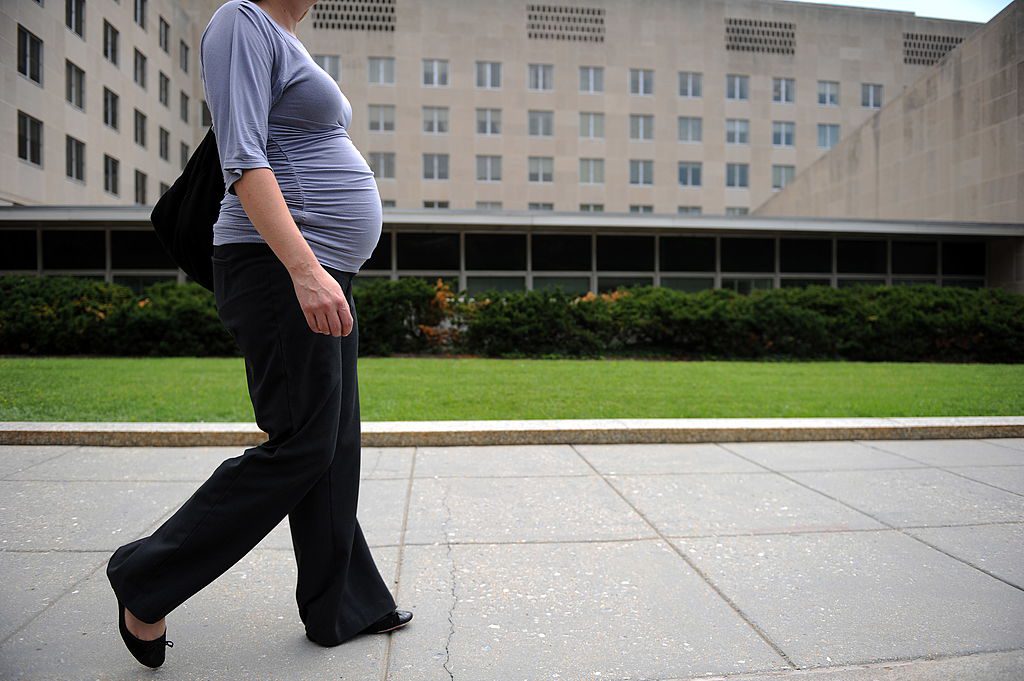
A pregnant woman walks outside the State Department on August 5, 2010 in Washington, DC. AFP PHOTO / Tim Sloan via Getty Images
A Houston mom knew she needed to stay alive for her teenage son. But not one of 90 doctors she saw was willing to save her life by ending her dangerous pregnancy.
Content warning: This story contains graphic descriptions of pregnancy-related medical complications, maternal death, and pregnancy loss.
Tierra Walker was just 37 years old when her son JJ, 14, found her lying facedown and unresponsive on her bed.
As he desperately called 911, he cried, “I need you, I need you,” and tried his best to bring her back to life with CPR, following the instructions of the emergency operator.
It was too late.
He lost his mother and best friend on his birthday.
Walker died at 20 weeks pregnant after multiple ER trips and hospitalizations. She had been examined by 90 doctors, including 21 OB-GYNs, during the previous months, according to a detailed investigation of her case by ProPublica.
Seizures, convulsions, soaring blood pressure, diabetes, and blood clots so severe that one required a thrombectomy had made her so weak that on the day of her death, she could only whisper as she lay in bed.
The first inkling that something was wrong was an episode of uncontrollable shaking after walking her dogs, months before she died.
JJ was so alarmed by his mom’s condition that he called 911. Walker was rushed by ambulance to the hospital, where doctors performed tests and discovered that she was five weeks pregnant. Since that initial hospital visit, the terrifying symptoms brought on by Walker’s pregnancy grew worse.
Yet not one of those 90 medical experts Walker met with ever suggested that she do the only thing that could have definitively saved her life—undergo an abortion to end the pregnancy.
In 2024, the year of Walker’s death, Texans were living under a law that banned abortions from the moment of fertilization with no exception for rape, incest, or a fatal fetal anomaly.
The only real exception was if the mother was at risk of “imminent” death, or a major bodily function was at substantial risk of impairment.
The potential punishment for a physician who would have made that call and performed an abortion on Walker was 99 years in prison, the loss of medical licensure, and a $100,000 fine.
Walker died just after Christmas at her home in San Antonio.
An autopsy revealed that she died of a dangerous high blood pressure condition brought on by pregnancy—preeclampsia.
The young mother is now the fourth woman in Texas documented to have died when she didn’t receive necessary medical care as a clear result of the state’s strict abortion ban.
Maternal mortality in general skyrocketed 56% in the first two years after the state’s initial abortion ban in 2021.
Texas OB-GYNs interviewed by COURIER Texas say that they are not surprised by the death of Walker, who was a beloved wife, mother, daughter, and niece.
“This is not a surprising case if you’ve been providing this care,” Houston family physician Dr. Bhavik Kumar said. “We (Texas doctors) warned after the first abortion ban, SB8, and the trigger ban, that things like this would happen.”
“When people aren’t able to access care that they need in a timely way, they will suffer and some of them will die. It wasn’t surprising, but it was still shocking and sad to read about what happened. She likely died from a stroke.”
A new law isn’t working
What may be even more frightening for the women of Texas and their loved ones is that even though the Texas Legislature passed SB31 last May—called the Life of the Mother Act, supposedly to allow doctors to terminate pregnancies in more cases—the OB-GYNs interviewed still believe that Walker would have died today.
The Life of the Mother Act was promoted by Republican legislators as a means of clarifying when OB-GYNs and other doctors could provide medically necessary abortions if a pregnant woman had a life-threatening condition.
The bill’s supporters claimed doctors would no longer have to wait until a mother’s death was imminent and before she suffered any adverse effects from that risk.
It was supposed to save the lives of patients who were suffering from dangerous pregnancy complications, allowing doctors to intervene and offer lifesaving abortions to women who wanted to terminate pregnancies instead of risking death to continue them.
Walker was one of those women.
She had asked her doctor if it would be safer to end her pregnancy more than two months before her death, having already endured the birth of stillborn twins after suffering from severe preeclampsia in a previous pregnancy.
Her physician rebuffed the question and told her that she wasn’t facing an emergency.
At the time of SB31’s passage, Houston OB-GYN Dr. Todd Ivey told COURIER Texas that “this bill gives me clarity and it gives a lot of the people I work with clarity.”
“We now know that we can use our reasonable medical judgement if something is life-threatening or potentially life-threatening, and we don’t have to wait until a pregnant female suffers any effects from the risk she has.”
However, multiple Texas OB-GYNs interviewed say that’s not what’s happened in the time since the bill’s passage. They say that Texas is just as dangerous now for women who develop a complication in their pregnancy, like Walker did.
“Tierra’s pregnancy would have ended with the same result today,” said Dr. Damla Karsan, a Houston OB-GYN. “I recently terminated a pregnancy for a woman who was suffering from PPROM, a premature rupture of membranes. She was turned away from two other Houston hospitals before I did the termination.”
What’s instructive about this example is that the condition of PPROM—when a woman’s water breaks well before a fetus is viable—is now another allowed exception under the Texas abortion trigger ban.
That’s because pregnant women in those cases are at high risk of developing deadly sepsis infections, as bacteria can easily enter their uteruses after the amniotic water breaks.
Austin resident Amanda Zurawski spent three days battling a life-threatening septic infection after her water broke at the 18-week mark of an extremely wanted pregnancy.
The Texas Legislature, after much lobbying, allowed doctors to provide abortions immediately to women like Amanda—but they can still be prosecuted. The amended law simply allows them to use the PPROM exception in their defense.
That’s why Karsan’s patient was sent away from two Houston hospitals in her desperate search to find a physician willing in Texas to perform a termination. Many doctors are still too afraid to provide abortions in Texas, no matter what the law says.
“When you look at a case like Tierra’s and you see how much a person has been in and out of emergency rooms, visits to different doctors, nurses, health care professionals looking at her case, you see how powerful these laws are,” Kumar said.
“You see how much they have a chilling effect, a silencing effect, and no matter where you go and how much resource you have or what health insurance you have, if the laws are that strong … this is silencing physicians’ ability to provide the best care.”
Walker’s death “is the precise consequence of these laws when we ban access to abortion.”
Dr. Anitra Beasley Brod, a Houston OB-GYN, agrees that Walker’s death was “not surprising” to her or other people who care for pregnant women.
“It’s not confusion about the law. Doctors know what the best care looks like. But when you take the words of the laws and put them into the real world in the context of the penalties that go along with them, your decision-making is much more complicated,” she said.
“You’re balancing not only the patient’s well-being, but your ability to continue to practice, to not be in jail, to not be sued, to just continue, to live … it makes decision-making much more complicated.”
“I have to think about whether I can defend my decisions in court.”
All the doctors interviewed insisted that their sole focus should be on the health of pregnant women and providing the best care for their patients, but said Texas’ abortion bans prevent that.
It seems that the much-touted Life of the Mother Act, SB31, has not changed the real-life situation for doctors or women in Texas.
“These laws that attempt to provide clarification only muddy the waters,” said Kumar. “It’s even more confusing.”
Yvonne Gutierrez, the Texas-born and bred executive director of Reproductive Freedom for All, a national organization fighting for reproductive rights, agrees.
“Doctors in Texas have been clear that this so-called clarification change is nothing,” she told COURIER Texas. “They still face extreme penalties and cannot rely on vague language in the law that is written by politicians and not medical professionals.”
“It’s not safe for women and you’re putting physicians in a terrible, terrible position,” she said. “That’s why medical professionals need to have the discretion to make these life-saving decisions. As long as abortion is banned, people will continue to be denied care, and they will suffer and die.”
A ticking time bomb
In fact, more than a dozen OB-GYNs outside of Texas who reviewed Walker’s medical records called her pregnancy “a ticking time bomb” and said that she should have been advised of the serious risks of her pregnancy from the very start, when she first began having seizures and convulsions due to her high blood pressure.
They all agreed that she should have been offered the option of an abortion at any time.
That never happened.
“With the complications that she was experiencing with this pregnancy and that there were so many physicians involved in this, just goes to show the threat that these physicians are under in being able to provide care,” said Gutierrez.
“The OB-GYNs who afterward reviewed her case said she needed an abortion and that was not made available to her.”
Dr. Lou Rubino, the former lead doctor of the Austin Women’s Health Center, agrees that the fear of 99 years in jail remains so high—even after the passage of SB31—that many Texas physicians refuse to talk about abortion at all.
Due to Texas’ abortion laws, Rubino fled the state to practice as the medical director at the Meadow Reproductive Health and Wellness Clinic in Virginia. However, she says that her former assistants all work at Texas medical offices today “where the second that a patient mentions the word ‘abortion,’ the physician and everyone else gets up and walks out of the room.”
“They won’t give the patient any information at all … I think they’re just scared and that’s wrong. That’s a lot of physicians. My former assistants all went to different offices and everyone’s doing that. How much bad care is happening right now in Texas every day?”
The Texas physicians interviewed for this story who remain in the state all stress that the Republican politicians writing the state’s abortion bans have no sense of how risky pregnancy is to women and that laws including SB31 only make it more dangerous.
“Pregnancies have risks, even the healthiest of pregnancies can turn on a dime. The number of things that have to go right to have a healthy mom and a healthy baby, it’s amazing to me that we don’t have more complications than we do,” said Karsan.
“I had a patient last month who hemorrhaged and needed a hysterectomy in an otherwise uncomplicated pregnancy … hemorrhage is one of the top risks of death from pregnancy—it happens in about 10% of deliveries.”
“I had to rush her into surgery. I tell my patients, I’d rather lose your uterus than lose you … but it’s not my first choice. Now she won’t be able to carry another pregnancy.”
This is an example of a situation that Texas’ Republican lawmakers don’t seem to understand. “They don’t have the experience or the training to define what is risky. Every pregnancy and delivery carries the risk of maternal mortality,” Karsan said.
“SB31 isn’t a clarification,” said Beasley Brod, the Houston OB-GYN. “It’s a statement that someone doesn’t need to be on their deathbed to receive an abortion. But does it need to be 70, 50, 40 percent imminent? What is not imminent?”
“Most people who are pregnant are young and they have a lot of reserve, even if they have other medical conditions. So they can take a lot. But it can go from someone who looks okay to someone who’s really sick, really fast,” she said. “Pregnancy itself is risky.”
Ken Paxton doesn’t trust doctors
Karsan also contends that despite what the law says—that doctors can “exercise” their “reasonable medical judgment” in deciding to do an abortion—Texas’ zealous anti-abortion Attorney General Ken Paxton and the state Supreme Court have ruled otherwise.
She says that in her reasonable medical judgment, she would have provided an abortion for pregnant mom Kate Cox.
Cox famously asked the state Supreme Court to allow her to end the pregnancy of her much-wanted but unviable baby with a condition called Trisomy 18, which is incompatible with life.
The pregnancy endangered her health and her ability to have additional children.
“Trisomy 18 is considered a terminal condition. It’s not a treatable, curable condition, so according to this SB31 legislation, an abortion was legal because that was my clinical judgement,” said Karsan.
“But Attorney General Ken Paxton made a threat very publicly” to prosecute any doctor or hospital who provided Cox with an abortion.
This all means that, despite the Life of the Mother Act, OB-GYNs, family physicians, and other medical providers are still at risk of being thrown in jail by an anti-abortion prosecutor like Paxton.
“I don’t know who else to blame besides the Republican lawmakers,” said Kumar, who flies to Ohio monthly to perform abortions at a clinic there.
“Lawmakers are being blatantly ignorant. They are aware of the situation and are choosing not to do anything different.”
Gutierrez from Reproductive Freedom for All backs up his view, warning that the Republican politicians are “not stopping” in their drive to prevent all abortions in the state.
In fact, just months after passing SB31, Republican Gov. Greg Abbott signed a law—HB7, the Woman and Child Protection Act—banning all abortion pills from entering and being possessed in the state, under the threat of $100,000 bounties for any providers.
“They’ve seen so many deaths like Tierra’s and stories from families and they’re not slowing down,” said Gutierrez.
That leaves all pregnant people in the state of Texas dependent on how willing their doctor is to risk Texas’ abortion laws if they need an abortion to save their life or health.
Karsan sums up the chilling stakes Walker faced as she pleaded with dozens of doctors for care as her condition spiraled.
“It’s unfortunate she didn’t come upon a physician who was willing to stick their neck out,” despite the legal risks. In Texas, that’s exactly what it takes to keep a patient like Tierra Walker alive.