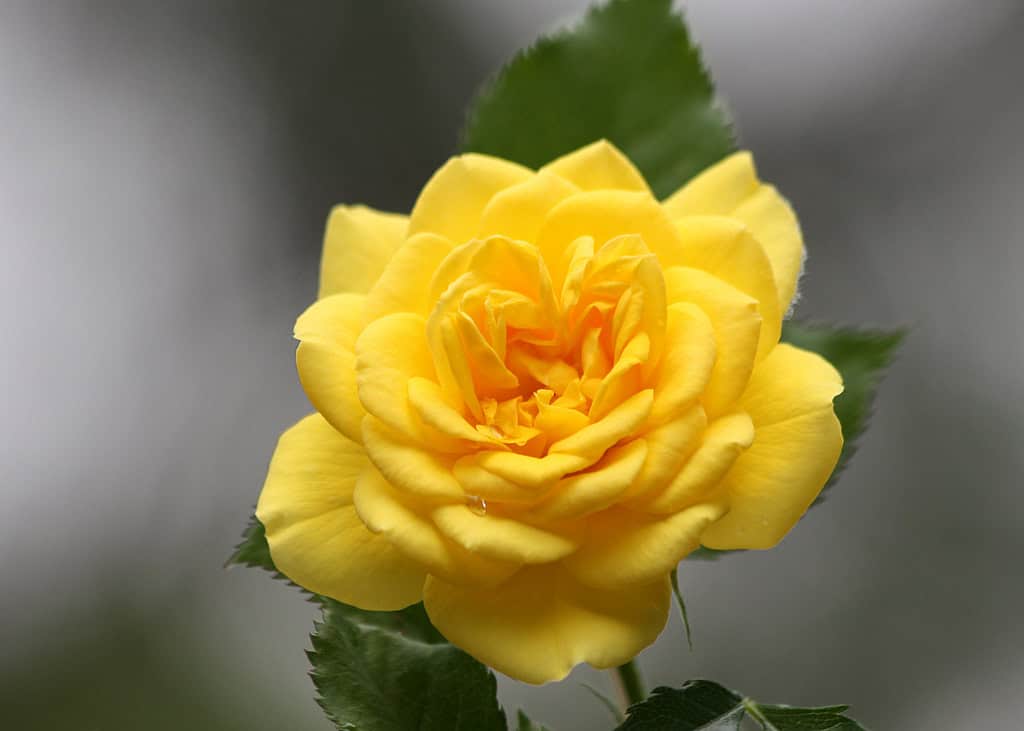
The Yellow Rose of Texas has a beauty captured in song, film, flowers, and more. (TexasEagle/BY-NC 2.0)
You’ve likely heard “The Yellow Rose of Texas” in some form or fashion. Learn more about the classic folk song, including what’s fact and what’s fiction.
At some point in your life, you’ve gotten an earworm stuck in your head. Thankfully, this situation is not nearly as bad as having an actual worm wriggling around your ears. Still, not being able to get a catchy song out of your head can feel frustrating. “The Yellow Rose of Texas” certainly fits the bill as an earworm. This traditional folk song has caused people to tap their toes and nod their heads for nearly two centuries.
As with many folk songs, there’s plenty of legend behind the origin of “The Yellow Rose of Texas.” While some of that legend is based in fact, there’s also been a bit of truth-bending over the years. We’re here to help decipher what’s real and what’s not.
Facts about “The Yellow Rose of Texas”
While exaggerated stories have risen about “The Yellow Rose of Texas,” historians generally agree on these facts, with ample documented evidence of their truthfulness.
The first published version was in “Christy’s Plantation Melodies No. 2” in 1853
The earliest published version of “The Yellow Rose of Texas” dates back to 1853. It was printed in the songbook “Christy’s Plantation Melodies. No. 2,” published under Edwin P. Christy in Philadelphia. Christy was also the founder of Christy’s Minstrels, a blackface performing group of the time. The songbook does not include an author or any accompanying melody, only the lyrics.
Christy’s Minstrels had several songs across these songbooks, including three others that named “roses” as attractive women. The group also sang “The Virginia Rose-Bud,” “The Rose of Alabama,” and “The Rose of Baltimore.” That could indicate that the songs’ subjects are not based on anyone in particular, but rather on a general desire.
In 1858, Firth, Pond & Company, a New York City music store, copyrighted and published the earliest known sheet music for “The Yellow Rose of Texas.” The sheet music includes a note that the song was “composed and arranged expressly for Charles H. Brown by J.K.,” a Tennessee resident. A J.K. Brown is in the 1860 U.S. census as a married 26-year-old bookseller with two kids, but it’s unclear if he arranged this music or the extent (if any) of his relationship to Charles H. Brown. Add this mystery to the legend of the song!
The lyrics have changed over the years
The 1858 version changed three parts of the original lyrics. Two are very similar changes: The opening line, “There’s a yellow girl in Texas,” became “there’s a yellow rose in Texas.” Later, “she’s the sweetest girl of color” was swapped to “she’s the sweetest rose of color.” The final change is in the second-to-last line, with “we’ll sing our sorrows o’er” switching to “we’ll sing the songs of yore.”
In 1864, General John Bell Hood led the Texas Brigade during Civil War fighting in Tennessee. After a tough defeat, another stanza was added to the song: “And now I’m going southward, for my heart is full of woe/I’m going back to Georgia, to see my Uncle Joe/You may talk about your Beauregard, and sing of Bobbie Lee/But the gallant Hood of Texas played hell in Tennessee.”
Around the end of the 19th century and beginning of the 20th century, references to “darky” were replaced by words like “soldier” or “fellow.” Mitch Miller, who scored a number one hit on the Billboard retail chart with the song in 1955, changed several lyrics in his version. Most notably, the second line adjusted from “No other soldier knows her, no soldier only me,” to “Nobody else could miss her, not half as much as me.” Additionally, the chorus included updated lines of “She’s the sweetest little rosebud that Texas ever knew” and replaced the name “Dearest May” with “Clementine” in the line that references other non-Yellow Rose of Texas women. And “She thinks if I remember, when we parted long ago” changed to “I know that she remembers, when we parted long ago.” It’s good to be certain about things.
It’s a staple of movie soundtracks
The mid-1900s featured several movies that used the song in some capacity. Elvis Presley performed a more rockin’ version for the 1964 film “Viva Las Vegas,” removing the racial lyrics and adding several more references to Texas and a bonus shout-out to Amarillo. Rock Hudson starts a fight in a diner in “Giant” (1956) while the melody rings in the background. For an extra cool experience, play the song while admiring the “Giant” mural in Marfa.
“The Yellow Rose of Texas” is even the title of a 1944 film starring Roy Rogers and Dale Evans. In the movie, the moniker is given not to a person but to the showboat on which Rogers and Evans perform. There are 11 songs over the 69-minute runtime, including a traditional version of “The Yellow Rose of Texas.”
Politicians love using the song during their campaigns
Texans love showing off their state pride, and politicians quickly adopted “The Yellow Rose of Texas” while working the campaign trail.
The Democratic Party used the tune’s melody as its theme song in 1956. Alas, it didn’t lead to presidential success, as the incumbent Dwight D. Eisenhower cruised to a victory against Democratic challenger Adlai Stevenson II. Senator Ralph Yarborough, who served Texas from 1957 to 1971, incorporated the song and flower as his campaign themes. Lyndon B. Johnson hosted a train tour during his vice presidential campaign in 1960, and the song would play when he arrived at and departed from each stop.
The state itself embraced the spirit of the song, too. When Eisenhower and John F. Kennedy visited Texas, they were routinely greeted by bouquets of yellow roses. In 1957, Governor Allan Shivers introduced the Yellow Rose of Texas Award to honor Texas women who demonstrate exceptional community service and volunteering. The award still exists today (and you can nominate someone here).
Legends that (probably) aren’t true
The most persistent legend of “The Yellow Rose of Texas” is that it’s about Emily D. West. Also known as Emily Morgan, she became a folk heroine during the Texas Revolution, which led to Texas’s independence.
West was known as a “high yellow,” a term used from the late 19th century into the 20th century to refer to a mixed-race free woman of color. She was captured by Mexican cavalry on April 16, 1836. Five days later, she was at the Mexican camp when the Texan army attacked, led by Sam Houston.
The Battle of San Jacinto lasted for a mere 18 minutes before the Texans emerged victorious. According to popular legend, the leader of the Mexican forces, General Antonio López de Santa Anna, was unprepared for the attack because he was in bed with West at the time.
That story was recorded by Englishman William Bollaert in 1842, who claimed to have heard it from Sam Houston. Bollaert’s journal was published in 1956, and some historians started toying with the idea that West’s description matched that of the woman featured in “The Yellow Rose of Texas.”
While that is a delightful legend, other historians have noted that Santa Anna was strongly opposed to inter-race relationships. And outside of Bollaert’s journal, there’s not much evidence of a distracting tryst going on.
Still, West’s popularity has grown so much that she even has a hotel named after her. You can also see a commemorative statue and plaque of West near the Alamo in San Antonio.
One writer who’s helped advance the legend is Frank Tolbert, a writer for the Dallas Morning News. In 1961, he wrote a passage about an Emily’s dalliance with Santa Anna in the “Informal History of Texas“:
“And what became of Emily? She lived to tell her story to her master, Colonel Morgan, and to inspire a wonderful song. Musical historians seem to agree that the folk song ‘The Yellow Rose of Texas’ was inspired by a good-looking mulatto slave girl. And in one set of original lyrics—not the ones popularized by Mitch Miller—the girl of the song is called ‘Emily, the Maid of Morgan’s Point.’”
For starters, “musical historians seem to agree” is the equivalent of someone saying “studies show” in a debate without providing any sources. Which historians? Tolbert doesn’t specify. He also doesn’t say where these original lyrics came from; they’ve never appeared in any other versions, nor in any coverage of the song.
However, Henderson Shuffler, a friend of Tolbert’s, Judge Thomas Stovall, and English professor Martha Anne Turner were all influential figures in the 1960s and beyond. Shuffler and Stovall gave speeches at meetings and functions that alluded to Emily and “The Yellow Rose of Texas.” Turner published a paper, monograph, and book that corroborated Tolbert’s findings. Turner’s works and the speeches by Stovall and Shuffler seem to only use Tolbert’s claim as research, flimsy as it may be.
And, as the movie “Wayne’s World” so eloquently puts it: “Well, you know how these things start. One guy tells another guy something, and then he tells two friends. And they tell two friends. And they tell their friends. And so on, and so on, and so on.”
We don’t imagine the legend around “The Yellow Rose of Texas” will vanish anytime soon, but at least you’ve got a better grasp on the song. Now, enjoy this classic rendition from Lane Brody and Johnny Lee: