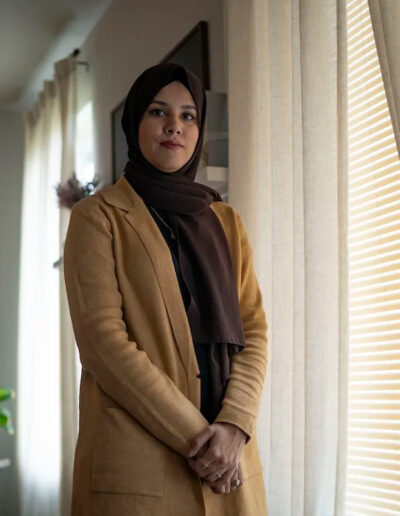
Oppong Hemeng, a senior climate coordinator for the city, presents the heat island study results during a press conference on April 3. (Photo by Katie Serrano)
A new study shows that some neighborhoods in Dallas are up to 12 degrees hotter than others, prompting the city to figure out solutions to heat islands.
Twelve Dallas neighborhoods — including Oak Cliff, Preston Hills, the Medical District, Oak Lawn, and Harwood — are among the hottest urban heat islands in Dallas.
Heat islands are pockets in the city with higher temperatures than surrounding areas. In Dallas, the maximum temperature difference throughout the city during the month of August was as much as 12 degrees, according to a new study.
Dallas officials shared the results of the city’s “Heat Island Study Phase II” during a press conference on April 3. The study will help find new ways to cool temperatures in the city’s heat islands, they said.
“We know the Dallas experience is wide temperature swings, and in recent years, the lows and highs have become much more extreme,” said Liz Cedillo-Pereira, an assistant city manager. “These extreme temperatures cause health problems for our residents, such as heat stroke or heart related deaths. Businesses and residents pay increased energy bills and must invest in more resilient infrastructure alongside the city and other local government entities.”
“We also know that residents living in historically disadvantaged neighborhoods where there has been historically lack of investment and limited access to resources or green spaces tend to be at greater risk,” Cedillo-Pereira added.
The hottest neighborhoods included Oak Cliff (Bishop Arts, South Oak Cliff, South Dallas, Glendale Park, and Wynnewood Heights), Love Field West Residential, Medical District, Pleasant Wood, West Dallas (Ledbetter Gardens, Westmoreland Heights, Fredrick Douglas, Brookhollow), Gribble, Claremont Addition, Preston Hills, North Dallas (Old Mill Court, Timberglen Park, and Highlands), Oak Lawn, Harwood and Downtown.
The study found cooler areas in Southeast Dallas, especially around the Trinity River and Great Trinity Forest, the largest urban forest in the country.
“Protecting and expanding these natural areas is essential to reducing urban heat,” City Councilmember Kathy Stewart said. I’m committed to ensuring our neighborhoods and business districts remain vibrant, welcoming places to live, work, and play. (This study) is key to addressing climate change and minimizing the effects of heat islands in our city.”
The city is working to alleviate extreme heat in the city by installing reflective pavements, planting more trees and vegetation, and requiring buildings to have cool roofs and smart surfaces.
The city is also working with the Texas Trees Foundation to increase the urban tree canopy. The foundation hopes to increase the canopy, which is currently at 32%, to 37% by 2040, according to the 2021 Dallas Urban Forest Master Plan.
The study, which took place on Aug. 10, was conducted by the city’s Office of Environmental Quality and Sustainability and takes place every five years.
Some 100 volunteers collected data to map where people are most likely to be at risk during extreme heat events. Volunteers mounted sensors onto their vehicles to capture data at three different times of the day, drove 21 routes covering over 240 square miles, and recorded 152,032 measurements. The highest temperature recorded was 101.4 degrees.
“ By mapping these heat spots, we gain valuable data to help drive solutions that foster healthier, more liveable areas in the city, as well as empower our communities with helpful information in the process,” said Paul White, interim director of the Office of Environmental Sustainable Quality and Sustainability.
For an interactive map of the study, click here.
Author

Support Our Cause
Thank you for taking the time to read our work. Before you go, we hope you'll consider supporting our values-driven journalism, which has always strived to make clear what's really at stake for Texans and our future.
Since day one, our goal here at COURIER Texas has always been to empower people across the state with fact-based news and information. We believe that when people are armed with knowledge about what's happening in their local, state, and federal governments—including who is working on their behalf and who is actively trying to block efforts aimed at improving the daily lives of Texas families—they will be inspired to become civically engaged.