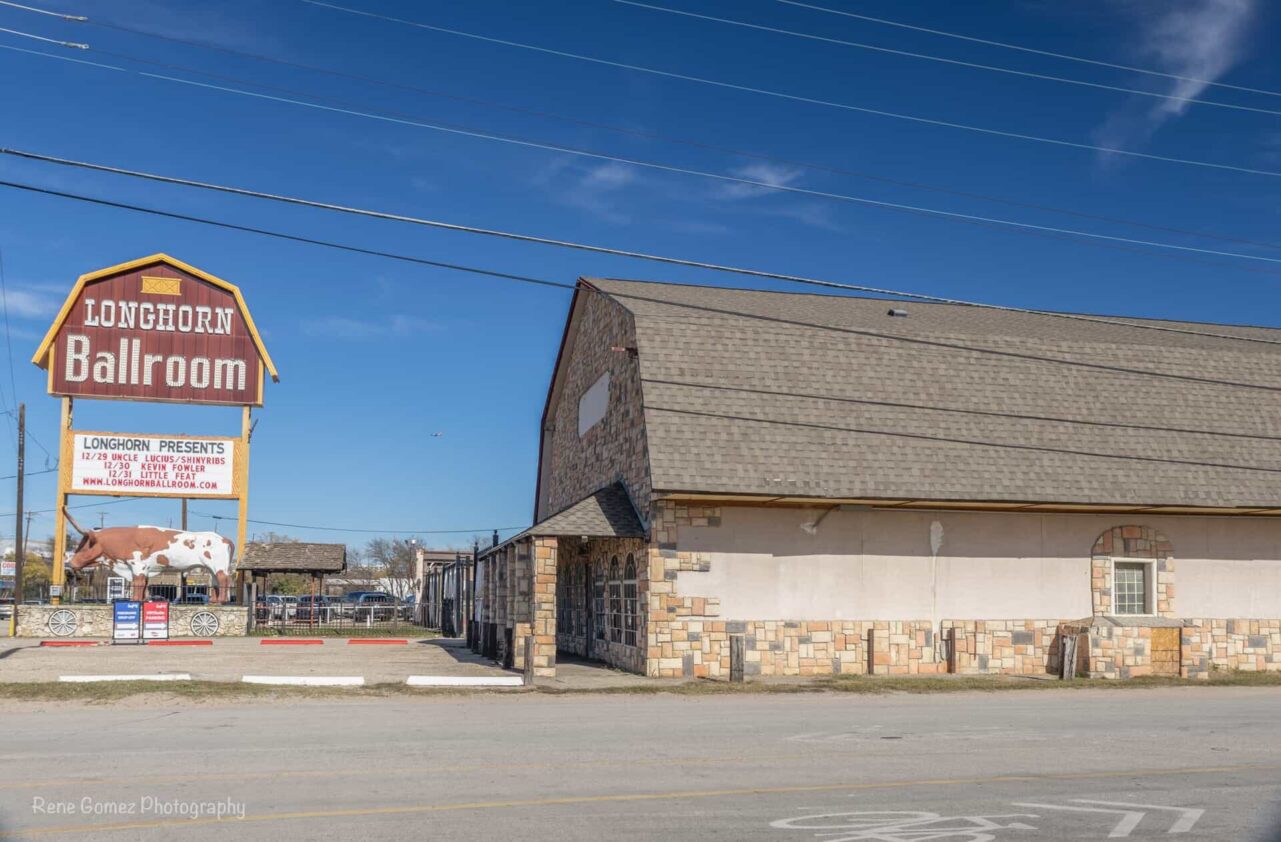
The Longhorn Ballroom is steeped in decades of music history. (Renegomezphotography/CC BY-SA 4.0).
The Longhorn Ballroom was an iconic venue for decades before falling into disrepair. Now, it’s back and better than ever.
The Longhorn Ballroom has seen its fair share of history. It first opened in 1950 under the name “Bob Wills’ Ranch House,” as it was originally built for country music icon and “King of Western Swing” Bob Wills, along with his Texas Playboys. Back then it was a honky tonk dance hall where people went to cut loose and listen to some tunes.
During a stretch of those first few years, the Ranch House was managed by, if you can believe it, Jack Ruby. This was almost a decade before Ruby made headlines for killing Lee Harvey Oswald, President John F. Kennedy’s assassin. Before all of that violence, Ruby was celebrated in 1954 for bringing Nat King Cole to perform in Dallas. It was an epic feat considering Jim Crow laws were still being strictly enforced in the city, but those rules didn’t apply to the Ranch House.
According to The New York Times, because the venue was located in Cedars, it technically fell outside of the Dallas Police Department’s jurisdiction. Because of this, Cole was not only able to hold a concert at the honky tonk, but seating for the event wasn’t segregated. Black patrons were allowed to sit in the front rows closest to the stage alongside white patrons. It was the first of many examples illustrating the Ranch House’s inclusive approach to entertainment.
Eventually, Douglas “Dewey” Groom took over the establishment in the 1960s—he was the one to dub it the Longhorn Ballroom, refurbish the exterior to look like an Old West Outpost, and to add the neon sign out front bearing the new name. Under Dewey’s management, a slew of notable stars held performances there, including Patsy Cline, George Jones, Loretta Lynn, Charley Pride, Willie Nelson, Merle Haggard, B.B. King, James Brown, Al Green, Ray Charles, Selena, Freddy Fender, and Johnny Rodriguez. For a full list of everyone who’s ever graced the Longhorn stage, click here.
The venue hosted countless iconic performances
One of the Longhorn Ballroom’s most iconic performances came in 1978 when the Dallas venue hosted British punk rock band the Sex Pistols. The Pistols only performed at six locations during their one tour of the US, making the occasion even more monumental when looking back on the way it impacted the genre’s history.
Jeff Liles books upcoming acts for the Longhorn Ballroom and also serves as Kessler Theater’s artistic director. He was a teenager when the Sex Pistols came to town and still has vivid memories of the show. Liles told The New York Times that bassist Sid Vicious “was writing on his chest with his blood. It was gross.” The blood on Vicious’s chest is clearly visible in surviving videos of the performance.
Liles said that hosting the Sex Pistols when the band’s music wasn’t necessarily viewed favorably by the public was par for the course for the historic venue. “The Longhorn’s niche is finding the stuff that’s not mainstream,” he said. Liles added, “When the Chili Peppers played here in the ’80s, or when the Butthole Surfers, the Sex Pistols, The Ramones and Patti Smith played here, they all recognized the counterculture aspect of it.” It maintained that commitment to bringing in cutting edge artists until the mid-1990s, when it was sold, fell into a state of disrepair, and was eventually abandoned.
It wasn’t until 2020 that a new owner, Edwin Cabaniss, came along to restore the Texas honky tonk to its former glory.
The historic location is welcoming a new generation of visitors
After Edwin Cabaniss purchased the Longhorn Ballroom, he got to work restoring its famous neon sign, as well as turning the property into a creative campus stretching over six acres. Cabaniss added a 6,500-capacity amphitheater which hosted its first official show on March 28 with La Mafia. The Dallas Morning News noted that the outdoor theater earned rave reviews for its festival vibe, charm, and comfortable seating options. Cabaniss said this was intentional. He told the outlet, “Because our configurations are flexible, standing and seated areas may change based on the type of show.”
By keeping things fresh and interesting, he’s hoping to appeal to a younger generation of audiences while still maintaining a sense of nostalgia for returning patrons who want to reminisce about the good ole days. Cabaniss is also expanding on Longhorn’s legacy by adding three restaurants inside of the 20,000-square-foot space previously occupied by a motel. Some of that has already been divided up into co-working spaces and live-work areas for local artists.
The idea of expanding Longhorn’s original footprint to include even more opportunities to foster creativity and inclusion sounds like the perfect second act for the beloved ballroom.