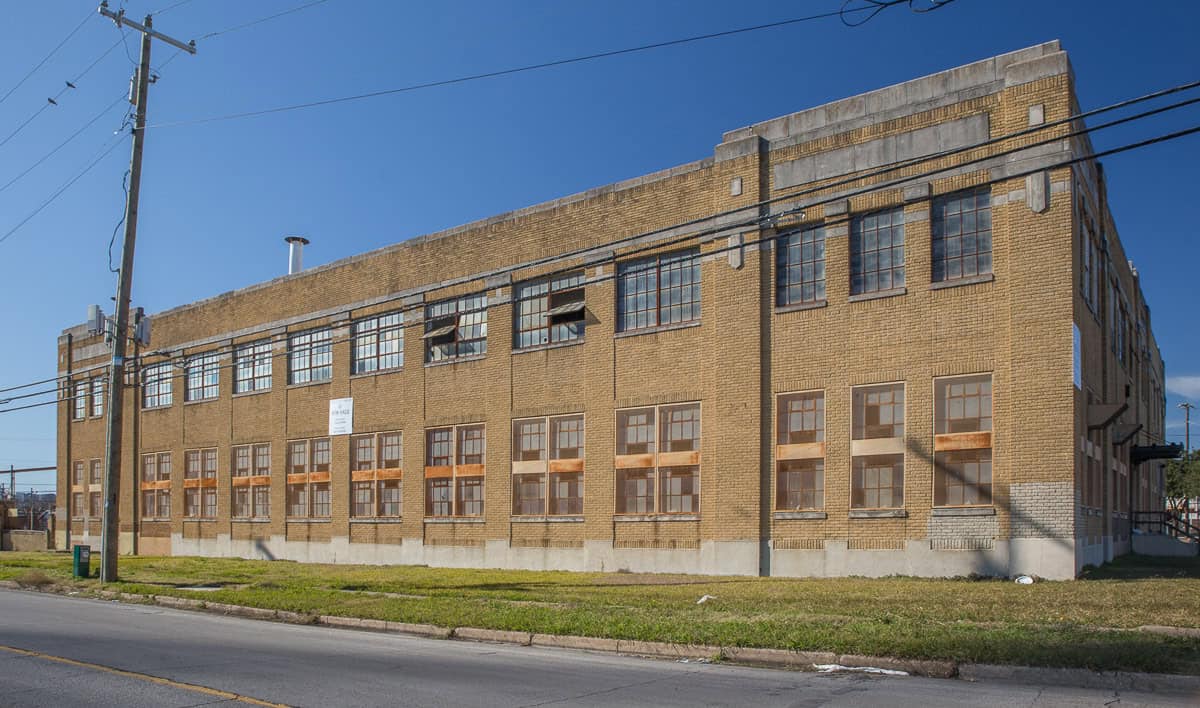
Mrs. Baird’s Bread opened a factory in Dallas 1953, and it was opened until 2002. (Renelibrary/CC BY-SA 4.0).
Mrs. Baird’s bread began from humble origins in 1908. Here’s everything you need to know about the Fort Worth brand.
When Ninnie and William Baird moved to Texas from Tennessee in 1901, they had no idea what the future had in store for them. William primarily focused on running restaurants when the Bairds first arrived in Fort Worth, but once his health took a bad turn, Ninnie knew she had to find a way to provide for their family.
So, in 1908, she set up her company, Mrs. Baird’s, and began selling bread, pies, and cakes. The couple’s eight children—Ruth, Bess, Hoyt, Lorine, Roland, Dewey, Marjorie, and C.B.—assisted her as she got the business up and running. The girls helped take care of the youngest siblings and completed chores around the house while Ninnie baked, and the boys made deliveries for her on their bicycles.
She was bringing in a steady stream of profits when tragedy struck the family in 1911 with William’s death. Ninnie and the kids continued to work hard in the midst of their grieving, and by 1915, she had arranged to buy her first commercial oven from the Metropolitan, a nearby hotel, to help increase her output.
The Metropolitan was asking $75 for the oven, but struck a deal with Ninnie to have her pay $25 of that in cash and provide the rest in baked goods. It’s just one example out of dozens that best showcase Ninnie’s hardworking, entrepreneurial, creative spirit.
The company’s growth
Roughly 13 years later, Mrs. Baird’s had become a full-blown enterprise composed of four separate bakeries. Then, in 1953, the company opened its first factory in Dallas. Roland Baird was vice president at the time, and he announced the opening with great pride. “This new plant was built to keep pace with the constant growth of Dallas and the surrounding trade area. With it, Mrs. Baird’s will be able to furnish even fresher and better bread to customers everywhere,” he said.
Ninnie remained involved in the company’s growth and success well into her later years. She died on June 3, 1961, when she was 92 years old, and the legacy she left behind has lasted through several decades and numerous generations of Texas consumers.
Ninnie created and ran a business during an era when it was uncommon for women to achieve this level of independence. In recognition of this achievement, the Texas State Senate declared her “a living example for mothers, wives, business executives, Christians and good people the world over.”
She not only produced high-quality baked goods on a massive scale, but she also paid her good fortune forward to her community. To this day, Mrs. Baird’s still donates over 90,000 loaves of bread to food banks in West Texas, Dallas, Austin, Houston, South Texas, Tarrant County, Corpus Christi, and San Antonio.
The original factory closed in 2002
Despite its widespread success, Mrs. Baird’s saw the closure of its Dallas factory back in 2002. It was a moment of sadness for those who spent many fond years enjoying the scent of freshly baked goods on the breeze. For almost five decades, the plant supplied the nearby community with the softest loaves of white bread imaginable (producing around two million pounds per week!).
The president of the company at the time of the factory’s closing, Juan Muldoon, said it unfortunately just wasn’t sustainable to keep that specific location going. In 2001, he said, “If I had to site a plant today, I would not pick that location. We can’t modernize it and keep it running at the same time, and we can’t expand it.”
Thankfully, the company stayed local and opened a brand-new 323,000-square-foot plant in nearby Fort Worth along Interstate 35W. This modernized facility allows Mrs. Baird’s to produce on an even larger scale. About 100 loaves are baked per minute, which is pretty astounding to think about. When you make bread, hand pies, and donuts this good, it’s easy to understand how these numbers continue to increase with supply and demand.
Popular products
If you ask anyone in the Dallas-Fort Worth area what product they love most from Mrs. Baird’s, most of them would likely say they have a special place in their hearts for the traditional sliced white bread. That’s really what got the company on its feet when Ninnie Baird set out to solidify her family’s future, and it remains one of the most purchased items to this day.
Other fan favorites include the frosted, powdered sugar, and cinnamon sugar donuts, as well as the honey buns, cinnamon rolls, and hand pies (available in cherry and apple). The company also expanded to include hot dog and hamburger buns. You can check out the full array of available products here.
Where to buy Mrs. Baird’s bread
If you’re on the lookout for Mrs. Baird’s bread, hand pies, donuts, and buns, they’re usually pretty easy to find. Most major retailers like Walmart, Kroger, Target, and Sam’s Club carry the products, as does the Bakery Outlet Store located at 7301 South Freeway in Fort Worth. This store locator lets you type in your zip code and the exact product you’re looking for, and then populates nearby results from there.
Oftentimes, third-party delivery services like DoorDash and Instacart will similarly display stores that sell Mrs. Baird’s in your area. To make this process simpler for yourself, go to the bakery’s website and click on the product you want to purchase. For example, if you follow this link for Large White Bread and then click the “Buy Now” button on the side of the page, a window will pop up showing you every purchasing option currently available. It also displays the price at each store, so you have an idea of how much everything is going to cost before you place your order.
This article first appeared on Good Info News Wire and is republished here under a Creative Commons license.
Related: The 2026 DFW local grocery guide