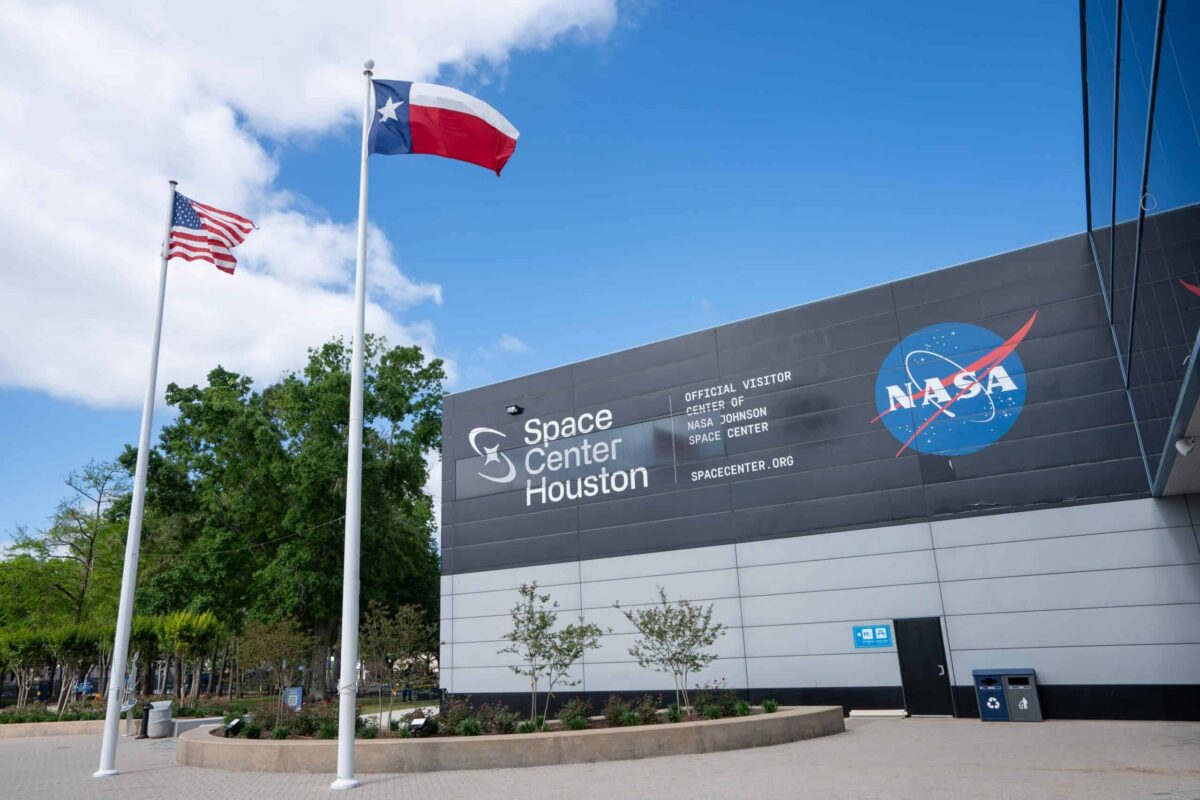
NASA's Artemis II mission will send astronauts on a 10-day mission to the moon. (Tada Images/Shutterstock)
Artemis II is set to send four astronauts further than any others have gone before. Here’s what you need to know.
It’s been over 50 years since astronauts have experienced the Moon’s gravitational pull. Apollo 17 accomplished the feat in December 1972, and now, a new group is set to follow in their footsteps this March. NASA’s Artemis Program—named after the Greek goddess Artemis, who is often depicted as representing the Moon—was designed to help create a permanent lunar presence. The newest version of this will be the Artemis II mission, which will take four astronauts into space to orbit the Moon before being launched back to Earth using the Moon’s gravity. In doing so, the crew will go further than any other astronauts have before.
The daunting task is being taken up by Reid Wiseman (commander), Victor Glover (pilot), and Jeremy Hansen and Christina Koch (mission specialists). As Houston Public Media notes, the crew of the Artemis II is set to make history in more ways than one: Koch will be the first female astronaut to reach the moon, Hansen will be the first non-American (he’s from Canada), and Glover will be the first Black astronaut to complete this epic feat.
Koch spoke with the outlet, saying, “We can actually learn more about solar system formation, more about how planets form, maybe around other stars, more about the likelihood of life out there, starting with studying the moon. And I think that question is, in my opinion, one of the biggest philosophical questions of our time. And I think some of the first steps to answering it start with this mission.” Koch, along with her crewmates, have been calling Houston home as they prepare to embark on this historic journey.
The director of Rice University’s Space Institute, David Alexander, explained that the Johnson Space Center in Houston “is crucial for any aspect of this particular mission. The astronauts are all trained here. They all go through the training that they do to allow them to do all the tasks that they need to do flawlessly and to keep everything safe and working. That all happens at Johnson Space Center mission control, where they’re actually controlling operations, testing out the systems, talking the astronauts through anything they need to talk to.” The astronauts will also complete their mandatory quarantine here before the trip.
And while the launch itself will take place in Florida, flight directors and controllers at Johnson will walk the crew through their launch and beyond, staying in constant contact throughout the flight process.
The Artemis II mission will last 10 days
According to Space.com, the launch window for Artemis II is very small. NASA is currently hopeful that it will be able to capitalize on the five prospective dates for March—the 6-9 or the 11—but they may have to wait for April’s six launch dates (April 1, 3-6, or 30) instead depending on an array of contributing factors. Regardless of when the crew takes off, though, they’ll be set to conduct a 10-day mission. First, the Artemis II will orbit the Earth twice before completing a trans-lunar burn (AKA when the spacecraft is propelled in a set direction) to the Moon’s natural orbit.
Their spacecraft, dubbed Orion, will also be using the Moon’s gravity to help launch the crew back toward Earth when their voyage is complete—they’ll land in the Pacific Ocean outside of San Diego. Artemis II will break the distance record held by Apollo 13 since 1970, traveling farther from Earth than any previous mission—including those that reached the Moon’s far side. Houston Public Media says that NASA will be closely analyzing Orion’s hardware, systems, and crew to determine if future trips to the Moon will be able to sustain themselves. The organization will also want to ensure that all emergency and safety protocols function properly and that the crew has what they need to collect the intended data.
How to keep track of the mission
If you’d like to follow along with the Artemis II’s mission, NASA is operating a 24/7 livestream on YouTube, which you can watch here. Currently, the rocket is docked, but its launch will be covered on that channel once the crew gets the go-ahead for take off.