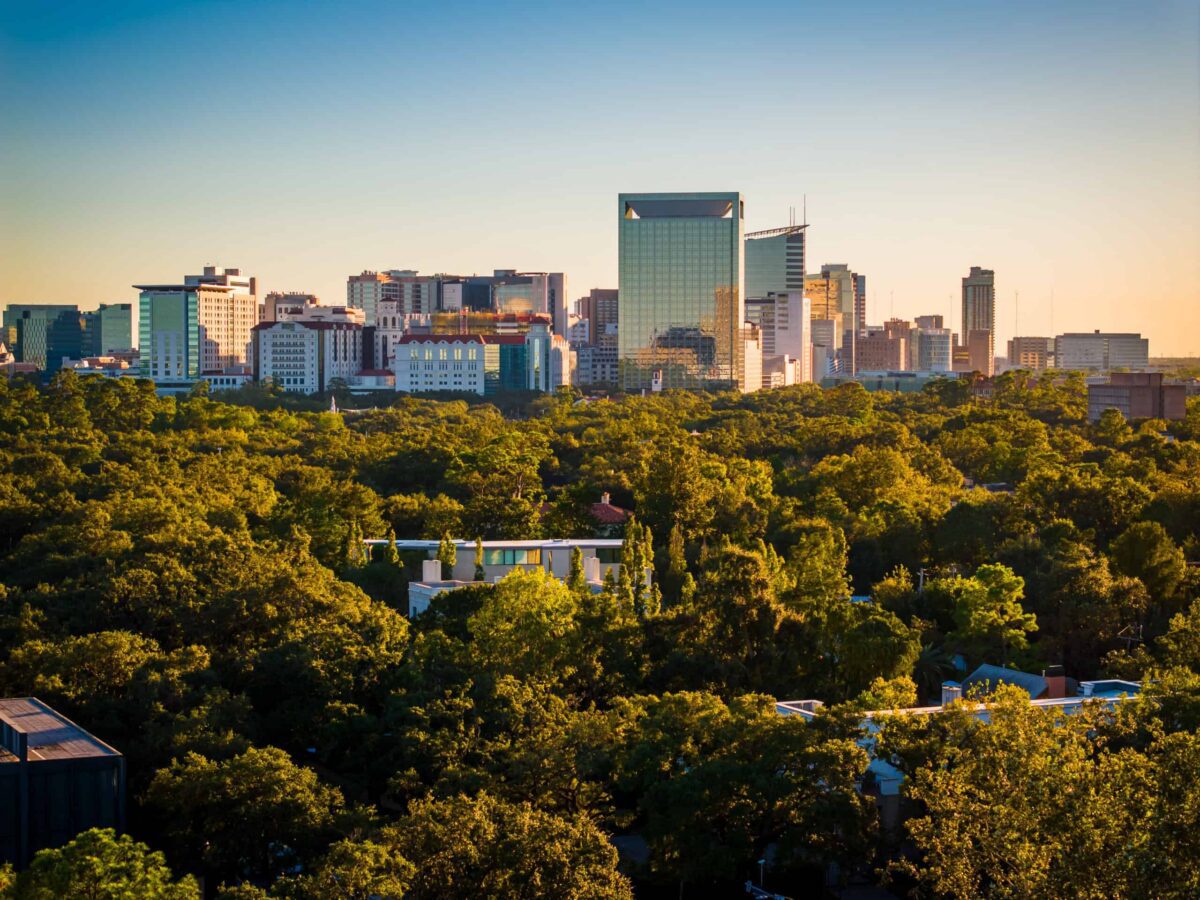
The Texas Medical Center skyline is proof of the nickname “Medical Mini-City.” (Courtesy Texas First Corporation)
The “Medical Mini-City” in Houston has earned its reputation as doctors deliver babies, perform surgeries, and pioneer medical breakthroughs.
The first time I experienced the Texas Medical Center, I literally stumbled upon it. I was staying at the lovely Blossom Hotel, where I picked up on the hotel’s distinct focus on medical-grade spa services and general wellness.
Then I noticed medical professionals in scrubs and white jackets walking down the surrounding streets. When I stepped outside to explore, I had no idea it would turn into a trek across a medical campus so massive that it’s actually considered a city within a city.
Welcome to the Texas Medical Center, a sprawling campus in south-central Houston just south of the city’s Museum District and rated one of the top places to visit in this city. Composed of 61 medical institutions, the Medical Mini-City, as it’s often called, has the unique distinction of being both the largest medical center and the largest life science destination in the world.
It’s a surprising discovery in a city that’s often misunderstood—after all, isn’t Houston just oil and gas? Far from it! Read below for everything that makes the Texas Medical Center one of the most fascinating draws in Houston.
Texas Medical Center is the largest medical center in the world
It’s fair to say that you’d have no problem getting in your 10,000 steps walking around just one of the medical institutions contained within the Texas Medical Center (TMC). But let’s talk about that goes-on-forever mini-city.
The 61 hospitals, scientific research centers, medical schools, and specialty facilities of TMC cover a whopping 1,345 acres. That’s roughly equivalent to 1,019 football fields! It’s also equal to more than 500 city blocks, so yeah, you’ll need a car to get around.
There are three campuses in this space: The Medical Center, TMC Helix Park, and the TMC Innovation Factory (keep reading to learn about what sets them apart). Combined, they make up 50 million square feet of developed space used for patient care, research, and education.
It’s not surprising, then, that the Texas Medical Center houses the world’s largest pediatric hospital, Texas Children’s Hospital, and the world’s largest cancer hospital, the MD Anderson Cancer Center.
In size alone, Texas Medical Center is a marvel, but let’s talk about how Houstonians—and people from all over the world—benefit from its services.
Texas Medical Center by the numbers
If you visit Texas Medical Center, you’re in good company. You are just one of an astounding 160,000-plus people who walk through TMC doors each day. That adds up to 58.4 million visitors a year.
Taking care of all those visitors are 106,000 employees and thousands of volunteers, all members of the Texas Medical Center Corporation, the nonprofit umbrella organization that encompasses the entire medical center. Now you’re beginning to see why “Mini-City” is an apt name for this part of Houston.
Each year, more than 10 million patients are treated here. To help you visualize, it would be like picking up the entire population of Atlanta, Miami, or Philadelphia, and plopping them down into the Texas Medical Center. It’s a staggering number, but I’m about to hit you with even more.
- TMC delivers one baby every 20 minutes, which means that every year, 26,280 children are born at this one medical center in Houston alone.
- The surgeons at TMC begin a new surgery every three minutes, meaning doctors are operating on patients every second of every day.
- Well over 13,000 heart surgeries are performed every year at TMC—and that’s just heart surgeries.
- TMC performs over 180,000 total surgeries a year.
- More than 750,000 people visit the hospital emergency rooms in TMC per year.
- Hospitals and medical facilities at TMC provide 9,200 patient beds for those who are admitted.
- In all, TMC records 10 million patient encounters per year.
Texas Medical Center is internationally recognized
Those incredible statistics don’t go unnoticed, and all eyes are on TMC. The standards here are high, meaning that not only must patient care be excellent, but there must also be a constant focus on research, innovation, and growth.
Texas Medical Center has managed to excel in all, drawing people from all over the world to consult with arguably the best doctors in their field. Over 18,000 international visitors come to TMC each year for treatment.
Its reputation has been lauded by medical organizations and publications like US News and World Report, which has repeatedly recognized TMC in its ranking of “America’s Best Hospitals.” Texas Medical Center has come out on top in all 19 categories of adult care and all 10 categories of pediatric care.
Aside from its success with patients, TMC has created opportunities for advanced study, making it a leader in the medical community. Since the turn of the century, it has doubled down on those efforts, opening TMC Helix Park as a central hub for research, innovation, and community.
One of TMC’s most impressive accomplishments? That would be creating the first artificial heart, the model for numerous successful implantations in the years since.
TMC doesn’t keep its resources to itself. The teams at Texas Medical Center created TMC Innovation Factory, where the best and brightest minds in medicine and scientific research come together for the ultimate in collaboration. The focus is on the future and on developing prototypes for the next great medical breakthrough.
In fact, at TMC, the research never seems to stop. Advancements in organ transplants, space medicine (you’re in the home of NASA, after all), spinal cord surgery, and personalized medicine are a regular occurrence here.
Visitors can get a first-hand look at how it all began at TMC’s three museums: the Health Museum, the Wallace D. Wilson Museum at the Texas Heart Institute, and the DeBakey Library and Museum.
You can also get lost in the TMC Library, where you’ll find everything from rare scientific journals to archives on NASA Space Life Sciences.

Other amazing accomplishments at Texas Medical Center
The Medical Mini-Center obviously has a lot to brag about, all of it well-earned and boast-worthy. But if your jaw is not already on the floor, here are a few more kudos to impress you.
- TMC performed the very first coronary artery bypass (successfully, of course).
- Remember the movie “The Boy in the Plastic Bubble” starring John Travolta? It was based on a true story about a boy with a severe immune disorder who could only live within a protective custom bubble. That innovation was the result of a collaboration between Texas Children’s Hospital and NASA, and it was the first of its kind.
- TMC launched Life Flight, the pioneering and now-national helicopter service designed to whisk high-risk patients to hospitals for life-saving care.
- Texas Medical Institute treated the first patient ever with a heart pump, an apparatus that has since become ubiquitous in the medical industry.
- Rice University and Baylor College of Medicine, both under the Texas Medical Center Corporation umbrella, partnered to discover a way to grow capillaries. This discovery has saved millions of lives around the world.
- Finally, Texas Children’s Hospital holds the record for delivering the only surviving sextuplets in Texas. The six babies were born at 30 weeks and nurtured into healthy humans—in fact, they are teenagers today living their best lives right here in Houston.

The Baylor College of Medicine sits prominently in the Texas Medical Center campus. (Courtesy Houston First Corporation)
There is so much to love about Houston and so many reasons why it’s become a tourist hotspot, but now we can add medical and scientific advancement to the list. Houston takes care of its visitors, saving lives, caring for the sick, and researching relentlessly for a healthier future.
This article first appeared on Good Info News Wire and is republished here under a Creative Commons license.
Related: Houston launches nation’s first public dashboard on gun injuries