Have you ever wanted your neighborhood to be named after you? That’s exactly what happened to a post office worker in Alief 130 years ago.
It can be hard to distinguish between neighborhoods in such a highly developed city, with strip malls, health clinics (who is Kelsey-Seybold, anyway?), and brand new box-style townhouses stacked next to each other on every block. But each Houston neighborhood has its own identity, with a name rooted in its history.
Below, we’ll give you the lore of Houston’s major neighborhoods and its oldest suburbs.
The Heights
True to its name, the neighborhood of the Heights sits 23 feet higher than downtown Houston. This elevation difference mattered a lot when the neighborhood was founded in 1896, as families were seeking an escape from the city’s poorly managed flood system without losing proximity to its amenities.
River Oaks
As Houston’s first master planned community, River Oaks got its name from the oak trees lining the streets of the neighborhood and its positioning against the south bank of Buffalo Bayou, a body of water that resembles a ‘river’. River Oaks was modeled after Dallas’ Highland Park, but was planned to be developed on a larger scale.
Meyerland
Named after the Meyer family who founded it, the neighborhood of Meyerland was slowly bought and developed into the area we see today by several generations of the Meyers. Joseph F. Meyer was brought to Houston when he was five years old, spending much of his adult life buying land in southwest Houston. His son eventually developed 1,200 acres of that land into Meyerland by the 1950s.
Montrose
Loved for its eccentric personality, the neighborhood of Montrose was named for a popular Scottish book from the 19th century. The founder of Montrose, John Wiley Link, developed the town shortly after building his own mansion in the area.
West University
Situated just west of Rice University, West U was named in 1917 for its location relative to the college. The streets of West U are named after famous universities and colleges throughout the United States, like Amherst Street (Amherst College), Rutgers Street (Rutgers University), and Duke Street (Duke University).
The Wards of Houston
When Houston was founded in 1836, it was divided into four distinct sections, or “wards”. The founders used geographic boundaries, like the bayous and streets, to create First, Second, Third, and Fourth Ward. Fifth and Sixth Ward were created in the late 19th century as the population grew and new neighborhoods were needed to represent the people living there.
While these numeric names may seem bland compared to the more creative ones that came later, residents have given nicknames to the wards throughout the years, with some still in use today.
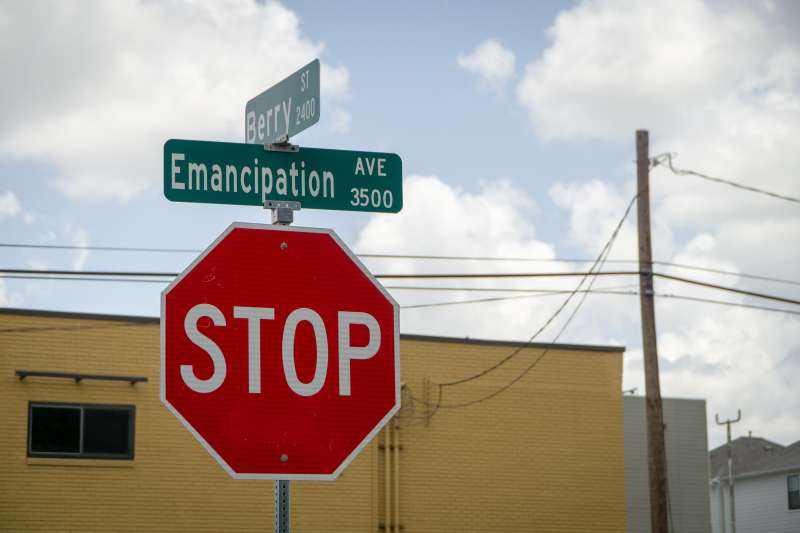
First Ward used to be known as “Vinegar Hill” to describe its rough environment of gambling, prostitution and other illicit activities that took place in the area. Second Ward is known affectionately as “Segundo Barrio” by locals, which literally translates to “second neighborhood”. Third Ward is sometimes called “The Tre”, a reference to the number three. Fourth Ward is known as “Freedman’s Town” because it was established by formerly enslaved Black Texans after their emancipation. Fifth Ward is known as “The Nickel” after the five-cent coin. Sixth Ward used to be called “Chaneyville” due to the presence of Chaney Junction, the first train stop on the route from Houston to historic site Washington-on–the-Brazos.
What about Houston’s biggest suburbs?
Katy
In the early 19th and 20th centuries, the Missouri-Kansas-Texas (MKT), commonly known as “The Katy”, was a railroad that connected the Midwest to much of East Texas. Katy gets its name from this major transportation hub, which ran until the late 1980s.
The Woodlands
A family contest gave The Woodlands its title in 1974. The founding family of The Woodlands—the Mitchells—competed with one another to pick the best name for the suburb. Pamela Mitchell, the daughter of the founding couple, proposed “The Woodlands” and the name stuck.
Sugarland
Sugarland gets its name from the history of sugar cane plantations in the area. The fields, harvested by enslaved Black people, turned into a brutal convict-leasing system after the Civil War. Black prisoners were “leased out” by the state of Texas to labor in service of the new plantation owners. When this practice ended in 1910, Black and Hispanic prisoners continued to be subjected to coerced labor on this land through the 1980s, through the Texas Department of Corrections.
Missouri City
Advertising the area as a “land of genial sunshine and eternal summer”, R.M. Cash and L.E. Luckel pooled their resources and bought the land that now makes up Missouri City. The founders of Missouri City wanted to advertise their new suburb in St. Louis, Missouri, so they had to come up with a clever marketing tactic. To attract families from Missouri, they named their new neighborhood after the state.
Alief
Alief was first called Dairy, or Dairy Station, in 1894. But when the city applied for a post office, the name was changed to Alief so that it wouldn’t be confused with another Texas town. Alief is the name of the first postmistress of the original city, Alief Ozella Magee.