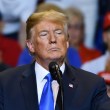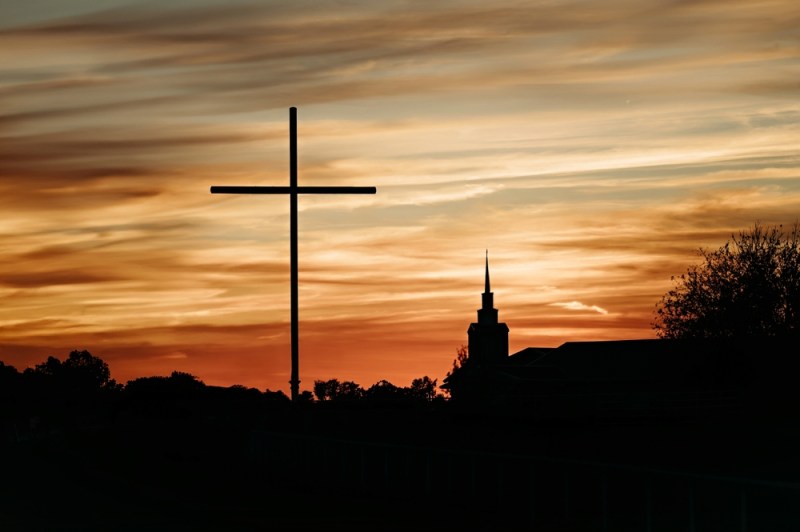
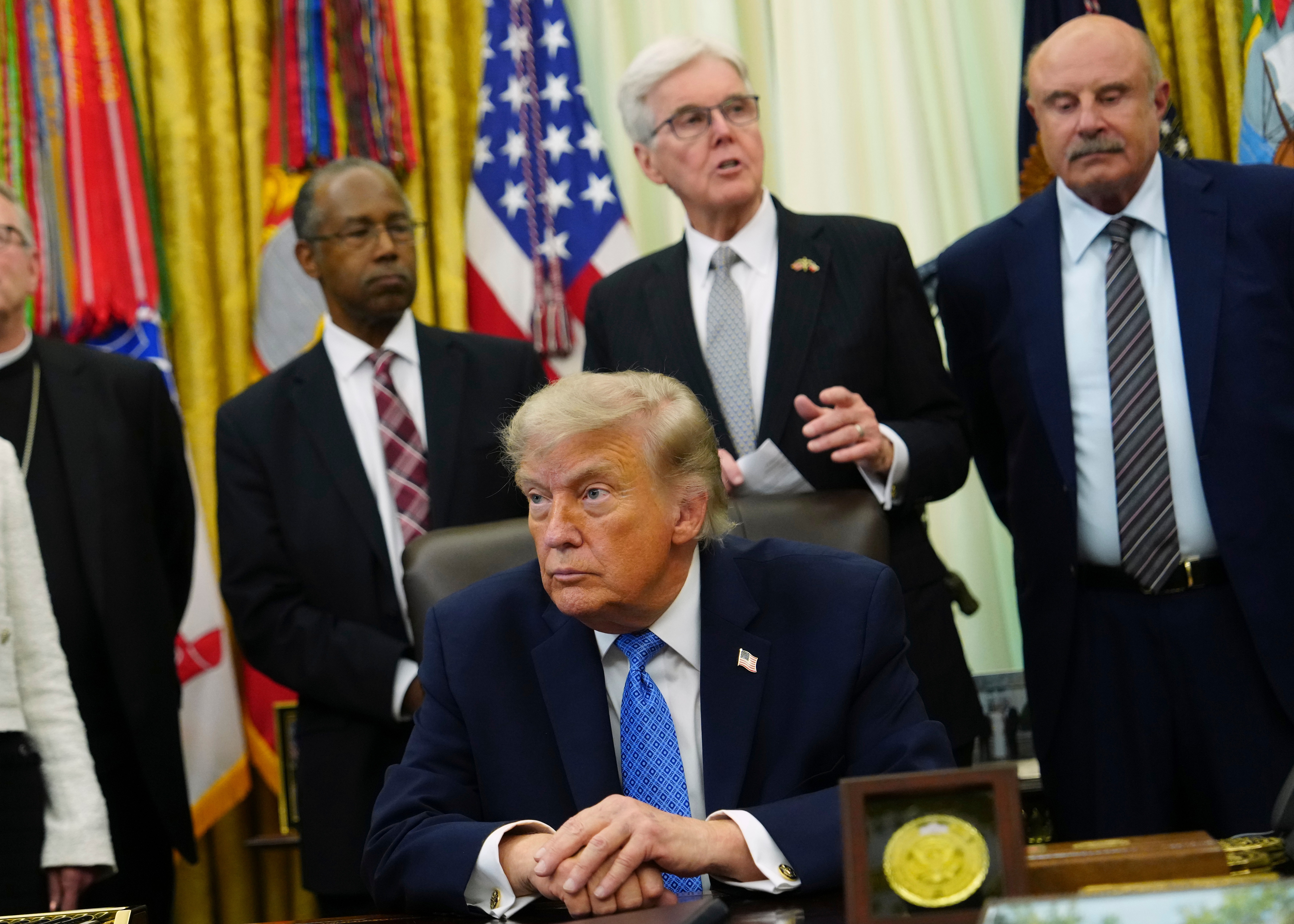
Standing in the Oval Office on June 26, Texas Lt. Gov. Dan Patrick (R) delivered what amounted to a declaration. As chair of President Donald Trump’s Religious Liberty Commission, Patrick told the president—and the country—the phrase “separation of church and state” has no constitutional basis.
“The overwhelming majority of our witnesses said that they were attacked and punished, and what was used against them was one phrase that’s not in the Constitution. And that phrase is separation of church and state,” he said.
Weeks earlier, at the Texas Republican Party Convention in Houston, Patrick had embraced a label that once carried political risk: Christian nationalist. “To me, that means I love God and I love America,” he told the crowd to roaring applause. “If that’s what a Christian nationalist is, here I am.”
State Rep. Vikki Goodwin, the Democratic nominee for lieutenant governor who will face Patrick in November, said his Oval Office remarks were not just constitutionally misleading—they were a preview of where Texas is heading.
“What he is trying to do is choose for us—to say that Christianity is the basis of our country,” Goodwin told Courier Texas. “That’s not religious liberty. It’s the antithesis.”
Patrick is technically correct on one narrow point: The phrase does not appear verbatim in the Constitution. But constitutional law scholars were quick to note the sleight of hand to Houston Public Media. Douglas Laycock, a professor of constitutional law at the University of Texas School of Law, said it was “a very old claim from people who want to use government power to impose their religious practices on other people.”
“The idea clearly appears in the Constitution,” Laycock added.
Sam Martin, Frank Church Chair of Public Affairs at Boise State University, was more pointed: “He’s arguing for a more privileged role for Christianity in public institutions—and that is a hallmark of Christian nationalist practice.”
Patrick’s remark didn’t come from nowhere. It is the culmination of years of steady movement.
In 2025, Texas required the Ten Commandments be displayed in public school classrooms. That same year, the state approved the Bluebonnet Learning curriculum—a Bible-infused elementary reading program that pays school districts $60 per student to adopt it. It requires kindergarteners to read from Genesis, includes activities asking students to identify the order in which God created various beings, and frames the biblical story of Queen Esther as historical fact.
On the same day Patrick stood in the Oval Office, the Texas State Board of Education voted to require all K-12 students—more than 5 million of them—to study Bible stories alongside classic literary titles. Elementary students will read “David and Goliath” and “Daniel and the Lion’s Den.” Middle schoolers will study the Sermon on the Mount. High schoolers will read about Adam and Eve.
Goodwin, who sits on the House Public Education Committee, said the curriculum push is not neutral. “We pay school districts to take that curriculum. So it’s not just that we’re providing it—we’re actually giving them an incentive to use it,” she said. “Kids who aren’t familiar with these texts might find that concerning. And it raises questions teachers really aren’t prepared to answer.”
She also described Patrick’s threat to eject a gallery member from the Texas Senate chamber for failing to stand during an opening prayer. “That’s not religious liberty,” she said. “He’s imposing his religious beliefs on other folks.”
Democratic US Senate nominee James Talarico—himself a Presbyterian seminary student and pastor-in-training—has offered one of the starkest definitions of what he believes is underway. “I define Christian nationalism as the worship of power in the name of Christ,” Talarico said earlier this year on The Ezra Klein Show. “These politicians want a Christian nation, unless it means providing healthcare to the sick or funding food assistance for the hungry or raising the minimum wage for the poor.”
Talarico’s faith is explicitly pluralist: He holds his own Christian beliefs sincerely, but frames faith as a personal conviction rather than a governing mandate. A “Christian X-ray” is how David French, an opinion columnist for The New York Times, put it. Talarico’s argument is essentially that Christianity loses its integrity when it’s wielded as political power.
Michael Emerson, a fellow in religion and public policy at Rice University’s Baker Institute, described the spectrum. “On the Republican side, then, you have Christian or evangelical conservative Republicans. Then, within that you have Christian nationalist Republicans, and then within that you have Dominionist Christian nationalist Republicans,” he said. “Dominionists, meaning the goal is to come close to having a theocracy, to have biblical teachings supplied to every aspect … of political life,” Emerson told Houston Public Media.
“That will put further wind in the sails for the national movement, not just the state,” he warned of a Republican win for the US Senate seat in Texas.
The movement has powerful money behind it. West Texas oil billionaires Tim Dunn and Farris Wilks—identified by scholars as Dominionists who want to align state law with biblical principles—have poured hundreds of thousands of dollars into the campaigns of Railroad Commission candidate Bo French and Comptroller nominee Don Huffines through the Texas Freedom Fund for the Advancement of Justice, a PAC they nearly entirely bankroll. That money is building a movement with a clear vision of who belongs in Texas—and who doesn’t.
For Muslim Texans, the Texas Republican Convention offered a preview of what exclusion looks like in practice.
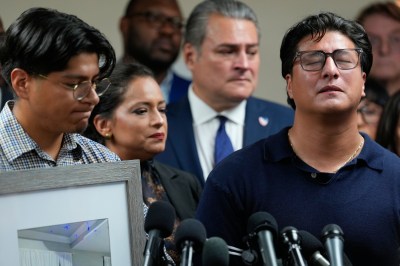
Tarek Hussein, an Egyptian-born Houston physical therapist who has been a Republican for decades, came to the convention as a delegate, and spent much of it fighting to stay. His son, Mohamed Hussein, another Muslim delegate, left in tears, according to The Texas Tribune. At a “Don’t Sharia My Texas” forum hosted by Patriot Mobile—a Christian nationalist cell phone company—speakers told hundreds of attendees that halal food and Muslim tithes were part of a scheme for global jihad. Islam, one speaker said, was “a cult of death.”
State Rep. Brent Money, who founded the Sharia-Free Texas Caucus, said the country should be run by Christians and cited an 1816 letter by the first US Supreme Court justice to argue Christians should hold office. When Mohamed Hussein stood to object at a separate panel, a former Southern Baptist pastor approached him and told him there was no place for him in America.
Mohamed came to the convention hoping to prove he had a place in his party. “What we got was kind of a confirmation,” he said.
Goodwin said the trajectory, left unchecked, leads somewhere most Texans haven’t contemplated. “I’ve seen where we start on a path and keep moving down it,” she told Courier Texas. “This Christian nationalism belief—that non-Christians shouldn’t have a place in our governing, shouldn’t have a place in voting—I believe that’s where this path is headed if we continue.”