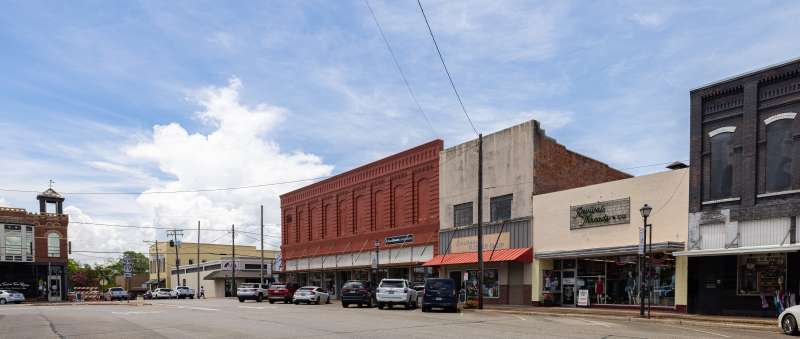
Paulette Goree was born 73 years ago at Panola General Hospital in Carthage. A baby born in her deep East Texas town today would likely have to be delivered elsewhere.
The hospital, now UT Health Carthage, still runs a 24-hour emergency room. But it no longer delivers babies. Goree, who has remained in the area her whole life and now serves on the city council in tiny nearby Beckville, said expectant mothers now drive roughly 30 miles for labor and delivery, and families often travel just as far for pediatric care.
“We don’t even have a maternity ward,” Goree said. “If you’re having a baby, or you need obstetrics care, or you need pediatric care, you’ve got to go… 30 miles.”
Even local services are stretched thin. Goree has tried for four months to get physical therapy for her shoulder at the Carthage hospital, eight miles from her home, rather than drive to Longview. The department hasn’t been able to fit her in.
“I’m suffering because of it,” she said.
Her experience reflects a pattern across rural Texas: hospitals survive by shedding services, residents drive farther, and patients pay more while waiting longer. In East Texas, 14 counties have only one hospital, and six have none. Statewide, Texas has led the nation in rural hospital closures.
According to the Texas Hospital Association (THA), 15% of Texas’ population is considered rural, and hospitals in rural areas serve proportionally larger numbers of older patients who are uninsured or rely on public insurance like Medicaid.
And recent federal policy changes have played a role in rural Texas hospitals’ woes.
Since Sept. 1, the Trump administration has withheld approval of about $9.8 billion in Texas Medicaid hospital payments, most of it from a program that helps cover the gap between Medicaid rates and the cost of care. The THA warns maternity wards and neonatal units are among the services at risk.
Goree, who is on Medicare, pays more than $200 a month for Part B, $348 for a supplemental plan, $15 for vision, and $30 for dental. She and her husband live on a fixed income, while food and gas prices keep climbing.
“I’m insurance poor,” she said.
As funding challenges persist, Goree said many neighbors don’t trust the local emergency room with a true crisis.
The hospital’s emergency department has a Level IV trauma designation, the lowest of Texas’ four levels. “When they get sick, they say, ‘Don’t take me to Carthage. Take me to Longview, or take me to Marshall,’” she said.
Younger rural Texans face their own squeeze. After enhanced federal subsidies for the Affordable Care Act (ACA) expired, Texas’ paid ACA enrollment fell from 3.42 million in 2025 to 3.28 million in 2026, and the share of enrollees in high-deductible bronze plans jumped from 18% to 31%.
Rural healthcare and affordability take center stage ahead of midterms
Affordability is another key issue for Goree, who said day-to-day life has gotten harder—starting at the gas pump.
The nearest Walmart is about eight miles away. For anything serious, residents head to Tyler, Longview, Marshall, or Henderson. Her husband often crosses into Louisiana for his doctor’s appointments in Shreveport.
Each trip carries hidden costs. “You’re going to spend gas money to get there. You’re going to spend money on food,” she said. “It just gets a little cumbersome.”
Goree said the outcome of the Nov. 3 midterm elections could be critical for rural healthcare and everyday costs in Texas, pointing specifically to the high-profile US Senate showdown between Attorney General Ken Paxton, a Republican, and Democratic state Rep. James Talarico.
“Washington shares some responsibility,” she said, “but I think it’s more on a state level, what we do with these rural hospitals.”
Paxton has not challenged the $9.8 billion hold on Medicaid by Trump’s team. Paxton also joined the multistate effort to overturn the Affordable Care Act.
Paxton’s campaign has proposed tax deductions for health insurance premiums and out-of-pocket medical costs. Meanwhile, ads backed by a pro-Trump super PAC have claimed that Talarico’s proposal of a public health insurance option for Texas called “Medicare for Y’all” could threaten some 30 rural hospitals in the state. A fact check found reporting citing that the ads relied on a study whose assumptions did not reflect Talarico’s true stance.
Talarico has expressed support for rural hospitals by proposing increasing Medicare and Medicaid reimbursement rates and recruiting more healthcare workers in rural areas. He’s made lowering the cost of living a central focus of his campaign.
When it comes to rural healthcare, Goree also worries about mental health. She reads the local police reports and sees how often officers pick people up during mental health crises. “We have nothing here to support people with mental illness,” she said.
The stakes are economic, too. Rural hospitals can often be a town’s largest employer. Goree worked at the Carthage hospital in college, and her sister was a nurse there. “If you wanted a job, first place you went to: the hospital,” she said.
For Goree, success is simple, and it begins where her life did.
“It would be nice if I can just go to Carthage,” she said, “and feel confident.”