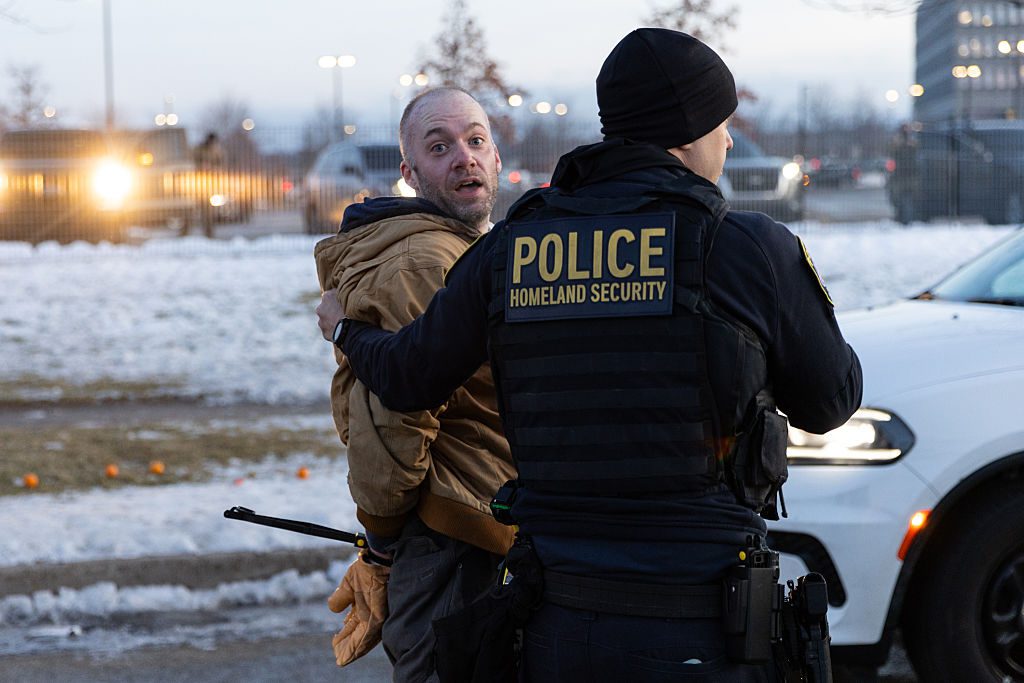
MINNEAPOLIS, UNITED STATES - JANUARY 09: Federal agents arrest a protestor outside an ICE facility after he allegedly attempted to block a vehicle during a protest against U.S. Immigration and Customs Enforcement (ICE), in Minneapolis, MN, United States, on January 9, 2026. (Photo by Mostafa Bassim/Anadolu via Getty Images)
We spoke to a legal expert about what to do if you encounter ICE, what local police can and can’t do, and how to get involved to protect your neighbors.
Masked federal immigration officers have become a visible presence in many communities across the country, and Texas is no exception. With no sign of immigration raids slowing down, Texans need to know their rights and how to safely interact with federal officers, whether they’re undocumented, US citizens, or somewhere in between.
As recent events have shown, those interactions can be a matter of life or death. According to a new report from The Guardian, eight people, including three in Texas, have died while engaging with Immigration and Customs Enforcement (ICE).
COURIER DFW spoke with Kristin Etter, the Director of Policy and Legal Services at the Texas Immigration Law Council, for her expert legal knowledge to better understand what’s happening with immigration enforcement and how the public should be interacting with these federal agents.
” We’ve just seen a huge change in the tactics over these last, this last year, but it’s really amped up over these last several months into a really militaristic—I don’t know how else to describe it—almost like a rogue agency at this point that appears to be operating outside the law in many different circumstances,” the attorney said. Although the law says one thing, she acknowledged, there’s a chance agents will break those rules. That’s why it’s more important than ever that Texans know their rights and how things should be done.
Are local police officers working with ICE?
Texas Senate Bill 8, which went into effect Jan. 1, requires most sheriffs that operate a jail to enter into a 287 (g) agreement with ICE. Doing so allows them to act as federal immigration agents. There are three different levels of this agreement, and counties can choose the one they’d like.
The most aggressive is the task force model. This allows state officers to actively stop, question, arrest, and transport individuals suspected of not maintaining legal immigration status.
The second is the jail enforcement model, which allows officers to determine if individuals arrested should be held 48 hours beyond their release date to investigate their status. The least severe model is the warrant service officer model, and that lets jailhouse officers serve ICE administrative warrants on people already in jail, claiming a violation of immigration status outside of the criminal charges they already have.
Etter called these agreements “dangerous” because they pull police officers away from their normal duties of protecting the communities they’re serving.
To see which model your county has adopted, check out Texas Immigration Law Council’s interactive 287 (g) map.
If you encounter an ICE officer, what should you say?
There are three types of law enforcement interactions. If an ICE agent starts talking to you while you’re walking down the street, for example, that’s a consensual encounter. You don’t have to stay and answer questions, Etter said, but if you do and say something incriminating, you could be arrested.
The second encounter is called an investigatory detention. This could look like an officer asking you to stay at the scene of a crime to give a statement.
The third interaction is a probable cause to arrest, where an officer believes a crime has occurred and arrests you.
Etter says that in any interaction you can always assert your Fifth Amendment right, giving you the opportunity to ask for a lawyer and then remain silent. But in a lawful arrest or detention, you are still required to share your name, address, and date of birth with officers under Texas Penal Code 38.02.
Is it okay to record ICE agents?
Etter confirmed that the First Amendment gives people the right to record government actors, but cautions that impeding or obstructing officers in any way puts you and those around you in a dangerous situation, which could lead to your arrest. You should try to keep a safe distance from the officers and their vehicles; Etter recommended at least 15 feet.
What if ICE knocks on your door?
“ You are secure in your home or you should be secure in your home,” Etter said.
The Fourth Amendment—which establishes a right to privacy and protects individuals from unreasonable search and seizures by the government—applies to everyone who lives in this country, regardless of your immigration status, she explained. Agents should not be able to enter your home unless they have a signed judicial search warrant.
Recently, a leaked Department of Homeland Security memo essentially authorized agents to enter homes and drag people out without a signed judicial warrant, but Etter said that’s not lawful.
Are there safe places for undocumented Texans? Can I help?
For years, immigration officers didn’t enforce immigration orders in sensitive locations like schools, churches, hospitals, and courthouses. These were protected under the Fourth Amendment as private spaces. In today’s climate, however, Etter said that the expectation of privacy should go out the window.
In terms of aiding undocumented individuals, Texas has very broad laws around human smuggling, which makes housing and aiding these Texans riskier for the helper. What is clear is that it’s a crime to drive someone in your vehicle with the intent to conceal them from law enforcement and is punishable with 10 years in prison or more.
There’s an ICE facility opening in my community—what can I do?
Protesting (with a clear safety plan) is an option, but it’s important to be aware of laws that could potentially be weaponized against you. Etter also suggests reaching out to your local representatives and asking them to help stop the facility’s opening. Many communities have been successful in blocking the construction of those centers because they worked with their local officials.
Do I have to worry about ICE if I’m a US citizen?
According to Etter, all Texans should be ready for detention. “ I think everybody at this point needs to have a level of awareness of how serious things are right now, whether you’re an immigrant or not, whether you look like an immigrant or not,” she said.
Nationally, we hear stories every day about US citizens being detained. Etter added that she’s been working with a local client who had lawful permit residency status, but was still arrested, sent to the worst detention center in Texas, and told she could be deported.
What can I do to support at-risk neighbors?
Communities are working together to offer mutual aid to those who may not feel comfortable leaving their homes. Etter said churches around Texas are arranging food deliveries, and some rural communities are running rapid response hotlines, ready to deliver medicine, get children to school, and respond to any immediate needs requested. For those looking to help, Etter suggested looking into grassroots operations like these.
“ We don’t know, one day it might be them and tomorrow it could be us,” she said. “And so it’s really important that we all come together and have a broad coalition of support and work within our communities to make sure your neighbor’s protected.”
Author

Support Our Cause
Thank you for taking the time to read our work. Before you go, we hope you'll consider supporting our values-driven journalism, which has always strived to make clear what's really at stake for Texans and our future.
Since day one, our goal here at COURIER Texas has always been to empower people across the state with fact-based news and information. We believe that when people are armed with knowledge about what's happening in their local, state, and federal governments—including who is working on their behalf and who is actively trying to block efforts aimed at improving the daily lives of Texas families—they will be inspired to become civically engaged.