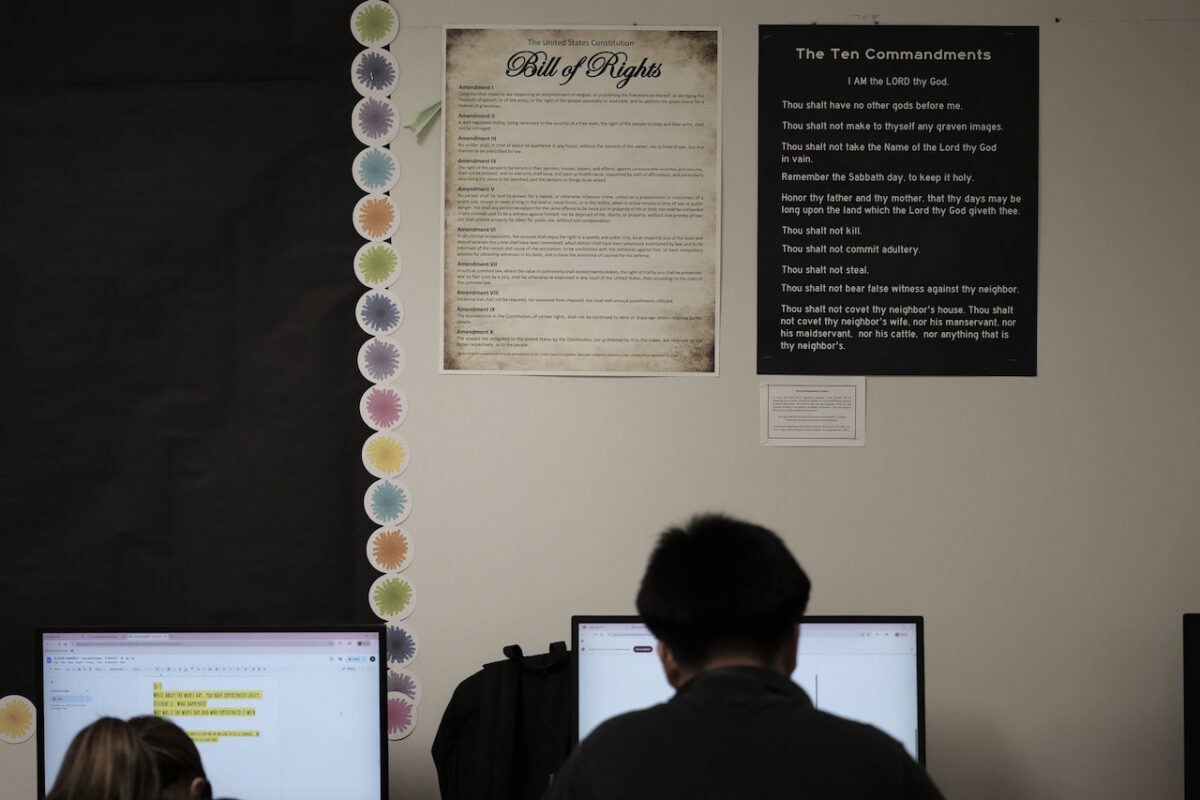
Students work under Ten Commandments and Bill of Rights posters on display in a classroom at Lehman High School in Kyle, Texas. (Photo by AP/Eric Gay)
DALLAS (AP) — Texas can require the Ten Commandments to be displayed in public school classrooms, a U.S. appeals court ruled Tuesday in a victory for conservatives who have long sought to incorporate more religion into schools.
The ruling sets up a potential clash at the U.S. Supreme Court over the issue in the future. Arkansas and Louisiana have passed similar laws, which have also been challenged in courts.
And Alabama Gov. Kay Ivey signed a similar law earlier this moth.
The 5th Circuit Court of Appeals said in the decision that Texas’ law did not violate the First Amendment, which protects religious freedom and prevents the government from establishing a religion.
Texas Attorney General Ken Paxton, a Republican, called the ruling “a major victory for Texas and our moral values.”
“The Ten Commandments have had a profound impact on our nation, and it’s important that students learn from them every single day,” Paxton said.
Andrew Mahaleris, spokesperson for Texas Gov. Greg Abbott, a Republican, said the mandate from the state was a “commonsense law, consistent with our history and tradition.”
Organizations representing the families who challenged the law, including the American Civil Liberties Union, said in a statement that they were “extremely disappointed” by the decision.
“The court’s ruling goes against fundamental First Amendment principles and binding U.S. Supreme Court authority,” the statement said. “The First Amendment safeguards the separation of church and state, and the freedom of families to choose how, when and if to provide their children with religious instruction. This decision tramples those rights.”
The ruling reverses a district court’s judgment that had blocked school districts from displaying the commandments.
The decision says the law “does not tell churches or synagogues or mosques what to believe or how to worship or whom to employ as priests, rabbis, or imams.”
“No child is made to recite the Commandments, believe them, or affirm their divine origin,” the ruling goes on to say.