MCALLEN, Texas — Vanessa Ovalle has a “frontline view” of Texas schools as a single mom and a speech pathologist at a local school in McAllen, a city in the Rio Grande Valley bordering Mexico. Ovalle described the state’s education system as “completely disappointing.”
In nearby Welasco, Catalina Ozuna said her daughter is working in an understaffed kindergarten classroom for little pay while being weighed down by the cost of daycare for her own child.
Meredith Keller, who for over a decade presided over a local school board south of Austin, calls a new voucher program that allows parents to use public dollars for private school “a slap in the face to everyone who went to public school.”
These Texas voters all have two things in common: They have backed Republican Gov. Greg Abbott in the past and are now throwing their support behind Democrat Gina Hinojosa in the November election, driven by concerns about the state of public education.
In this Republican bastion, angst over the state’s public education system has helped fuel Hinojosa’s campaign, giving voters here one of the most competitive governor’s races they’ve seen in decades.
That a Democrat has a chance is a welcome surprise for voters like Maria Colmenero, 32, who stood at the back of an Hinojosa rally this month in Brownsville, a town along the Mexican border, holding one of the campaign’s school-bus-yellow “Save Our Schools” placards.
Colmenero said the main issue driving her support for Hinojosa is the state of public schools in Texas. She said she’s homeschooling her three daughters because the local public school options just “weren’t up to par.”
“That’s the major thing for us, and I truly believe that if you pay the teachers more, if you have a better education curriculum, that it could be so much better for the kids and for everybody,” Colmenero said.
“We told them that if she wins, ‘Y’all can actually go back to school, a public school,’ and they’re excited. They want her to win. We all want her to win.”
In Texas, the rollout of a $1 billion school voucher program allowing parents to use public school dollars to cover some of the cost of private schools led to backlash as neighborhood public schools closed or shifted to four-day schedules, while others struggled with persistent teacher shortages. Hinojosa has promised to end the voucher program, increase teacher pay and “DOGE” the state’s education agency by ending no-bid contracts to education vendors and curbing the size of the agency. Hinojosa has also promised to stop state takeovers of local school districts and has criticized the use of artificial intelligence in the classroom.
Hinojosa got her start in politics by fighting the closure of her son’s local public school. She ran on the success of that fight to become a member of her local school board in Austin. She now represents a central Austin district in the Texas House, where she’s worked on a wide set of education issues, from directing more tax dollars to neighborhood public schools to curbing standardized testing.
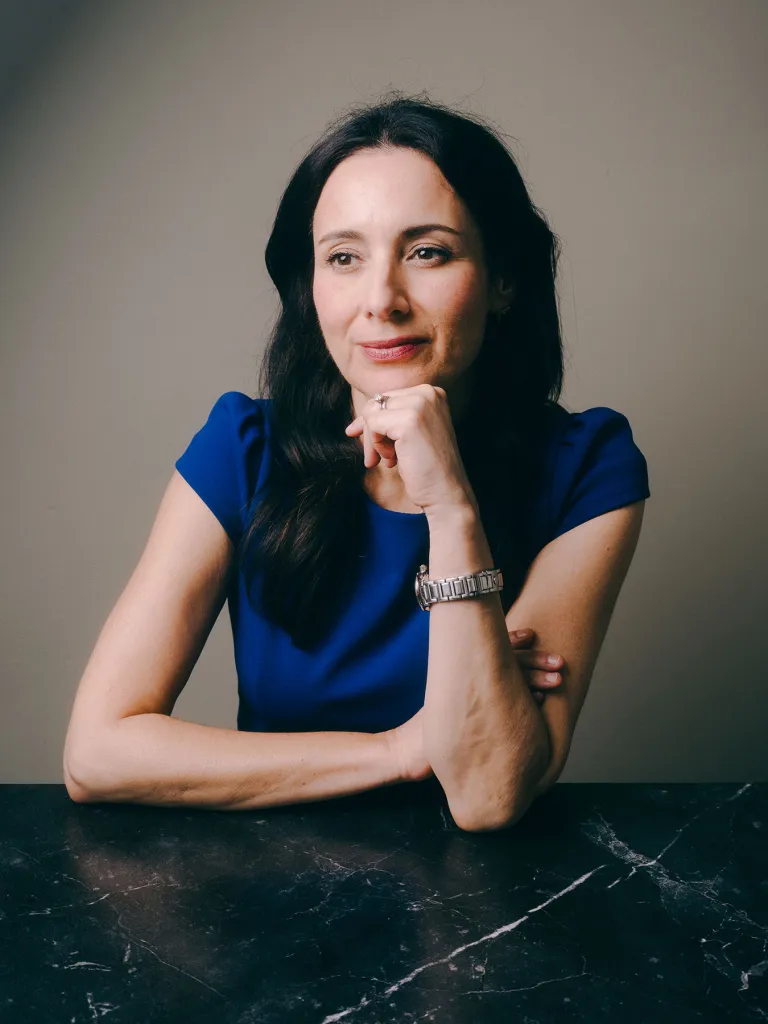
“I was told at the beginning, ‘You talk too much about education,’” Hinojosa told The 19th. “Well, I’m going to talk about it some more. I’m a mom, and I have a son who is 21 and I have a son who is 14, and I have seen the deterioration of our public schools in that time. And I know, I know that the parents and the teachers are just trying to hold it together.”
Toward the end of her younger son’s time in elementary school, Hinojosa said, during Abbott’s second term as governor, administrators simply couldn’t find a teacher for his class. They ended up splitting the class and assigning more students to other teachers, she said. “That’s how bad it was.”
In a campaign swing through the Rio Grande Valley, a heavily Latino part of the state, Hinojosa worked to shore up support among Latino voters preoccupied with the state of public education. All of the counties that make up the Valley swung for President Donald Trump in 2024 by double-digit margins, but polling shows that collapsing support for the GOP among Latinos could reverse that trend.
Ovalle, the speech pathologist, said she previously supported Abbott and typically stands “closely toward the right” politically. But at Hinojosa’s rally in McAllen this month, Ovalle was nodding along with the Democratic candidate, recording clips of her stump speech. Asked which part of Hinojosa’s message resonated the most, Ovalle said it was her comments on education.
“I work at the school setting … I see what our educators go through, and it is completely disappointing to see how hard they work and how they are being failed by the system,” she said. “I’m not only fighting for myself, but fighting for them as a whole.”
Ozuna came to see Hinojosa at a breakfast with Tejano Democrats this month — a standing-room-only event inside an Hidalgo County restaurant where voters got to meet the candidate over tacos locos and huevos a la mexicana. Republicans won over a majority of voters in Hidalgo in 2024 with a 20-point swing for the GOP. Ozuna said that her daughter, the kindergarten teacher, holds a college degree and is working toward becoming a certified teacher but has struggled to get through a series of financial hoops. She had to take on a three-month unpaid internship in a classroom and several thousand dollars in fees for her certification. That’s on top of a high daycare bill.
Watching her daughter’s journey next to headlines about chronic teacher shortages made her pay more attention to Hinojosa, who has promised to boost teacher pay and direct more dollars to public education. Ozuna has supported Abbott in the past, but not this cycle. “We know that she’s not going to let anybody control her, and that’s what we need,” Ozuna said.
Hinojosa isn’t the only Democrat who has worked to define the issue of public education, avoiding the GOP’s framing of it as a culture war battle. Last fall, Virginia Democrat Abigail Spanberger flipped control of the governor’s mansion by promising to make the state’s schools “the best public schools in the nation,” while criticizing Republicans for “eroding faith in our public schools” and opposing Republican efforts to bring vouchers to her state. Their playbook could help Democrats chart a path forward on the issue ahead of the 2028 election.
By tapping into frustration with the state’s education system, Hinojosa said, she has been able to attract voters in a state where political loyalties run deep. Keller, the former school board member, said she has long been dissatisfied with the way Republicans have run the state’s public education system. She’s been speaking at campaign events with Hinojosa, hoping to create a permission structure for other Republicans to back the Democrat.
“I was silent about my choice for a very long time, just because people are so ugly, and then I realized I needed to say it out loud. I needed to tell everybody: ‘I did vote for Greg Abbott, and that was a mistake. This time I am voting for Gina Hinojosa,’” Keller said.
Hinojosa made clear that the coalition she’s building around her education agenda isn’t about turning Republicans into Democrats.
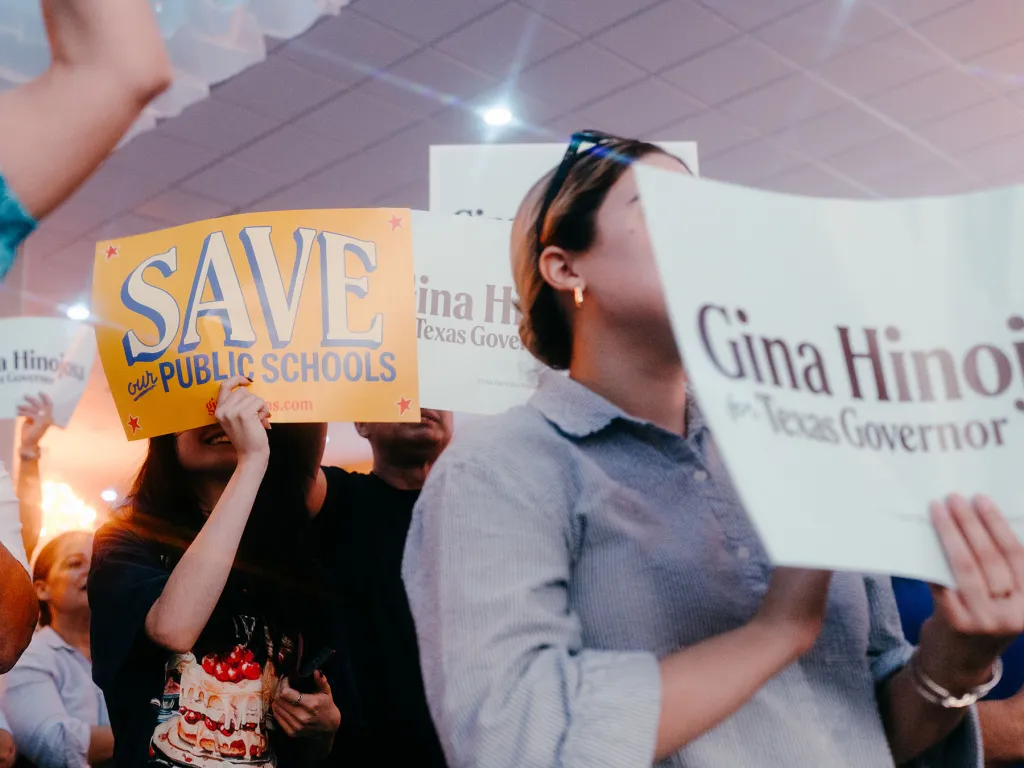
“I think we are coming into a time when people have been disappointed by both parties, and it creates space and opportunity for people just to vote for the candidate. And I have built credibility on the issue of public education,” Hinojosa said.
One of those voters is Lynn Davenport, 55, who described herself as a “staunch conservative” in a new campaign ad for Hinojosa that began airing over the weekend across the state. Davenport’s journey from being a Trump supporter who attended his January 6 rally to protest the results of the 2020 election to becoming an Hinojosa voter is a long one, but she made clear that the issue that moved her to the left on this particular race is education.
Davenport first met Hinojosa when she started advocating in the state legislature to fight back against the sudden expansion of standardized testing in her kids’ schools and other legislation that she says “privatizes” public education by giving contracts to outside organizations for education services. A stay-at-home mom to three kids in Dallas at the time, she grew worried watching her youngest son come home crying after testing, and watching the climate of the school change. Years later, she said the same dynamics have yielded a system of vouchers and charter schools that “divert money from public schools to private hands” and robs parents of their choice school being their neighborhood school.
Education isn’t the only issue on voters’ minds. The high cost of living, data centers, Trump’s unpopularity and the GOP’s struggles with Latinos have all helped create openings for Democrats here. Recent polling shows Democratic U.S. Senate candidate James Talarico pulling ahead of scandal-plagued Republican Attorney General Ken Paxton. The tight race will be one of a handful that will decide control of the U.S. Senate, which could help lift up Hinojosa.
Davenport isn’t planning to switch parties, and she’s not supporting Talarico in November. (That’s in part due to his comments about giving religions “equal time,” in Texas’ school curriculum when the GOP was working to insert more Christianity.)
For Davenport, it’s about education, and Hinojosa herself. In the legislature, she said, Hinojosa was among the Democrats who “would listen to the moms and the parents.”
“I know she more aligns with the Democrat Party, obviously, so we don’t agree on everything,” Davenport said of Hinojosa. “But on this subject, we do.”