By Joshua Fechter and Paul Cobler
Expanding Medicaid. Boosting the minimum wage for Texas workers. Ending tax breaks for data centers. Banning Flock cameras. Building high-speed rail.
Those ideas and more were among the bills filed by Texas Democratic lawmakers as a new era of lawmaking under a Democratic governor and divided Texas Legislature kicked off Monday morning.
Among other ideas: undoing a state law that requires sheriffs to partner with U.S. Immigration and Customs Enforcement and forbidding border wall construction at state parks. Democrats also filed proposals to end the state’s year-old school voucher program and boost per-pupil funding for public schools.
The 90th session of the Texas Legislature will convene Jan. 12.
As of 2 p.m. Monday, more than 1,160 bills had been filed, with more expected during the unofficial opening of the next legislative session. Bill filing will continue through March 12. Most legislation will fall short of the governor’s desk, but Monday’s flurry will offer an early glimpse of lawmakers’ priorities.
Many Democratic proposals can expect heavy resistance in the Texas Senate, where Republicans have held onto a majority after last week’s midterm elections. And while Republicans took a drubbing in last week’s voting, bills filed Monday signaled they haven’t abandoned their priorities.
First out of the gate were House and Senate bills to expand access to Medicaid, long sought by Democrats and blocked by Republicans who argue expansion would be wasteful. Under Republicans, Texas has long held out on expanding Medicaid under the Affordable Care Act — which would send the state up to $10 billion a year and cover an additional 1 million Texans. Texas is the most populous state to not allow Medicaid expansion.
State Rep. John Bucy, D-Austin, filed a bill that would direct the Texas Health and Human Services Commission to expand Medicaid. The agency would have to file a plan to do so to Washington. State Sen. Judith Zaffirini, D-Laredo, filed a companion bill in the Senate.
Bucy acknowledged that any move to expand Medicaid health insurance coverage would face pushback from the Texas Senate, where Republicans continue to hold a majority.
“We do think there’s going to be a lot of room to find compromise,” he said. “The House and the Senate need to find compromise to get things done for the people of Texas.
Medicaid in Texas mostly covers low-income children, new moms and older adults. It does not cover working-age adults who either earn too little to afford health insurance on their own or work for an employer that offers health insurance.
Democrats and Republicans also took aim at data center construction. Legislators signaled that regulating data centers would be central to their efforts next year after the data center boom became a dominant issue on the campaign trail.
Proposals were filed to require data centers to share more information about their water usage with the state, to bar data centers from receiving tax incentives and to give government entities more direct regulation over data center development.
The bills tackle key points of friction in communities with data center development. Residents worry the facilities will drain local water resources and cause electricity rates to increase. State efforts to survey the facilities on their water use have seen low participation rates.
A bill by Zaffirini would require large data centers to share information about their water usage with the state water development board.
The industry has also faced criticism for pursuing tax incentives. Lawmakers from both parties have expressed interest in repealing a state sales tax exemption for data centers, which The Texas Tribune reported in April has ballooned to more than $1 billion in annual revenue foregone by the state.
By noon, Democratic and Republican lawmakers filed three separate bills to repeal the sales and use tax exemption for data centers.
A murkier subset of exemptions offered by local governments in the form of Chapter 380, 381 and 312 agreements allow data centers to negotiate tax abatements, rebates and direct infrastructure work from cities and counties seeking to lure economic development.
Zaffirini’s bill would bar data centers from pursuing those local tax incentives and prevent cities and counties from renewing those already in place.
Immigration enforcement targeted
Democrats also took aim at the Trump administration’s aggressive immigration enforcement and border wall construction efforts.
A bill by state Rep. Trey Martinez Fischer, D-San Antonio, would repeal a 2025 law that requires sheriffs who run or contract out operations of a jail to take part in a 287(g) partnership, which allows U.S. Immigration and Customs Enforcement to deputize state and local law enforcement officers with certain immigration enforcement authorities. State Sen. José Menéndez, another San Antonio Democrat, filed a similar bill in the Senate.
The bills would allow sheriffs to terminate their agreements with ICE and stop the comptroller’s office from awarding grants for these partnerships. The proposal would also dismiss any actions from the attorney general’s office that sought to enforce the 2025 law.
There were 565 partnerships under the 287(g) program in Texas as of Nov. 4, ICE data shows. Nearly two-thirds of them are under the task force model, which is the most aggressive version that allows local officers to question individuals about their immigration status during routine police work.
Another bill by state Rep. Eddie Morales Jr. of Eagle Pass would essentially aim to bar the feds from building a border wall on state park property.
Lawmakers filed at least three bills seeking to rein in use of automated license plate readers like Flock cameras, including legislation from Bucy that would ban the devices outright. State Rep. Brian Harrison, R-Midlothian, who filed bills in two prior sessions seeking to limit the devices’ use, also filed a bill limiting how police can use them.
Gov.-elect Gina Hinojosa campaigned against the spread of the AI-powered cameras, and told The Texas Tribune in September she supported a ban.
Democrats also made moves on the education front, filing several bills aimed at repealing the state’s voucher program, which allows students to attend private school using taxpayer dollars.
State Rep. Donna Howard, D-Austin, filed a long-sought proposal to raise the base amount of per-student funding the state provides to public schools, known as the basic allotment, and tying any future increases in that base funding to inflation.
Democrats also filed bills to raise the state’s minimum wage from $7.25 an hour, the rate set by the federal government. A pair of proposals from state Reps. Ana-María Rodríguez Ramos of Richardson and Armando Walle of Houston would raise the minimum wage to $15 an hour, while a proposal from Martinez Fischer would raise it to $17 an hour.
Texas is one of eight states that don’t allow residents to register to vote online, according to the National Conference on State Legislatures. A bill by Bucy would change that, directing the Texas secretary of state to work with the Texas Department of Public Safety and Department of Information Resources to figure out a way to allow online voter registration.
Democrats will also seek to restrict who can purchase semi-automatic rifles. A bill by state Rep. Joe Moody of El Paso would raise the minimum age to buy certain semi-automatic rifles in Texas to 21.
And as Texans complain about worsening traffic congestion on the state’s highways, Democrats have signaled they’re looking at other ways to get around the state.
A bill filed by Bucy would direct the Texas Department of Transportation to kickstart a high-speed rail line connecting Dallas, Waco, Austin and San Antonio along the congested Interstate 35 corridor. The state agency would have to enter a comprehensive development agreement with a private company to build, maintain and operate the line, which would have to reach speeds of at least 110 miles per hour.
Property taxes, gambling
Republicans remain in majority control of the Senate as Lt. Gov.-elect Vikki Goodwin, a Democrat, prepares to take office as part of a Democratic sweep of statewide offices in last week’s election.
Republican lawmakers, and some Democrats, offered a slew of proposals aimed at reining in property tax bills. Harrison of Waxahachie filed a longshot bill to abolish property taxes and create a joint committee on the abolishment of property taxes. Harrison and state Rep. Brent Money, R-Greenville, each proposed constitutional amendments to get rid of property taxes.
House Republicans have long sought to tighten the state’s appraisal cap, which limits how fast a home’s taxable value can rise each year. That cap stands at 10%. Under a bill by state Rep. Jared Patterson, R-Frisco, the cap would decrease to 3%. Tax policy experts on both sides of the aisle have warned that tightening the state’s appraisal cap wouldn’t result in lower tax bills and would have nasty side effects.
Republicans have unsuccessfully sought to forbid local governments from hiring lobbyists in past sessions. That push now faces an even tougher climb in a divided Legislature. Still, state Rep. Mike Olcott, R-Fort Worth, filed a bill to do just that.
Rep. Charlie Geren, R-Fort Worth, filed a House joint resolution that would allow voters to decide whether to legalize both casino gaming and sports wagering in Texas. Resolutions require two-thirds support in the House and Senate before voters can weigh in.
While a similar resolution passed the House in 2023, it failed in the Senate, where Lt. Gov. Dan Patrick has for years blocked efforts to expand gambling in Texas. While it is unclear what appetite the Republican-controlled Senate will have for legal wagering, Lt. Gov.-elect Vikki Goodwin voted for the failed 2023 measure when she served as a state representative.
Democrats will control the House in the 90th Session and will elect a leader to replace Speaker Dustin Burrows, R-Lubbock, on the session’s first day.
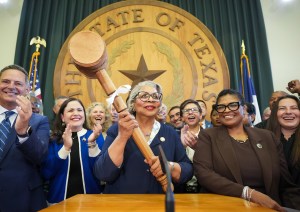
Democratic Rep. Senfronia Thompson, the longest-serving woman and the longest-serving Black legislator in any state, announced Friday that she had enough votes to win the speaker’s gavel.
Gov.-elect Gina Hinojosa campaigned heavily on reversing GOP education policy, like the state’s school voucher program that lets families use tax dollars to pay for their children’s private schooling. That law was passed during the 89th Legislative Session in 2025.
Democrats broadly also campaigned on establishing tighter guardrails on data center development, pulling back restrictions on consumable hemp products and lowering the cost of living in the state.
Hinojosa on Thursday signaled a willingness to work with Republicans in the Senate on issues as she announced a transition team made up of Democrats and Republicans.
“I would hope that elected leaders from both parties don’t get in the way of the progress we can make together to deliver for working people,” Hinojosa said. “That is our obligation as leaders in this state, and I look forward to working with Republican leaders in the Legislature.”
This story will continue updating as bills get filed.