Kimmie Fink, a Liberty Hill ISD parent, is raising her children Catholic. But that doesn’t mean she wants the Ten Commandments displayed in their public school classrooms.
“The Ten Commandments might match our children’s faith traditions, but we’re very well aware that Texas is an incredibly diverse state, and they can cause harm to children with other faiths—and trample on a parent’s right to guide the moral and religious upbringing of their own children,” Fink told Courier Texas.
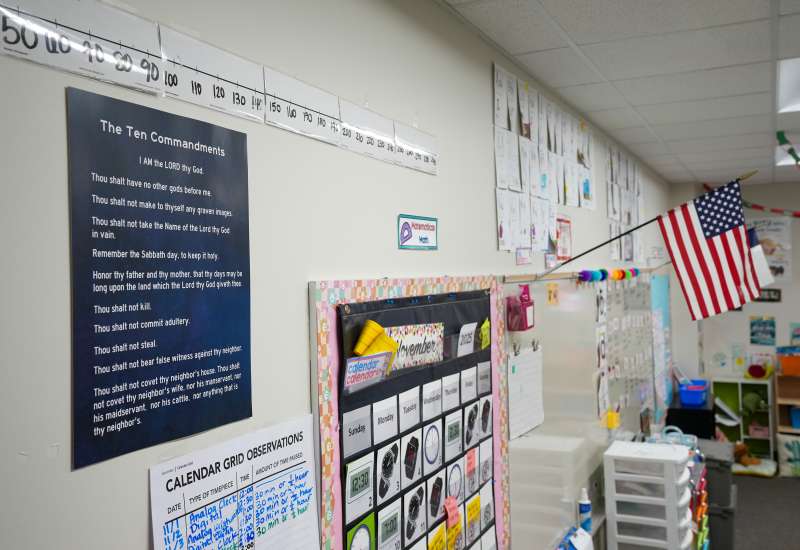
She’s referring to Senate Bill 10, a new law the Texas Legislature passed in 2025 requiring a poster of the Ten Commandments that’s at least 16 inches wide and 20 inches tall be displayed in all public school classrooms.
The mandate has faced legal hurdles since it went into effect in September. Groups of parents and religious leaders have filed lawsuits over the law, alleging it violates the First Amendment, the separation of church and state, and amounts to lawmakers promoting Christianity over other faiths—including in Fink’s own district.
In Rabbi Nathan v. Alamo Heights Independent School District, a US District Judge sided with the plaintiffs and blocked the law from taking effect in districts named in the case. A second lawsuit resulted in a federal judge blocking 14 more school districts from having to comply, while a third—asking a federal judge to block all Texas schools from following the law—is pending.
But Attorney General Ken Paxton asked the 5th Circuit Court to overturn the ruling in Rabbi Nathan v. Alamo Heights ISD, and allow all 17 active judges on the court to hear the case. On April 21, the federal court ruled against the plaintiffs, allowing Texas to enforce the law in all classrooms.
‘We are going down a really scary path.’
“ My daughter is in fifth grade, and I’ve asked her if she sees these posters in her classroom that I’d like her to let me know,” Fink said. “It’s definitely colored a lot of our conversations. We’ve talked about people in our neighborhood who are Hindu and celebrate Diwali and people in our neighborhood who are Jewish and Muslim, and she has this understanding that not everybody believes the same thing.”
Fink’s daughter loves graphic novels, and was recently reading the graphic novel adaptation of Anne Frank’s diary, which was banned in Keller ISD in 2022.
“My youngest was asking questions about it, and I used it as a moment to discuss why we don’t demonize religions,” she said. “Because horrible things happen when you do. It’s not a conversation I really expected to have, and I don’t think it’s a conversation I would be having with my kids if we didn’t live in Texas,” she added. ”But we are going down a really scary path.”
Under the law, schools must accept and display any privately donated posters.
Megan Boyden, who has two students in elementary school in Denton ISD, said she was relieved that posters weren’t donated to her children’s school when the law first took effect.
“ The Ten Commandments bill to me is very disturbing because of how young my kids are,” Boyden said. “I went to my representative’s town hall last spring, and I said, ‘Religious aspect aside, why do you want to put the word ‘adultery’ or ‘kill’ on my kindergartener’s classroom wall?’ It’s just really not appropriate for a five-year-old.”
On May 8, Boyden received word the district received a huge donation of posters—enough to go up in every classroom.
The donations came from two sources, including Republican state Sen. Brent Hagenbuch, according to a public information request submitted by Boyden.
“It’s just disgusting. It’s crazy and disappointing, and now I have to explain to my kid what all this means,” she said. “It will probably be up by the time they get to school on Monday.”
The donation also coincided with Paxton announcing investigations into 29 school districts that hadn’t been complying with the law—just one of many new mandates that took effect during the 2025-26 school year.
SB 11 took effect this school year and forced districts to vote on whether to adopt a voluntary designated prayer time during the school day. But the majority of districts across the state chose to reject the policy, much to Paxton’s dismay.
These bills continue to expand on a conservative push to infuse more white Christian nationalism into public schools, as the Texas Board of Education approved Bluebonnet Learning in November 2024, which are learning materials for kindergarten through eighth-grade students that include a Bible-based curriculum.
Board members are also deliberating a social studies standards overhaul that critics say leans too heavily into white, Westernized Christian teachings at the expense of other religions and cultures.
They’re also reviewing a standardized book list that could make the Bible required reading in Texas public schools.
‘When you try to stifle a minority population from having a voice and representation in school, it’s just going to cause significant struggles and it’s going to cause kids to not properly be prepared for society.’
Lawmakers also passed SB 12, which stripped K-12 public schools of all diversity, equity, and inclusion initiatives and created a “Parental Bill of Rights”—something that had unintended consequences on how school nurses were able to administer care for students.
The bill prevents schools from developing or using policies that reference race, ethnicity, gender identity, or sexual orientation; bans DEI as a factor in hiring prohibits teachers from using they/them pronouns; bans clubs based on sexual identity; creates an avenue for parents to file complaints; and requires districts to create policies for disciplining employees who engage in DEI-related tasks.
“It’s infuriating,” Sarah Inatomi, a licensed counselor and mother to a future Plano ISD student, said. “ When we allow people to be who they are, children’s empathy and their understanding on how to navigate a complex world increases. Because it’s not like when you erase these things in school they stop existing elsewhere. These kids are gonna have to go into the workforce and learn how to interact with all kinds of different people, so when you try to stifle a minority population from having a voice and representation in school, it’s just going to cause significant struggles and it’s going to cause kids to not properly be prepared for society. That’s why I want my daughter to go to a diverse public school.”
If Texas continues down this path, Inatomi said she would consider other options for her daughter—including homeschooling or moving to a different state.
SB 12 also includes provisions requiring schools to get written parental approval before offering routine health assistance—resulting in reports some school nurses wouldn’t give bandages or take temperatures for fear of violating the law.
“We don’t even have a full-staffed nurse at school anymore, that’s how bad it is,” Alex Friedman, a mother to a student in Dallas ISD, said. “I’ve been at school meetings this year with parents complaining that because of lack of proper paperwork, the nurse wasn’t able to touch the student, not even to help with a scratch. A lot of these laws placed more of a burden on school administrators and parents, and for the most part they’re not efficient and not really enhancing anything for students.”
SB 13, which requires that school boards, rather than librarians, have the final say over which books or materials can be put in school libraries, banning anything that doesn’t adhere to “local community values,” was also signed into law by Gov. Greg Abbott last year.
The bill has resulted in more book bans, with some districts shuttering entire libraries while each title could be audited and reviewed. It also requires teachers to audit their own book shelves in their classrooms.
“ We’re working through the implications because even teachers’ libraries are supposed to be certified, and that’s a huge burden,” Boyden said. “And at the same time, we have cut administration in our district so substantially that there’s almost nothing… there’s nothing left to cut, and these unfunded mandates are just becoming crippling.”
Fink’s district is having similar problems.“ We’re having an issue with books getting stuck in purgatory because these new boards don’t have a time to review them,” she said.
Friedman said she hopes districts can put their trust back into the experts.
“ Trust the librarians, because they are the best equipped to know what should be there, what’s appropriate for those ages, and if a kid has questions, he can come and ask his parents at home,” Friedman said. “But just banning everything, let’s just say no society that banned books was deemed a good society.”
‘We’re focusing on details that, in the end, are not enhancing the quality of their education.’
Boyden said in order to rebuild a successful education system, lawmakers need to go back to “the science of what’s best for kids.”
“It almost seems like every bill that gets put forward is a vendor bill and someone is making money off of it, and it’s not rooted in science for how kids learn, how best to retain teachers, how to make schools flourish,” she said. “So we just need to go back to what’s good for kids and make them the focus instead of how much money we can make off public education.”
Fink’s reflection on Texas education is more forthright.
“It’s a sh*tshow,” Fink said. “The state of Texas education—at the state level, when we’re talking about the legislature, the State Board of Education—it’s all highly partisan, it’s corrupt, it’s wasteful. I always talk about them as shenanigans, it’s always something new with the lege, and it’s so discouraging. It makes me so worried about all the students across the state.”
But she also finds hope in her children’s teachers.
“I’m so grateful to my children’s individual teachers who are in an environment that’s so oppressive and continuing to do the best for students with what they have,” she said. “They are going above and beyond, and my children are thriving because they have caring teachers. We should be taking things off their plate, not adding to it. All of these new unfunded mandates—they need to focus on the children in front of them.”
Friedman echoed these sentiments. “Public education in Texas is under threat right now,” she said. “I think there’s a lot of forces at play trying to completely undermine it, and it’s going to impact generations of students. We’re focusing on details that, in the end, are not enhancing the quality of their education.”