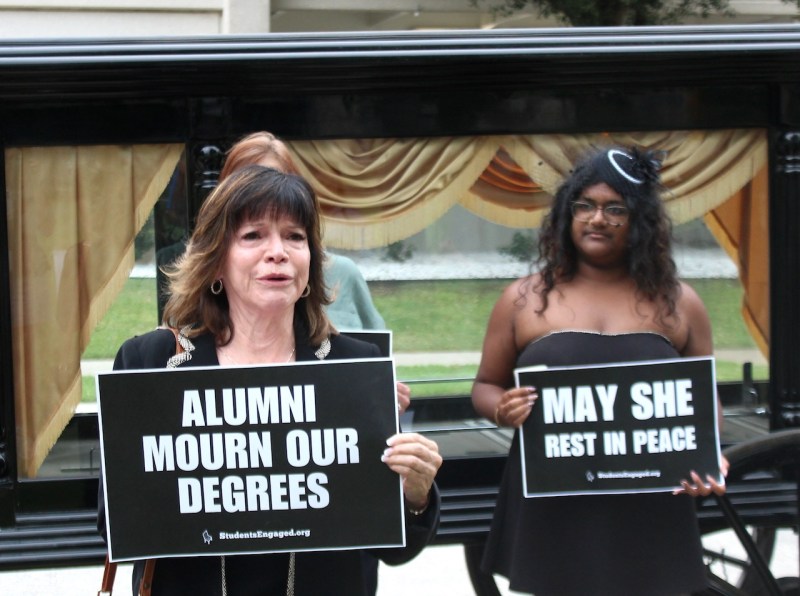
Speaking in front of a horse-drawn hearse with signs that read “May She Rest in Peace” and “Alumni Mourn Our Degrees,” students, faculty, and alumni sent a clear message to the University of North Texas System’s Board of Regents on Thursday afternoon: Academic freedom at UNT is dead.
The mock funeral and protest was organized by Students Engaged in Advancing Texas, and acted as a demonstration to mourn the loss of more than 70 academic programs, the elimination of all diversity, equity, and inclusion initiatives on campus, and the recent censorship of an art exhibition criticizing US Immigration and Customs Enforcement.
The program cuts will affect four master’s programs, two undergraduate majors, and 25 undergraduate minors, along with over 40 graduate and undergraduate certificates. While current students can finish their degrees, new students can’t enroll in any programs slated to close.
The Media Arts, School of Applied Liberal Arts, Linguistics, and Teacher Education and Administration master’s programs are all closing. Several majors in the English, Biological Sciences, and College of Information departments will merge.
Undergraduate minors, including Dance, Africana Studies, Mexican American Studies, LGBTQ+ Studies, Arabic, Special Education, and Women’s and Gender Studies will no longer be offered.
The cuts, which the university said are meant to combat a $45 million budget deficit, are “politically charged,” according to the event organizers.
“ We’re here to protest the elimination and consolidation of over 70 programs throughout undergraduate and graduate degrees, along with minors, certificates, and other individual courses that no longer align with what UNT says is simply just budget cuts, but we know are politically charged because it’s only affecting these programs,” Sumya Paruchuri, a UNT student and development director at SEAT, told Courier Texas.
“ The way that Texas politics works is very much divorced from the reality of what students need or want, and the only way to combat that and make sure that our rights are properly advocated for and protected is to make sure that students go out and vote,” Paruchuri added. “These are people that were appointed directly by the governor to pursue what he wants to do. President Keller was handpicked by Greg Abbott to be the new president two years ago, and we’re seeing the effects of that now with the budget cuts.”
Senate Bill 17, which requires universities to close their diversity, equity, and inclusion offices, passed the Texas Legislature in 2023. It has triggered sweeping changes on campuses and caused audits of entire course catalogues to ensure professors aren’t teaching “illegal” DEI topics.
“ We lost our multicultural center, we lost our Pride Alliance, we lost some faculty affinity groups,” Tracy Everbach, who has been a journalism teacher at UNT for 15 years, said.
“We also lost groups for Black faculty and LGBTQ faculty and Latino faculty, a lot of those programs were eliminated from campus, and that was also a loss for students because they lost places where they felt like they had a home.”
The changes and ongoing censorship have caused Everbach to leave the university, a decision she said she didn’t make lightly.
“ They offered senior faculty a buyout to give us one year pay if we left, and I felt that this was a good time for me to leave because syllabuses are being run through an AI program now to identify keywords,” she said. “And I teach a class, my signature class, is on race and gender in the media that I already know has been flagged, and I really don’t want to undergo any censorship of my syllabus and my teaching.”
Everbach’s decision is an ongoing trend that education advocates are calling a “brain drain,” with many Texas professors looking for jobs in different states over fear and anxiety due to increased political interference on campuses.
“ When professors are forced to overcomply with state regulations and university policies in fear of being prosecuted, academia dies,” Paruchuri said. “But we will not let it die quietly. Students know what is happening, and it’s not something we will let happen while sitting on our hands. We are watching our professors become nervous, our courses, degrees, and minors get cut, and our departments lose funding.”
In 2025, the Texas Legislature passed Senate Bill 37. The new law went into effect on Sept. 1, and overhauls the governance of public higher education in the state. It shifts control of curriculum and campus decision-making from academic leaders to political boards appointed by the governor. It also created a state-level Ombudsman to investigate noncompliance with state law.
“ I speak from the heart as someone who loves North Texas,” said Valerie Martinez-Ebers, a UNT alumna and professor. “I have two degrees from UNT, and have taught there for 27 years. I have 11 degrees from UNT among my family. I have always been proud of this university until the last two years.”
Now, Martinez-Ebers said she’s embarrassed to say she’s a UNT alum due to the overcompliance of SB 17 and 37.
“That’s not what higher education is supposed to be,” she said of the censorship of faculty and students. “And it just brings me to tears.”
Thursday’s event was the third mock funeral organized by SEAT this month, with similar events taking place at Texas Tech University and the University of Texas at Austin.
“ Whenever they think that they can just cut programs and students, professors, alumni don’t care, they’ll continue to do it because nothing is stopping them,” Paruchuri said. “So making sure that they see students care is super important, and it’s a strong reason to continue to show up whenever there’s opportunities to. Universities have stood at the front lines of democracy, and any attacks on that can lead to things like authoritarianism and fascism. What we’re seeing doesn’t just affect students—it will spill out larger than that.”