After immigration and deportation enforcement emerged as major concerns for many South Texas voters, families affected by separation are looking to newly elected leaders for answers.
For Blanca Deli Blancarte, the election results brought hope, but they didn’t bring home her husband.
The Weslaco woman said her husband, Ramon, a Mexican national who had lived in the US for about a decade and worked in agriculture, was detained in March and deported in July. He helped raise her children, and she says his absence has left the family with one question for her district’s House winner, Rep.-elect Bobby Pulido.
“I wanna know what is it that he’s gonna do to help out our relatives that were deported and to see how we can get them back over here,” Blancarte said.
Her question reflects the uncertainty many immigrant and mixed-status families in the Rio Grande Valley have post-election period. The candidates they supported have won, now they hope they’ll see the change promised.
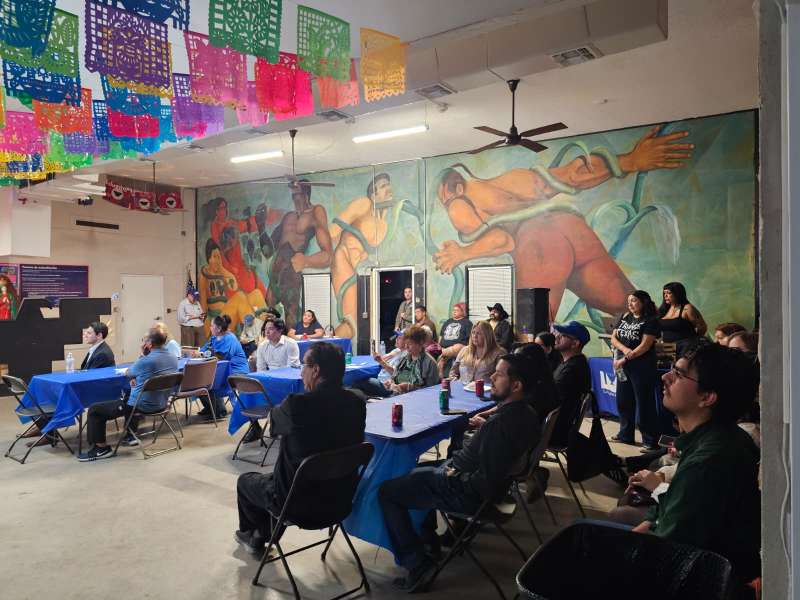
La Unión del Pueblo Entero, or LUPE, is a Rio Grande Valley grassroots organization that works with immigrant and working-class families on issues including immigration, civic engagement, and community advocacy. For them, that question has shifted their focus from voter turnout to lawmaker accountability.
Tania Chávez Camacho, president and executive director of LUPE and LUPE Votes, said immigration enforcement, ICE activity, and family separation were among the top issues organizers heard repeatedly while knocking on doors ahead of the election.
“When it affects somebody that was separated from their loved ones, that’s why they showed up to the polls,” Chávez said. But she cautioned against viewing the election results as an endpoint.
“We’re also not thinking that these politicians are gonna come save us,” Chávez said. “We need to organize, and we need to ensure that the decisions that were made at the ballot are carried forward.”
Blancarte said her husband initially entered the country with a permit, but after it expired, the family struggled to resolve his status. She said his deportation has been especially difficult for her children.
“I don’t have children with him, but he raised my children,” she said. To them, she added, “he’s their dad.”
Her daughter, 22-year-old Clarissa Benavides, voted for the first time this election. When asked what motivated her to cast a ballot, her answer was emotional and brief.
“Just what’s going on with my dad,” Benavides said. Asked whether she missed him, Benavides became emotional before simply replying, “A lot.”
For Blancarte, the hope now is that newly elected leaders will find ways to make the immigration system easier for families trying to navigate it and stay together.
She said she especially wants to know what incoming Congressman Pulido can do for families like hers.
“How is it that he’s gonna help with our people, with our families?” she said. “’Cause there’s been so many families that have been broken.”
The first 100 days
LUPE, which organizes throughout the RGV, says it is already preparing a list of priorities for the transition period and the first 100 days of the new administration.
Chávez said the organization wants representation on advisory boards and other forums where the incoming administration will gather community input.
She also said LUPE will push for executive actions and legislative changes related to immigration enforcement, including changes to state and local cooperation with federal immigration authorities and Operation Lone Star.
“We have a plan,” Chávez said. “We know what we need to see in that community, and our plan is to ensure that we hold them accountable.”
She described LUPE’s approach as “co-governing” with elected officials — bringing members’ priorities directly to state and local leaders rather than waiting for those officials to set the agenda.
At the same time, Chávez acknowledged an important limitation, which is immigration enforcement is largely a federal matter. That means a change in Texas leadership does not automatically reverse a deportation or resolve an individual immigration case.
Instead, Chávez said, LUPE believes state and local officials have more control over how Texas agencies and local law enforcement cooperate with federal immigration authorities.
What can change locally?
That distinction between federal immigration policy and local policing is already playing out in Texas. She pointed to Houston as an example.
“Local authorities have control over their own law enforcement,” Chávez said, arguing that city leaders can direct police departments to limit when officers notify ICE during routine encounters.
Houston Mayor John Whitmire took such a step Nov. 6, signing an executive order that limits when Houston police contact US Immigration and Customs Enforcement. Under the new policy, officers will no longer notify ICE solely because someone has an administrative immigration warrant during a routine traffic stop or another encounter that does not result in an arrest. Police can still contact ICE when someone is arrested for a jailable offense.
The move reversed guidance issued earlier this year that had instructed officers to contact ICE any time they encountered administrative immigration warrants.
For Chávez, Houston’s decision illustrates one of the areas where LUPE believes South Texas officials can act, even while larger immigration policy remains tied up in Washington.
She said LUPE wants mayors and other local leaders across the RGV to examine their own law enforcement policies and determine how much cooperation with federal immigration authorities is required, and how much is a local choice.
That local changes are likely to become part of LUPE’s post-election push as the organization begins meeting with newly elected officials and pressing them to turn campaign promises into policy.
For families currently facing detention or immigration proceedings, Chávez said the immediate advice is more practical; seek qualified legal help, know your rights, and prepare for the possibility of detention.
“Every immigration case is different,” she said. “We should not be using a cookie-cutter approach to court representation.”
Blancarta says she is living it and is seeing it all around her.
“There are families that have been here longer, like I’m not only talking for my husband,” Blancarte said. “They’ve been here for 30, 40 years, and they’ve still been deported… It’s heartbreaking.”
A better life for South Texans
While immigration was a major part of LUPE’s election organizing, Chávez said members were also talking about more basic quality-of-life concerns, especially in colonias, unincorporated towns that lack infrastructure.
She described canvassers walking through some communities with flashlights because of inadequate street lighting and said residents also raised concerns about transportation, trash pickup, and the cost of living.
“We had to do canvassing with flashlights,” Chávez said. “Can you imagine the day that we actually get to light up all the colonias at once?”
Colonias can typically be found along or near the Texas-Mexico border. They’ve historically faced economic hardship and, in many cases, inadequate access to necessities like clean water, electricity, and sanitary sewage systems. Under Texas law, the definition includes qualifying low-and very-low-income communities in counties within 150 miles of the international border with living conditions often compared to Third World countries.
Many Texas colonias date back to the 1950s, when developers sold inexpensive, often undeveloped land to families who had few other options for homeownership. The lack of basic infrastructure has persisted even as billions of state and federal dollars have flowed to the border for security and immigration enforcement.
Those everyday gaps in infrastructure are exactly the kinds of issues Chávez said LUPE wants elected officials to address now that the election is over.
For LUPE, Chávez said, that is part of the larger point. Political participation is not only about electing candidates. It’s about using that political power to push for changes that residents can see in their daily lives.
“It’s not just about one election,” she said. “It’s about every single election thereafter, and it’s about what you do in between each election.”
For Blancarte, the change is urgent.
“We miss our loved ones.”