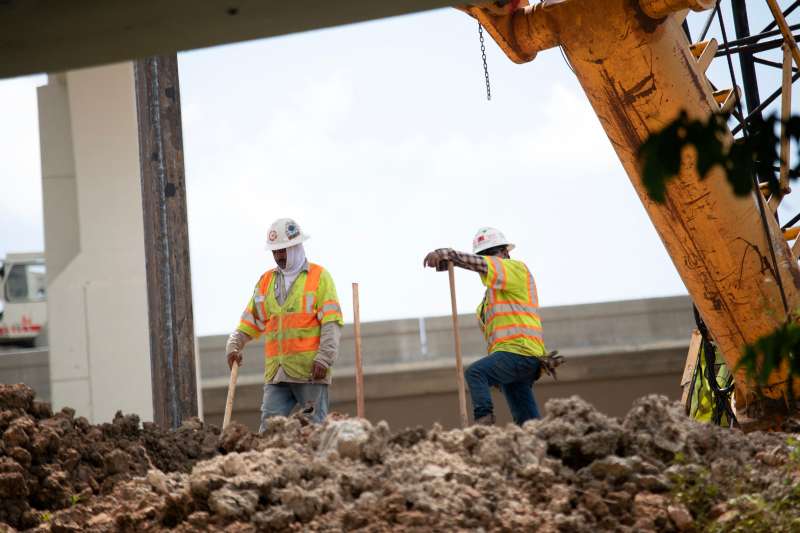
Texas is hot. For workers, it’s deadly. As the summers get hotter, outdoor workers face heat-related injuries and even death because there are no federal or state protections keeping them safe.
The state ranks first in heat-related worker deaths, with more than 300 Texans dying of heat exposure in 2023—the highest number since it began tracking these deaths in 1989. But even if you take work out of the equation, heat-related deaths in the US rose from an average of 700 around2018 to a staggering 1,700 between then and 2025. In 2023, 562 of those deaths were in Texas.
On top of increasingly dangerous heat across the country, Texas has been impacted by a significant heat wave this summer, with record-breaking temperatures expanding from Texas and Oklahoma all the way to California. The increased heat is the result of accelerated climate change, which scientists say is making Texas hotter as each year passes.
As a result, the heat index levels in many Texas cities have broken records this summer, and because the US doesn’t have a workplace heat standard, outdoor workers have had to labor in the sun with minimal protections.
Maria Terrazas has been a landscaper in the Dallas-Fort Worth area for 20 years. She comes from an intergenerational family of landscapers and works alongside her son and father. Terrazas says that without a workplace heat standard, the Texas summers can be life-threatening.
“It’s like you’re burning. When you’re walking behind the lawnmower, the sun is hitting your face, your back, every inch of your body,” said Terrazas.
Just last summer, Terrazas experienced a heat stroke from prolonged heat exposure, which was a combination of migraines, nausea, and blurred vision. But with no enforced standard for outside work, there’s a good chance that experience won’t be her last.
What the law does and doesn’t say
While there are no federal workplace standards for heat specifically, current laws say that employers must provide free drinking water and maintain a workplace free from hazards that could cause death—which includes in the heat.
The Occupational Safety and Health Administration (OSHA) seeks to remedy the lack of specific regulation with recently proposed nation-wide workplace protections for hazardous heat, including requirements to provide cold water and shade if the heat index rises above 80 degrees. It also includes paid breaks as needed and paid 15-minute breaks every two hours if the heat index rises above 90 degrees.
But these protections are being threatened by a new bill that was introduced by Indiana Republican Rep. Mark Messmer in 2025, which would block OSHA from enabling a nationwide standard. The bill, H.R. 6213, would allow Congress to prioritize economic productivity over workers’ well-being. Houston-area US Republican Rep. Brian Babin is a cosponsor of the bill.
The House Education and Workforce Committee recently approved H.R. 6213 and it is set to advance to the House. If approved there, it would need to pass in the Senate before becoming law.
Houston-area Democratic Rep. Sylvia Garcia—who grew up picking cotton in the Texas heat—is one of the lawmakers pushing back on H.R. 6213. Garcia has built her platform on advocating for workers’ rights, especially when it comes to heat protections.
Texas, in particular, has focused on stripping those heat protections away. In 2023, Governor Gregg Abbott eliminated heat protections for outdoor workers in major cities across the state with House Bill 2127—nicknamed the “Death Star Bill.” This bill removed mandated water breaks enforced by local ordinances in Austin and Dallas.
That same year, USPS was fined after 66-year-old Dallas postal worker Eugene Gates collapsed and died from heat exposure. The same thing happened in 2025 to 51-year-old DFW postal worker Jacob Taylor. Then, it happened again just this summer to 58-year-old DFW postal worker Umeshkumar Thakkar.
Leonard Aguilar, President of the Texas AFL-CIO, advocates for nearly 250,000 workers across the state of Texas who are members of unions. Aguilar says that these heat injuries and deaths are largely preventable.
“ There are other states that have taken this issue and are leading by example of protecting workers and putting workers first,” said Aguilar. “Texas shouldn’t be coming in last in this race, and it’s unfortunate that they are putting the billionaires and the corporations in front of the workers that make our state run every day.”
A dangerous game
Without mandated water and shade breaks, already dangerous work becomes deadly. Minds can go foggy and workers’ bodies are pushed to their limits—then mistakes are made.
Albert Salazar has been a roofer in the North Texas area for 30 years and now teaches other workers roofing skills. Salazar says that the extreme heat of Texas becomes even more hazardous when height and equipment are involved.
“You’re always running the risk of falling off the roof,” said Salazar. “You’re also running risk operating equipment, like a roof cutter. I’ve seen in a lot of instances where the heat gets to people cutting the roof—you lose control of a saw or a roof cutting machine.”
When heat protection laws aren’t implemented, employers have the ability to take advantage of workers. Immigrant workers, in particular, face heightened risk from exploitative employers and are much less likely to report unsafe working conditions or heat stroke.
In Texas, almost half of all outdoor workers are immigrants, and widespread fear over immigration enforcement, job loss, and retaliation lead to increased likelihood of heat-related injury or death.
Paul Puente was a Houston electrician in the construction industry for 12 years before working for construction labor unions. Puente says that federal workplace standards are key to protecting immigrant workers.
“When there are people out there who don’t have a voice, there should be laws and rules for employers to let them know we’re here to protect our workers,” said Paul Puente. “We’ve seen a lot of employers taking shortcuts and threatening folks if they don’t work without any rest breaks. We’ve also seen retaliations if anybody speaks up.”
While Congress decides the fate of workers’ futures, those laboring in the heat invite politicians to spend a day in their shoes.
“Come and work with me for a day and feel what we feel, and then decide what’s best,” said Terrazas. “That’s the only way to decide on a law, you know? Come survive one day and then decide if you can have water breaks.”
While there is no Texas legislative session until 2027, members of the public can make their voice heard by writing to their representatives about setting a mandated standard for heat protections.