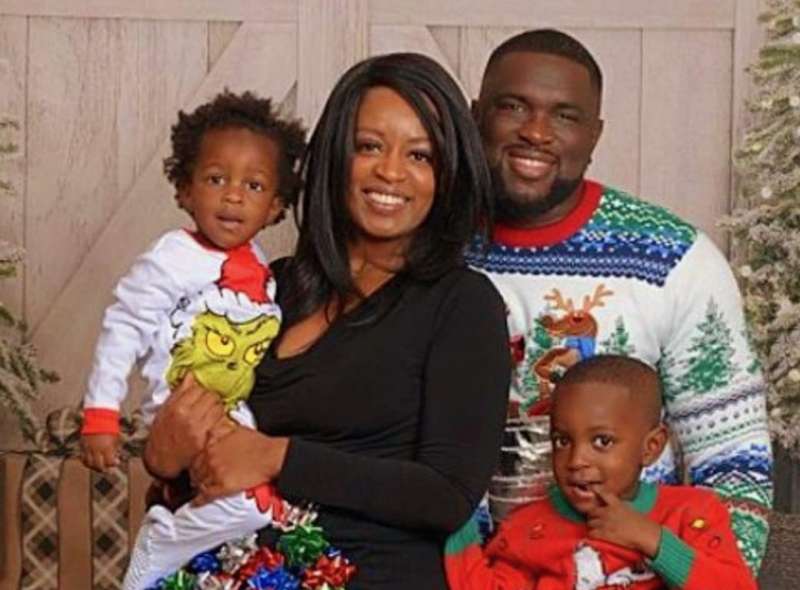
“Choosing to bring new life into the world shouldn’t be a death sentence,” insisted Michelle Maloney, the San Antonio attorney working to bring justice to Texas widower Hope Ngumezi and his two young sons.
Three years ago, in June 2023, Hope’s beloved wife Porsha was happily expecting the couple’s third child until she began to miscarry at 11 weeks pregnant.
The healthy 35-year-old finance manager for a charter school went to the emergency room at Houston Methodist Sugar Land Hospital, just 10 minutes from her home in suburban Houston.
Both she and Hope were certain that she would receive the safe and critical medical care that she needed as she passed fetal tissue and blood clots the size of grapefruits at the hospital.
An ultrasound confirmed that she had partially miscarried and that her fetus no longer had a heartbeat. But the heavy bleeding didn’t stop.
Still, the hospital’s OB-GYN, who examined her just once, moved Porsha from the ER— where staff were equipped to respond to emergencies—to a regular floor, where she received less monitoring.
Porsha arrived at the hospital at 3:37 p.m. By 2 a.m., she began gasping for air and within minutes, she had died of hemorrhage.
A dozen doctors who reviewed her medical records for ProPublica, which broke the story about her death, said that Porsha should have urgently received a very simple and standard procedure for a miscarriage—a D&C (dilation and curettage).
The 10-15 minute D&C would have removed all remaining fetal tissue in her womb, which her uterus was trying to expel with heavy contractions and bleeding. The procedure would have stopped the bleeding.
“The poor thing bled to death for lack of a D&C. It’s atrocious,” Austin OB-GYN Nancy Binford told Courier Texas.
Read More: He took his wife to a Texas hospital for a miscarriage. She left in a body bag.
Anti-abortion legislation leads to more maternal deaths
Tragically, Porsha is one of several pregnant Texas women whose deaths have been documented since the state became the first in the country to impose a six-week abortion ban in 2021.
Then, in 2022, after the US Supreme Court overturned Roe v. Wade, Texas’s trigger abortion ban starting from conception took effect.
Doctors in the state found themselves under the threat of 99-year prison sentences if they were convicted of performing abortions deemed “medically unnecessary.” Many Texas doctors now take a very conservative approach to treating miscarrying women for fear that a D&C could be classified as an abortion, said Texas attorney Michelle Maloney, who specializes in reproductive healthcare malpractice.
Since 2022, maternal mortality has skyrocketed by 56% in the state. Black women have died at the highest rate. In 2023, they were 2.5 times more likely to die from pregnancy-related causes in Texas than white women, according to an analysis of federal health data by the Gender Equity Policy Institute. Nationally, Black mothers in states with abortion bans are now more than three times as likely to die as white mothers in those states, up from just over two times before the bans took effect. Porsha is one of those victims, but she is far more than a statistic to her grieving husband, Hope.
“No one should be able to go to a hospital with their pregnant wife and leave without their loved one,” he told Courier Texas. “Porsha was full of life. She was intelligent, ambitious, caring, compassionate, and funny. She loved her family. She was my best friend.”
Now, Hope is suing the hospital, the chain of seven Methodist Sugar Land hospitals, the OB-GYN, Dr. Andrew Ryan Davis, and the emergency room physician, Dr. Nayan B. Patel, who were in charge of Porsha’s care.
The lawsuit for medical negligence and wrongful death was filed on behalf of himself, his two young sons—Nolan and Aidan, now 8 and 5— and Porsha’s mom, Pashona Lewis.
“We are suing for monetary damages, but Hope and I want to go beyond the economics. We want the hospital to agree to provide guidance and support to their physicians treating women who need medically necessary D&Cs or abortions. What happened to Porsha shouldn’t happen again,” Maloney said.
“Since the abortion bans have been in place, hospitals have had time to establish new protocols for their doctors who treat pregnancy complications,” she added. “But most have not done that. The Association of Obstetricians and Gynecology has also said that if you are a hospital in an abortion ban state, you have to provide guidance and support to physicians in order to prevent deaths of pregnant patients.
“You should not die of a miscarriage in a hospital in the United States. It’s unbelievable,” she said.
‘No one should have to go through this’
Hope, with help from Maloney, wants to force the doctors and Methodist Sugar Land hospitals to take accountability for depriving Porsha of lifesaving care.
“It seemed like the hospital was trying to sweep Porsha’s death under the rug,” Hope said. “It seems like these big hospitals, all they care about is money, so suing them for damages is a way to fight this battle.”
He doesn’t want other pregnant women to die like Porsha. “No one should have to go through this,” he told Courier Texas.
Hope said after Porsha’s death, he blamed himself for not insisting that his wife be sent to the operating room for an urgent D&C—something that his mother, who trained as a doctor in the Dominican Republic, advised the couple to get.
Porsha was in severe pain and bleeding heavily; however, the hospital OB-GYN told the couple that the hospital’s “routine” for miscarriage treatment was to give her a medication called misoprostol first, to help the uterus push out the remaining fetal matter.
“He put us in a situation where we believed him, even though Porsha had a low platelet blood clotting issue which made her bleeding more dangerous and it was noted in her medical chart,” Hope said.
“I don’t know why he couldn’t just tell us that he didn’t want to perform a D&C and we would have left and tried to find another hospital that would have done the procedure.”
Instead, after Porsha lost consciousness from heavy blood loss and then received a blood transfusion, she was transferred under the doctors’ orders out of the emergency department to a regular hospital floor.
Porsha should never have been given the drug misoprostol while miscarrying at 11 weeks pregnant, according to Dr. Amber Truehart, an OB-GYN at the University of New Mexico Center for Reproductive Health.
Truehart examined Porsha’s medical records for ProPublica.
“Misoprostol would never have worked fast enough,” Truehart said. “The patient will continue to bleed and have a higher risk of going into hemorrhagic shock.”
“After Porsha died, I felt shame. I felt responsible because I hadn’t insisted that Porsha get an immediate D&C,” said Hope.
By the afternoon of the day that Porsha died, Hope realized that her death was preventable. Friends of his mother who were medical providers came by his house and all were shocked that she hadn’t been given a D&C.
But he didn’t have any idea that Texas’s abortion ban could have contributed to her death.
“I was aware of the abortion ban, but I didn’t know the depth of it,” he said. His knowledge of the ban remained limited until he was contacted by ProPublica reporters investigating her case a year later.
“I began doing my research on Texas’s abortion laws,” he explained. “I saw that it leaves a lot of gray areas that can prevent doctors from doing what they need to do. Connecting the dots hurt so much… it’s sickening.”
Until then, “I was blaming myself for her death,” Hope said. “After that I was able to give myself some grace. I did the right thing by taking Porsha to professionals. My role was to be with her and comfort her.”
‘It’s killing the women you represent’
At first, when Hope was approached to go public with Porsha’s story, he said he was scared to open up because it meant reliving her death.
“Then I felt like Porsha talked to me and was telling me that this was my way to fight back. And so I was like, ‘message received.’”
He very recently traveled to Washington, DC, with his brother and sons to speak to Texas Congresswoman Sylvia Garcia and members of Sen. Bernie Sanders’ staff about how Texas’s abortion ban contributed to Porsha’s preventable death.
Spreading awareness propelled Hope to Capitol Hill. “Just being able to get the opportunity to speak to lawmakers, that’s all I needed,” he said.
He said he has spoken out against the Texas abortion ban at various events, but he also sometimes stops pregnant women and their partners on the street to warn them about the dangers if they have pregnancy complications.
“They’re pretty shocked when you tell them that they need a ‘Plan B’ if they experience complications,” he said. He also explains to fellow Texans that the ban was passed by the Republican members of the state’s Legislature.
He said he just can’t understand why the state’s politicians won’t make changes to the abortion ban, knowing that pregnant women like Porsha have been documented to have died since it became law.
Although the state Legislature passed The Life of the Mother Act in 2025 with the goal of giving doctors more leeway to provide abortions and D&Cs, Texas OB-GYNs and family physicians interviewed by Courier Texas said it has not improved the situation or saved women’s lives.
Read More: ‘She likely died from a stroke’: Inside the chilling reality of Texas’s abortion laws
Michelle Maloney agreed. “The clarification of a ‘medical law’ written by politicians instead of medical personnel hasn’t moved the needle.”
Both doctors who treated Porsha have now been disciplined by the Texas Medical Board. The Board concluded that OB-GYN Dr. Davis delayed providing Porsha with appropriate care.
Davis has been ordered to complete eight hours of continuing education work, including four hours on managing miscarriages.
Hope wants to see a complete end to the abortion ban.“It’s killing the women you represent and it’s like you’re turning your back on them. As a leader you can’t do that. Also, this isn’t just a women’s issue. It’s a family issue,” he said.
“I don’t agree with the ban, with lawmakers, especially men, telling me what to do with my body. And these men are dictating what a woman should do. We live in a country of freedom and you’re taking that freedom away from women,” he added.
“You know, every man came from a woman. We should be cherishing that. Especially when they bring a child into this world.”
Editor’s Note: This story has been updated to correct a misspelling.