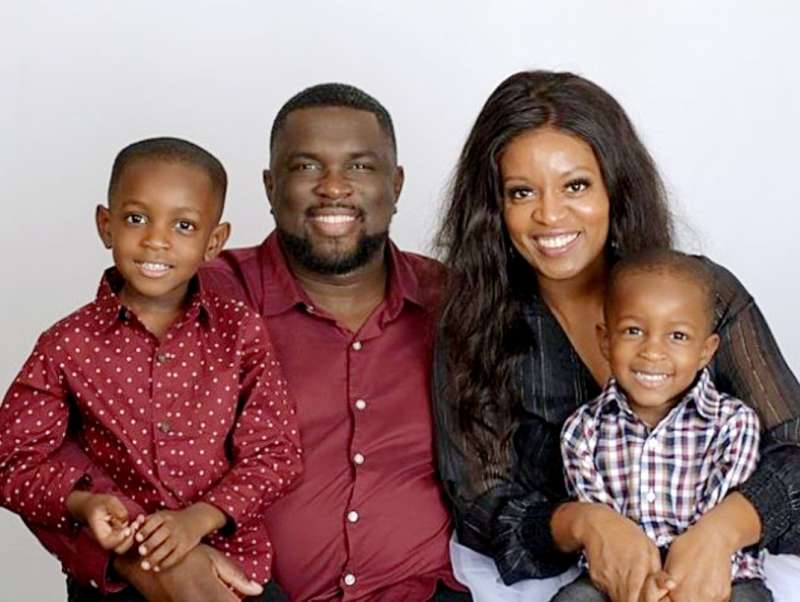
Texas dad Hope Ngumezi shares with special correspondent Bonnie Fuller how his pregnant wife, Porsha, bled to death while waiting in agony for hours for medical care. Trigger warning for our readers: This story contains transparent descriptions of Porsha’s miscarriage and death in the hospital.
”How the hell did my pregnant wife, Porsha, come to the hospital for help with a miscarriage and just a few hours later, leave in a body bag?
How was that possible?
That is what I couldn’t understand after my wife died suddenly in a Texas hospital while she hemorrhaged after a miscarriage. Why did this nightmare happen?
I learned later that same day in 2023 that her death was totally preventable. But I wouldn’t know for another year that my wife likely would be alive today if it hadn’t been for the Texas state Legislature and governor passing a law banning abortion.
Porsha and I were aware of the Texas abortion ban, which went into effect after Roe v. Wade was overturned by the US Supreme Court. But when she became pregnant with our third child, neither of us realized that it could affect the medical treatment of women having pregnancy complications.
Porsha was just 11 weeks pregnant with our third child and we were very excited. We had two young sons, 3 and 5, and wanted to have a large family, so we planned to keep on going.
It was June and the boys had just finished their school year. We decided to celebrate by taking a couple of days off and driving from our home in Houston to a water park called Kalahari, just outside of Austin.
Porsha had made all the arrangements for the vacation. She was always in charge of that. We had been married for six years but had been together since we met at Lamar University in Beaumont, Texas, in 2007.
Our first meeting was at my 21st birthday party. I had told my friends to bring some of their friends to the party and I spotted Porsha from across the room when she first walked in the door.
I had never met her before, but as soon as I saw her, it was like in the movies when everything stops. There seemed to be an aura around her. I went to the bathroom to splash water on my face to sober up and to figure out how I was going to talk to her.
I don’t know how it happened, but I was able to sit by her and we spoke for hours. It was so easy to talk to her. We just connected instantly.
I had never felt that with anyone else. I knew right away that she was “The One.” By January 2008, we were a couple and we had been together ever since.
When we got married, we had two weddings. One was an American white wedding. The other was a traditional Nigerian wedding. I was born here, but my parents both immigrated from Nigeria in the 1970s. Porsha’s family was all from Houston.
I’m an aircraft engineer and Porsha was a finance manager for a charter school in Houston.
She was a great mother. She just loved her boys so much and they loved her, too. They were both mama’s boys and were always hanging around her, which I loved.
She had no complications with those first two pregnancies or the births, even though she had a low platelet issue called chronic idiopathic thrombocytopenic purpura.
Editor’s Note: Chronic idiopathic thrombocytopenic purpura can cause easy bleeding and difficulty clotting. Porsha also suffered from iron deficiency anemia and had sickle cell trait.
Porsha’s OB-GYN at the time of her first two pregnancies was aware of her condition and was careful to monitor her.
We didn’t expect that we would have any complications with the third pregnancy. On the day that we left for Austin, though, Porsha noticed some spotting. She called her OB-GYN.
This was a new OB-GYN and Posha hadn’t met her yet. Her old OB-GYN had moved away. Porsha explained to her doctor what was happening. The doctor told her that if the spotting became more frequent, it could be a miscarriage and that she should go to a hospital emergency room.
We were at the water park for two days. On the day that we began the drive home, Porsha’s spotting was becoming heavier.
We were both getting worried. I remember that I reached over and grabbed her hand and she smiled at me. We decided that as soon as we arrived home, Porsha would head immediately to Houston Methodist Sugar Land Hospital.
It was about 10 minutes away in a suburb outside of Houston. It seemed like a very nice hospital and we thought we would get better care there than going downtown.
Editor’s Note: The hospital also lists OB-GYN as one of its areas of care.
I would stay with the boys until my mother could get over to babysit and then I would join her.
By the time Porsha got to the hospital at 3:37 p.m., the bleeding had become heavy. After she had been there for about three hours, she went to the bathroom and had a partial miscarriage there. A lot of blood and blood clots came out.
She texted me while I was giving the boys a bath and we were both heartbroken. I learned later after she died that she had been pregnant with a daughter. We had both wanted a girl so much.
Nevertheless, I felt that Porsha was in good hands at the hospital. After all, women have miscarriages. It happens and doctors are trained to handle women with miscarriages. This wasn’t a unique situation.
Porsha was taken to get an ultrasound, which confirmed that she had lost the baby. There was no heartbeat.
But she had lost so much blood that the ER doctor ordered a blood transfusion for her. The nurse was about to give her a blood transfusion when I arrived.
We were talking. She said that she was cold and I was leaning over to hug her and warm her up when she started to slur her words and suddenly she lost consciousness.
It was really scary.
Luckily, the nurse caught the situation and she came rushing in and began administering the transfusion.
She told me to try and keep Porsha conscious. I was telling her, “Babe, stay with me. Stay with me.”
She regained consciousness but she still hadn’t seen a hospital OB-GYN—just the ER doctor—even though she’d been there for hours. She was still passing blood clots as big as grapefruits.
Porsha doesn’t like hospitals and the whole time she was there that afternoon and evening, she was worried and scared. I kept reassuring her, “It’s going to be over and we’ll get out of here and be back home with our kids.”
I was trying to keep her spirits up. We called my mom, who trained as a doctor in the Dominican Republic and had practiced there before she moved to the US. Since she’s been here, she’s worked as a clinical research associate, focusing on cancer research.
She was in Dallas because one of my two sisters—who are both nurses—had just given birth there.
My mother told us that Porsha needed a minor and common procedure called a D&C (dilation and curettage) in order to clean out her uterus by removing all the fetal tissue which remained in it after the partial miscarriage.
Editor’s Note: Without a D&C, the uterus may keep trying to expel material in it by contracting and bleeding.
It was after speaking to my mother that the hospital OB-GYN, Dr. Andrew Ryan Davis, finally showed up and did his medical evaluation. It sounded like he knew what he was talking about.
He said, “It is our routine to first have Porsha take the drug misoprostol and see if that helps to pass the remaining fetal matter and blood clots. If that doesn’t work, then we can do a D&C.”
Editor’s Note: More than a dozen doctors who reviewed Porsha’s case for the news site ProPublica concluded that misoprostol can be an effective drug to end early, low-risk miscarriage, but was inappropriate for Negumezi, who had been bleeding heavily and suffered from a low platelet condition. The Texas Medical Board, which reviewed Porsha’s case, confirmed that she should have been given a D&C immediately because of the volume of blood she was losing.
Even though what Dr. Davis said conflicted with my mom’s advice, Porsha and I trusted him. He was the staff OB-GYN and he said that this was the hospital’s routine procedure. We accepted that Porsha’s miscarriage was “routine” and he gave her the drug.
He also told us that he was going to move Porsha out of the ER and to a section of the hospital where he could reach her more quickly. But the ER nurse who had been taking care of Porsha came to talk with us and she said, “If you don’t feel right about the move, then say something.”
Even though I wasn’t sure that leaving the ER was the right move, we again decided to follow the doctor’s advice. But on the way up to the room, Porsha said that her chest was hurting.
Her new nurse treated her complaint like it was something normal and brought her Tylenol. However, over the next couple of hours, Porsha complained another four times that her chest hurt.
I began to get more and more upset because no one was doing anything. The doctor didn’t come to check on her and finally, after Porsha complained a fifth time, the nurse brought her morphine for the pain.
Editor’s Note: Chest pain in Porsha’s condition was caused by her heart not receiving enough oxygen from her blood due to her severe blood loss, according to a consultation with a Texas OB-GYN, who read about Porsha’s case.
Porsha was also incredibly thirsty because she wasn’t supposed to drink since the misoprostol hadn’t fully dissolved on her tongue.
I remember that we were having a conversation about how she couldn’t wait to get out of the hospital to see the boys and get something to eat when she just started gasping for air.
I grabbed the hospital telephone and screamed to the nurse, “Something’s wrong with my wife, she can’t breathe!” It was about 1:30 a.m.
I remember that the nurse came in and she began calling “Code Blue” or something like that.
More people came into her room, but there didn’t seem to be any sense of urgency like on TV shows about medical emergencies when everyone’s rushing to try to save someone’s life.
I was pushed aside but I was telling Porsha, “Come on babe, you’re going to be alright. Come on, Babe. This is not going to be our ending. You’re going to make it.”
The medical team injected her with something, they were doing CPR and they gave her heart electric shocks several times from defibrillator paddles.
I was crying, I was shouting, I was praying. I felt like I was having an out-of-body experience.
There was a female doctor and she pulled me out of the room and told me to call Porsha’s mom, which I did.
Her mother must have heard the panic in my voice. I told her that she needed to get to the hospital now. She lived close by and she and Porsha’s stepdad got there really quickly.
The ER doctor that had seen Porsha earlier arrived and I could hear him say, “Let’s do this and then that but there was no urgency in his voice. I went back into Porsha’s room and I heard him say, “Anybody have any ideas?”
I was like, what?
Then he told me, “We’re not seeing or hearing any heartbeat.”
It felt to me like he was trying to get my OK for them to stop trying to revive her. But I said, “You got to do more. You got to try.” I just could not accept that he was trying to tell me that Porsha had died.
The OB-GYN finally showed up and that’s when the staff announced that Porsha was deceased. It was 2 a.m. Porsha had arrived there at about 3:30 p.m. in the afternoon. It had been about 10 hours since she had first walked into the hospital alive and in need of help for a miscarriage.
Despite the medical team announcing that she had died, I kept thinking that Porsha would come back. I wanted her to wake up so bad. I took her hand and it was cold but I felt like I could warm her up. Porsha always called me “the heater.”
She used to get cold really quickly and would come to me to just warm her. But now, she stayed cold.
Her mom had gotten in the bed with her and was crying.
I didn’t leave the hospital until the sun was coming up. I waited until the coroner came to get her body to do an autopsy. I walked with her as he rolled her away. Her cause of death was vaginal hemorrhage.
Then I just jumped in my car and left.
I was scared of what would happen to me. I felt so broken. I wasn’t myself and I didn’t want my sons to see how upset I was. I was thinking that I wanted to get them dressed and dropped off at their summer camp so I could get my state of mind back while they had a normal day.
I was fighting back tears as I got them dressed and they kept asking, “Where’s mommy?” I told them that she was still at the hospital.
The moment that I got them into their camp, which was at the local school, I broke down. The principal and the assistant principal came out and I told them what happened.
The pain damn near killed me. It hurt so much.
I realized that Porsha’s death was preventable later that day. A lot of my mom’s friends who are in the medical field came by my house and they all said that she should have been given a D&C, not the misoprostol. They kept repeating, “All they had to do was clean her uterus out.”
One of the guys said, “She already had the miscarriage. It wasn’t an abortion. Why couldn’t they give her a D&C?”
It made me so angry but also made me feel so terrible. How could I not have known that?
I kept going over everything that had happened in my head to figure out what I did wrong. I felt shame. Porsha had needed the emergency D&C.
When I looked back at those hours in the hospital, I felt like there had been so many times that the OB-GYN could have intervened to save her life. But he never came back to see her until after she died.
I didn’t tell my sons that their mommy had died for a couple more days. I didn’t know how to do it. I just remember crying a lot when I finally broke the news to them. What hurt the most was the confused look on their faces.
My older son, who was just 5, was trying to understand. But a couple of days later, they were both asking again, “Where’s mommy?”
When my youngest son, who was 3, would see a woman with braids like his mom had been wearing, he would just take off and run to her thinking that was his mom.
Still today, three years later, they say, “I miss mommy.” They remember her. They remember the trip to the water park.
One of my fears has been letting depression check me out. My sons already lost their mother, so I have to be available to them. I’ve had to summon all my strength to get up every day despite having low energy.
I have to put a smile on my face, wake the boys up and start their morning off great. The single dad thing has been tough, especially as I’ve coped with the grief.
But luckily their grandmothers and aunties live close by and I can take them to them to get lots of hugs and cuddles and extra love.
I didn’t realize that Texas’s abortion ban could be a contributor to Porsha’s death until I was contacted by reporters from the ProPublica news organization, who were researching Porsha’s medical situation for a story, about a year after she died.
Porsha had been upset when Roe v. Wade was overturned. She didn’t like seeing rights taken away from women.
But neither of us thought the Texas abortion ban could ever play a role in her pregnancy or that the treatment she received while miscarrying was being affected by the law.
But once I spoke with the ProPublica journalists, I realized that it creates a lot of gray areas which prevent doctors from doing what they need to do to care for women having pregnancy complications.
On top of that, the punishment for doctors performing an abortion is so great that it could affect their medical decisions.
Editor’s Note: Doctors in Texas face up to 99 years in prison for performing an abortion that is deemed medically unnecessary, in addition to the loss of their medical license.
Connecting those dots and relating them to Porsha and how her care was put in jeopardy was just sickening to me.
My belief had always been that laws are here to protect us and make life better for us. Not kill us.”
Watch for Part 2 of Hope Ngumezi’s story, in which he tells Courier Texas how he is fighting back against the doctors and hospital and against the Texas government, all of whom he believes are responsible for Porsha’s preventable death from a miscarriage at age 35.