A microscopic parasite that can leave people battling diarrhea for weeks is showing up across Texas and this year, South Texas is seeing an unusually large share of cases.
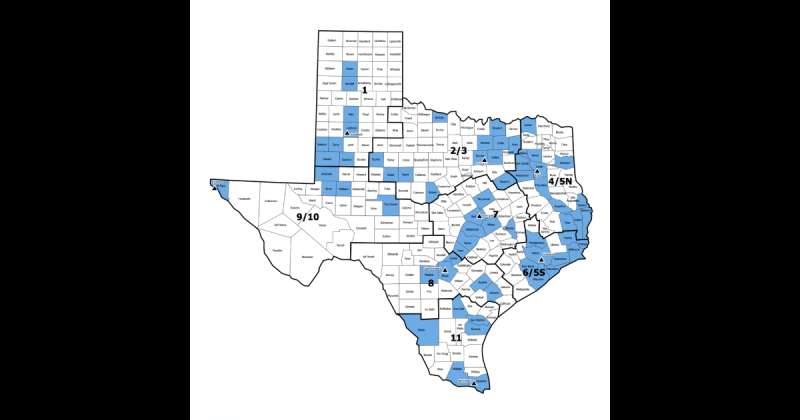
Nearly half of the 106 lab-confirmed Cyclospora cases reported statewide from early May through late July were reported in South Texas, according to information provided by Texas Department of State Health Services (DSHS) to Courier Texas.
Forty-eight of those cases were reported in an area stretching from Corpus Christi through the Rio Grande Valley. Another 29 were reported in the greater Houston area. Together, the two areas accounted for roughly 73% of cases.
The number of cases statewide isn’t unusual for this time of year. Where they’re showing up is.
“Cyclospora tends to be in different spots of the state from year to year,” Texas DSHS press officer Douglas Loveday told Courier Texas. “This year, Public Health Region 11 has had a higher proportion of cases than previous years.”
It’s not the first time South Texas has stood out. Dr. Juan Carlos Lopez-Alvarenga, a UTRGV School of Medicine professor and epidemiologist, told Courier Texas that Cameron County had the highest rate in the region during a major Cyclospora outbreak in 2019. But he cautioned against assuming South Texas’ climate or environment was responsible.
“Cameron County had the highest rate in our area in that year, but was not related to local environment, but to cluster of foods distributed,” Lopez-Alveranga said, noting that Cameron County imports large volumes of fresh products. “There is no evidence that is happening again in this area.”
So, what exactly is Cyclospora?
Cyclospora isn’t your typical stomach bug. It’s a microscopic parasite that causes an intestinal illness called cyclosporiasis. People become infected by consuming contaminated food or water.
Symptoms include watery diarrhea, fatigue, loss of appetite, stomach cramps, bloating and nausea. They typically begin about a week after exposure, though symptoms can appear anywhere from two days to two weeks or more later. Without treatment, the illness can last a month or longer and symptoms may disappear and then return.
The Texas cases come as federal health officials investigate a much larger multistate Cyclospora outbreak linked to recalled iceberg lettuce from Taylor Farms de Mexico. As of Aug. 5, the CDC reported 9,481 illnesses, 398 hospitalizations, and two deaths across 17 states in that outbreak.
The recalled iceberg lettuce was distributed to consumers, restaurants, and retailers in at least 27 states, including select Walmart stores under the Marketside brand and Taco Bell locations.
But there’s an important distinction: Health officials have not said that the recalled lettuce is responsible for South Texas’ unusually high share of cases. Federal health officials have been investigating multiple Cyclospora outbreaks and illnesses, meaning not every reported infection is necessarily connected to the Taylor Farms lettuce outbreak.
Why the numbers don’t always match
The reporting challenges come amid broader questions about the nation’s ability to track foodborne illness. CDC data show reported infections from several pathogens commonly transmitted through food were higher in 2024 than during the agency’s 2016-2018 comparison period, though improved testing may account for some of that increase. Meanwhile, the Trump administration’s CDC scaled back its FoodNet surveillance program in 2025, ending required active tracking of six pathogens, including Cyclospora.
Those concerns are getting fresh attention as the federal food-safety workforce shrinks. Reuters reported recently that FDA employment fell 22% between 2024 and 2026, while foreign food-facility inspections fell 13% in 2025. Food-safety experts told Reuters that recent outbreaks involving produce from Mexico highlight the challenges regulators face overseeing an increasingly interconnected US-Mexico food supply chain. There is no evidence that federal cuts caused the current Cyclospora outbreak, but experts have raised concerns that fewer resources could make foodborne threats harder to detect and investigate.
Cyclospora surveillance hasn’t disappeared, however. The parasite remains nationally notifiable, meaning states continue reporting cases to the CDC through a separate national surveillance system even after FoodNet’s requirements changed.
And even under the existing system, case counts don’t always line up in real time.
If you’ve seen different Cyclospora totals reported by local health departments, the state, and the CDC, it doesn’t necessarily mean one agency’s numbers are wrong.
Loveday said there can be a lag as cases move through local, state, and federal reporting systems. Investigators conduct detailed interviews with patients about potential exposures.
The CDC’s seasonal count also has additional requirements. Loveday said cases included in that count require a positive lab result and an interview to determine that Cyclospora was acquired domestically.
“The investigation forms are very detailed and time-consuming to complete, so that adds to some of the lag time as well,” Loveday said.
What Texans should know
For most otherwise healthy people, Alveranga said Cyclospora generally isn’t considered life-threatening. But prolonged watery diarrhea can become more serious for older adults, people with weakened immune systems, and those with limited access to medical care or adequate hydration.
His advice for South Texans is straightforward: Stay hydrated and seek medical attention if watery diarrhea persists or signs of dehydration develop.
“With another outbreak occurring, our response should focus on clear public information, adequate hydration, food safety, and timely medical evaluation when symptoms are persistent or severe,” Alveranga said.
Cyclospora can also be easy to miss. Testing for the parasite isn’t routinely conducted in most US laboratories, even when a stool sample is being tested for parasites. The CDC says healthcare providers may need to specifically request testing for it, so people with persistent symptoms should ask their healthcare provider about it.
The recalled Taylor Farms lettuce is already past its best-by dates and should no longer be available in stores or restaurants. Anyone who still has recalled lettuce at home should throw it away or return it. You should also wash anything that may have touched the lettuce with hot, soapy water.
Health officials recommend washing hands and rinsing fresh produce thoroughly before eating, cutting, or cooking. However, washing fruits and vegetables alone cannot guarantee that Cyclospora will be removed. Federal health guidance says cooking produce to at least 158°F (70°C) kills the parasite.
South Texas’ unusually large share of cases remains just that: a concentration, not evidence that something unique to the region is causing infections.
The Valley has seen a similar pattern before. But as both state health officials and Lopez-Alveranga caution, where cases appear—and what ultimately caused them—are two different questions.