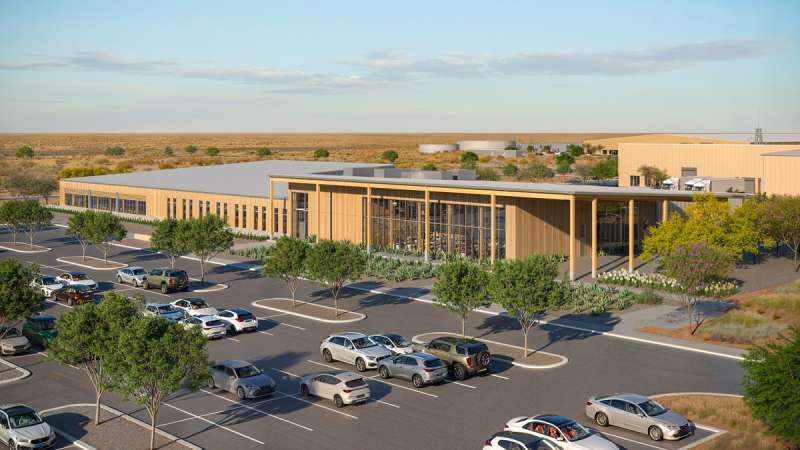
Reporting by Adam Powell, El Paso Times
Texans are growing increasingly wary of data centers cropping up in their communities.
A new poll from The Texas Politics Project found that 56% of Texans either opposed or strongly opposed the construction of an AI data center in their communities. By contrast, only 9% of respondents said they “strongly support” new data center construction, while 20% “somewhat support” new data centers and 16% had no opinion.
But even those numbers are not immune to a partisan divide.
Among Democrats, 71% oppose or strongly oppose the construction of a data center in their communities, with only 15% in support. On the other hand, Republicans were almost evenly divided on support or opposition to new data centers, with 42% supportive of data center construction in their communities and 44% opposed. Among Independents, 62% opposed data centers in their communities and 17% supported them.
Texans in rural or suburban areas, where current or planned data center construction is more prevalent, were overwhelmingly opposed to new data center development. These areas are strong political bases for Texas’ Republican Party.
Sixty-two percent of rural Texans opposed data centers, with 50% strongly opposed, compared to only 22% in support. The numbers were similar among suburban Texans, with 60% voicing opposition and 25% offering support. In urban areas, 45% were opposed versus 36% supportive.
AI skepticism
When it comes to the rise of artificial intelligence (AI), most Texans expressed “a significant degree of skepticism” about its potential for positive impact, the poll found.
Nearly half of Texans expect AI to negatively impact the economy compared to only 29% who expect a positive impact. 5% of respondents said AI will have no impact and 17% expressed no opinion on the topic.
Among Democrats, 61% expect a negative impact on the economy because of AI while only 21% expect a positive impact. Republicans are closely divided on the issue, with 38% expecting a positive impact and 40% expecting a negative impact. Only 15% of Independents expect a positive impact.
Young voters, between the ages of 18 and 29, were the most optimistic, with 50% expecting AI to have a positive impact on the economy versus 38% who expect a negative one. At the other end of the spectrum, 58% of voters 65 or older expect AI to have a negative impact on the economy compared to only 18% who expect a positive impact.
What is a data center?
A data center is a continuously operating facility that houses computing infrastructure, servers, storage systems, networking equipment to store, process and manage digital data for businesses, cloud services and other applications.
How much water does a data center use?
The average 100-megawatt data center consumes around 2 million liters of water per day, the equivalent of 6,500 U.S. households. Larger data centers, such as the one being planned in El Paso, can consume up to 5 million gallons each day.
Adam Powell covers government and politics for the El Paso Times and can be reached via email at apowell@elpasotimes.com.
This article originally appeared on El Paso Times.
Related: Texas-based companies dominate list when it comes to customers’ power shutoffs