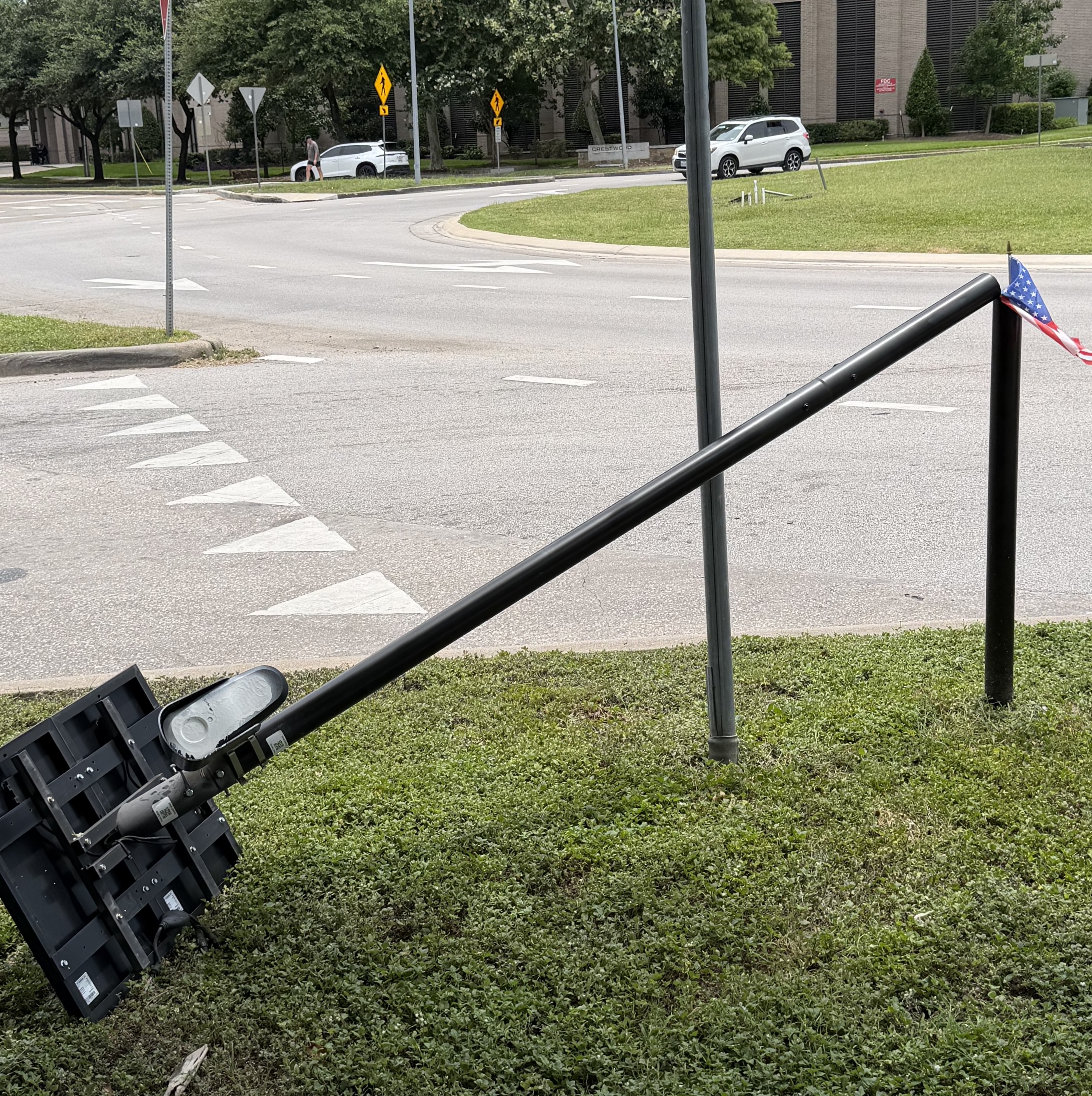
On the morning of the Fourth of July, two Flock surveillance cameras lay on the ground near a roundabout in central Houston—they’d been knocked down and spray painted white, and the pole that held one was stuffed with an American flag.
A few days later, two more cameras were found broken at Memorial Park.
“I think [the vandals] are sending the message of the right to life, liberty and the pursuit of happiness,” said local barista Angele Smith.
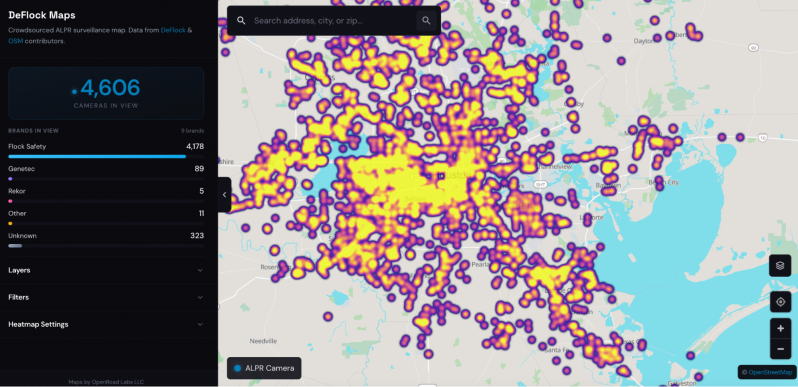
But has the city of Houston received the message? It just renewed its contract with the ultra-thorough security camera company, Flock Safety, in the spring—an $869,000 investment in the operation of its 3,800 cameras spread across the city. Houston leads the nation in Flock camera usage, relying on the cameras more than other cities during a police staffing shortage.
Local residents are well aware of how surveillance is a part of American life.
Chris Alan owns Memorial Trail Ice House, a bar that sits on the same street the dismantled cameras once surveyed. He says he has come to assume he’s being watched when moving through the city.
“The moment you step out of your house, you’re on somebody’s camera, whether it’s a Ring Door[bell] Camera, a camera on somebody’s building, or a grocery store camera—you’re being watched,” he said.
But Houston didn’t add just any old porch cameras to its landscape when it signed its initial multimillion-dollar agreement with Flock Safety, it opted for the most intrusive on the market.
Flock Safety differs from standard camera companies in that it partners with law enforcement. A representative of the Flock sales team said they’ve even gone on police ride-alongs to witness its use in an official law enforcement capacity.
Unlike a typical doorbell camera, Flock cameras use AI to collect photo and video footage of license plates and people—the cameras even automatically zoom-in to see what you’re doing on your phone—then, they upload that information to a cloud system. That data can be accessed by Flock Safety, police officers, and anyone who purchases and installs a Flock camera.
Short-range devices like Ring cameras, on the other hand, aren’t designed to pick up the same identifying data. With limited zoom potential, these cameras are meant for alerting residents when someone comes to their door. Customers are typically provided limited coverage of motion-detection around the device, a common complaint of homeowners.
Flock cameras can also be purchased by private customers and individuals, enabling them to search for records of cars that passed by, down to the make and model.
“Now it’s just behind a paywall. If you have enough money or are powerful enough, you [can] grow your power and can exploit people without them knowing,” said Smith, who sees these subscriptions as a pay-to-view of people’s personal data.
Stopping crime or creating it?
Juan “Johnny” Rodriguez, who owns SPAR Houston, a local boxing gym near the recently disarmed cameras, said that for business owners, the cameras act as preventative measures against potential crime.
Flock Safety reports that 700,000 crimes are solved annually using their cameras—that’s roughly 10% of all reported crime in the United States. The Harris County Sheriff’s Office said the Flock camera network was crucial in recovering two kidnapped children in the city. But not all Houstonians are comfortable with Flock’s police partnership.
Steve Baker, an employee of a local business on Washington Avenue, said,
“Think about the people that aren’t doing anything wrong and their data gets collected, like people [targeted by] ICE. I don’t like that they could go find out where [those people are] and pick [them] up.”
Similar criticism of Flock cameras has gone viral for misuse by police officers.
The Johnson County (Texas) Sheriff’s Office used data from over 83,000 Flock cameras across the country to track down a woman they suspected of having an abortion.
In Pasadena, a Houston suburb, a police sergeant resigned in July after a Flock camera caught him tracking and stalking a female officer.
Inside Houston city limits, Flock cameras are currently being used to track down undocumented immigrants on behalf of ICE’s Enforcement and Removal Operations division.
Residents in Austin successfully stopped their city’s Flock program after a sustained, two year-long campaign by a coalition of activist groups against the use of the cameras.
Where Flock programs aren’t discontinued, they’re disarmed. In Bandera, Texas, after the city installed Flock cameras in early 2026, residents repeatedly cut them down. The city replaced them three times only to have them removed each time. Bandera finally terminated its contract with Flock just 10 months after launching the program.
“We should get rid of them, like Austin got rid of them, or at least turn them off. It’s governmental overreach,” said Smith, who wants Houston to end the surveillance program.
A Harris County Commissioners Court meeting was held on July 9 and a potential amendment to Houston’s contract with Flock cameras was addressed. Amendment 253 proposes expanding use of Flock cameras to be county-wide, increasing surveillance across Harris County and the Houston metroplex. Activists urged members of the public to testify at this meeting and to email or call their commissioners.
Residents can testify at city meetings to raise concerns about Flock cameras. Activists put together a toolkit to instruct Houstonians on how to write and call their local officials. The next meeting where surveillance technology will be discussed is set for July 21 at the Harris County Administration Building.