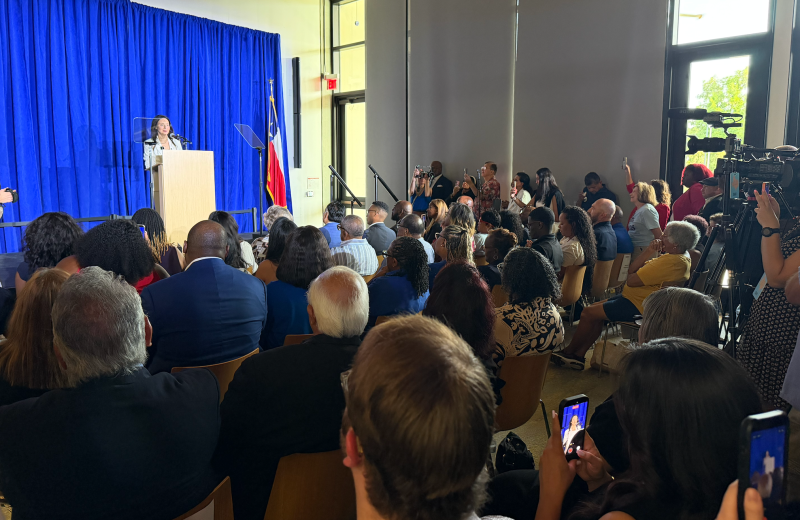
Sixty one years ago today, President Lyndon B. Johnson signed the Voting Rights Act into law, reshaping access to the ballot box across the country. On Wednesday evening, Texas Democratic candidate for governor Gina Hinojosa stopped in Houston to commemorate the anniversary and reflect on the law’s legacy. She told attendees the fight to protect voting power, including ongoing battles over gerrymandering, remains central to Texas’ future. Her visit underscored how the principles behind the Voting Rights Act continue to shape the state’s political landscape.
“The Voting Rights Act never guaranteed victory to anyone,” she said. “It guaranteed the right of the people to decide. That is the oldest idea there is in America. When that right is defended, ordinary lives change. Because nothing good in this country ever came from powerful people waking up one morning deciding they felt generous that morning.”
She added: “Social Security came because they had the votes. Medicare came because we had the votes. First we won the vote, and then we won better lives.”
Hinojosa said Texas accounts for nearly 10% of seats in the US House, giving the state outsized influence in any redistricting fight.
“Erase 10 Democratic seats in Texas, and it is over. No Democratic majority in Congress, not for just an election cycle, likely for a generation. Texas becomes too big. The math no longer works.”
US Rep. Christian Menefee (D‑TX) experienced first hand how gerrymandering can affect Black and Brown communities.
“It should be both Christian Menefee and Al Green in the House of Representatives. But that was stolen away from us. That was stripped from our communities,” said Menefee. “Republicans were chomping at the bit to be able to go and redistrict, gerrymander, redraw their maps so that communities of color aren’t allowed to elect a candidate of their choosing.”
The stakes Hinojosa described are not hypothetical.
The Supreme Court has methodically dismantled the Voting Rights Act over more than a decade—first in Shelby County v. Holder in 2013, which eliminated the preclearance requirement that forced states with histories of voter discrimination, including Texas, to get federal approval before changing their election laws. Then in Brnovich v. Democratic National Committee in 2021, which made it harder to challenge voting restrictions under Section 2.
The final blow came on April 29, 2026, when the court ruled 6-3 in Louisiana v. Callais that states can use race as the basis for gerrymandering as long as they don’t explicitly state their discriminatory intent—effectively gutting Section 2 of the Act entirely. Legal scholars called it “the final nail in the coffin” of the Voting Rights Act. Chief Justice John Roberts had been working toward this outcome since he was a young attorney in the Reagan administration.
Meanwhile, Trump requested that Texas redraw its congressional maps mid-decade—outside the normal post-census redistricting cycle—with the explicit goal of flipping five Democratic House seats to Republicans. A Trump-appointed federal judge found the resulting maps were drawn to intentionally dilute Black and Latino voting power. The Supreme Court allowed them anyway.
It’s in the face of this, then, that Hinojosa said Wednesday night any path to long term congressional control must account for Texas’ outsized role, arguing the state’s political map will shape national representation for years. She said Gov. Greg Abbott—who has launched redistricting wars in earlier cycles after those key provisions of the Voting Rights Act were rolled back, is preparing another round next year.
“Republicans in Austin who have run Texas for 30 years have already told us what they will do next,” said Hinojosa. “Next year they will slice up the state to erase five Democratic seats in Congress. Two years after that, Texas will gain five more seats from the census.”