Texas Republicans didn’t just hold their primaries last night. They issued a verdict on who they are.
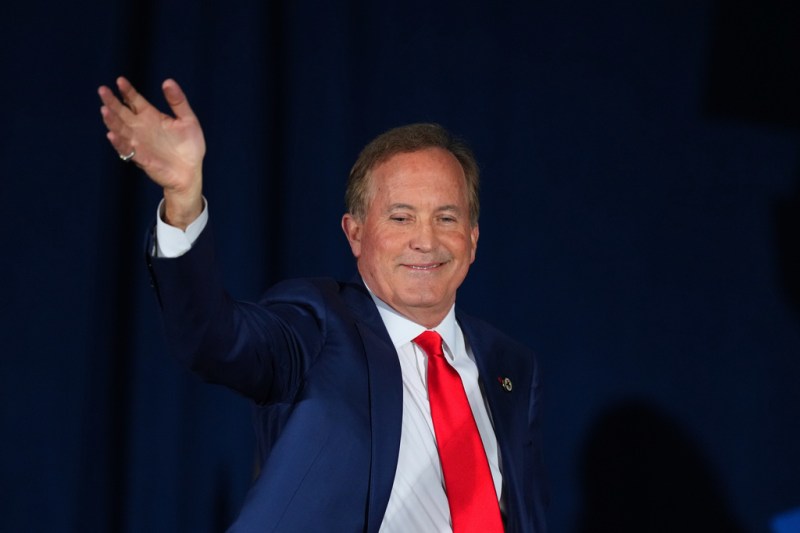
The results were unambiguous. Ken Paxton—impeached by his own party, investigated by the FBI—is the state’s Republican nominee for United States Senate. Mayes Middleton, a self-funded oil heir who has virtually no courtroom experience and spent $16 million calling himself “MAGA Mayes,” is the Republican nominee for attorney general. Bo French—a candidate who asked his social media followers to vote on whether Jews or Muslims pose “a bigger threat to America”—is the Republican nominee for railroad commissioner, having defeated an incumbent endorsed by Texas Gov. Greg Abbott (R). In each race, the candidate most aligned with Donald Trump’s brand of politics won. In each race, experience, institutional support, and establishment credibility lost.
The message from Texas Republicans could not be more clear: MAGA is not a moment. It is the party.
Start with Paxton, because his story is its own chapter in the history of Texas political impunity. He was indicted on three felony securities fraud charges in 2015, just months after taking office. Eight of his most senior aides reported him to the FBI in 2020, accusing him of bribery and abuse of office for allegedly misusing the power of his office to benefit his friend and political donor, Austin real estate developer Nate Paul—who also employed a woman with whom Paxton acknowledged having an extramarital affair. The Texas House voted 121-23 to impeach him in 2023 on articles including bribery, obstruction of justice, and abuse of public trust—a vote led by Republicans. The Texas Senate acquitted him. The Justice Department declined to prosecute him in the final weeks of the Biden administration. Four of the whistleblowers who reported him won a $6.6 million judgment against his office—paid for by Texas taxpayers.
That is the man Texas Republicans have chosen to send to the US Senate. He beat a four-term incumbent who voted with Trump, as he reminded voters over and over again in his ads and appearances over the course of his campaign, “99% of the time.” John Cornyn was not insufficiently conservative. He was insufficiently loyal. When times were tough and Trump was being impeached, and the Jan. 6 investigations were at full heat, Cornyn was slow to genuflect. Trump remembered. One Truth Social post, and the institutional senator of 24 years was done. The race wasn’t close.
The Paxton primary is a case study in what Republican politics in Texas has become. Loyalty to one person is not a supplement to policy. It is the policy. As Van Jones lamented on CNN after Paxton’s victory last night, “The bad man won.” That’s oversimplifying it. Despite their personal and stylistic differences, both Paxton and Cornyn’s outcomes in the Senate would likely have been the same. But the political signal the choice sends is clear.
Mayes Middleton follows the same template, applied to the attorney general’s race. Middleton, one of the most conservative members of the Texas Senate, is an oil and gas executive who graduated from law school but—as his opponent frequently pointed out—has virtually no courtroom experience, having worked exclusively within his family’s energy company. That opponent, Chip Roy, was a former federal prosecutor, a former first assistant attorney general, and a former chief of staff to Ted Cruz. Roy is a man who had spent his entire career inside exactly the institution he was seeking to lead. Roy had an almost perfect record of voting alongside the Trump agenda and had personally worked with the president to carry legislation on his behalf. His ads for the race talked more about Trump than his own record. It wasn’t enough. Middleton hammered Roy as being not sufficiently loyal to the President and for saying Trump had committed “clearly impeachable conduct” on Jan. 6 on the House floor. That apostasy plus other past clashes between Roy and Trump were sufficient to doom him. “MAGA Mayes“—self-branded, self-funded, self-described—won by 11 points.
Middleton has vowed to be the ideological successor to Paxton, casting himself as a culture war combatant first and the state’s top lawyer second. He faces Dallas State Sen. Nathan Johnson, a civil lawyer, in November. Johnson has promised to restore the AG office’s non-partisan functions—child support enforcement, consumer protection—and to stand with blue-state attorneys general in pursuing litigation against the Trump administration. What Middleton has promised is to “defeat the left,” calling it “the number one most important thing we have to do.” In an office as powerful as Texas’ AG, that is not an abstraction. Paxton used it to investigate political opponents, sue doctors, force a $10 million settlement from the state’s premier children’s hospital, and file one hundred lawsuits against the Biden administration. Middleton has indicated he intends to do more of the same.
Then there is Bo French, who will now regulate the Texas oil and gas industry—arguably the most consequential economic role in state government—despite never having held public office and having spent the campaign demonstrating that he is unserious about the job he is seeking.
First, what the Railroad Commission actually does: despite its name, it has not regulated any part of the railroad industry since 2005. What it does regulate is Texas’ oil and gas sector—an industry that generated $27 billion in revenue last year—overseeing pipelines, drilling permits, natural gas facilities, and the infrastructure that keeps the state’s electrical grid supplied with fuel. It is, in short, one of the most consequential regulatory bodies in the state. After the 2021 winter storm killed 246 Texans and caused billions in damage, the Railroad Commission became the center of the debate over whether Texas’ gas infrastructure had been properly maintained. French’s answer to that history is to talk about Islam.
French drew condemnation from fellow Republicans for his social media activity that referred to political opponents by using slurs for gay people and people with disabilities as well as instructing followers to vote on whether Jews or Muslims pose “a bigger threat to America.” At the Conservative Political Action Conference (CPAC), he called for the deportation of 100 million people—nearly a third of the country—including legal visa holders and US citizens who “call for the overthrow of our Constitution,” adding, “That’s the only way we’re going to stop the Islamification of Texas.” He nicknamed his incumbent opponent “Jihadi Jim.” Gov. Greg Abbott endorsed and campaigned with the incumbent. Lt. Gov. Dan Patrick (R) distanced himself from French over his comments. Harlan Crow and Miriam Adelson—two of the biggest donors in the Texas Republican Party—backed the incumbent. None of it mattered. French was backed by Paxton and by megadonor Christian white nationalist billionaire pastors Tim Dunn and Farris Wilks, and he won.
An April University of Texas/Texas Politics Project poll found a majority of Texas voters disapprove of Trump’s handling of the economy, and that Texans’ views of the economy have turned sharply negative since the Iran war began. Trump’s national approval numbers are at historic lows. Gas prices are up more than 30% since February. In Texas, restaurants are closing, construction is slowing, and farmers are getting squeezed. None of that moved the Republican primary electorate.