Chinese immigrants once faced sweeping restrictions in the United States, including alien land laws in 15 states, bans on citizenship, limits on employment and exclusion from public schools. Those measures culminated in the Chinese Exclusion Act of 1882, which blocked immigration from many Asian countries for more than eight decades.
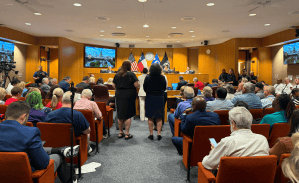
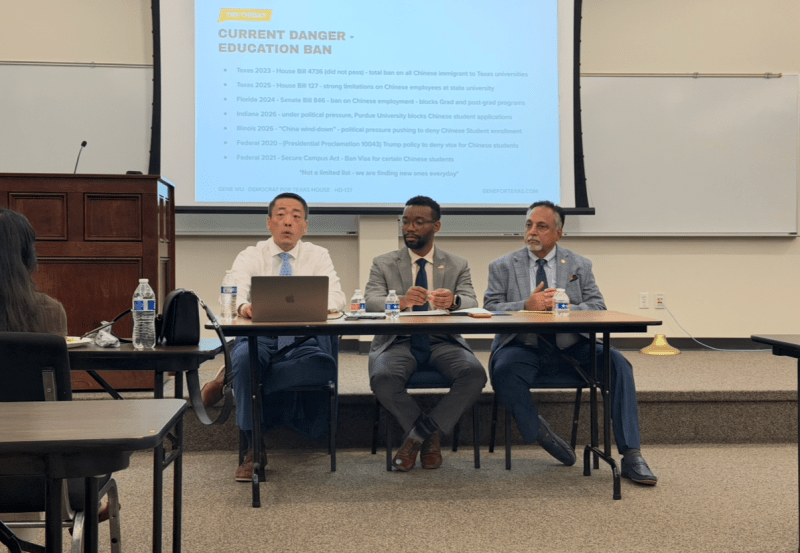
At a town hall in Fort Bend County Tuesday night, three Texas Democratic legislators warned a crowd of diverse families that the same playbook is being run again.
“Ultimately at the end of the day they’re the same attack and for the same reasons,” said state Rep. Gene Wu, who represents House District 137. “Silence isn’t an option when hate becomes state policy. Texas families are watching their neighbors get targeted, their kids questioned in classrooms, and their communities painted as threats, simply for existing here.”
The warning comes as 30 states have passed 58 bills restricting foreign property ownership since May of this year, with 331 of the 525 bills introduced—63%—including provisions that prohibit or restrict Chinese citizens from owning some form of property since 2021. In Texas, that push has already become law. Senate Bill 17, passed during the last legislative session, restricts property purchases by citizens of China, Iran, North Korea, and Russia.
Amatullah Contractor, a local organizer present at the town hall, also pointed to Senate Bill 17, saying the measure echoes early 20th‑century alien land laws and contributes to a climate of suspicion toward immigrant communities.
Wu said these efforts amount to “a warning” for East Asian, Muslim American, and South Asian communities.
The alien land restrictions are one strand of a broader set of proposals that Wu, Fort Bend County Commissioner Dexter McCoy, and state Rep. Suleman Lalani described as converging on AAPI communities. Additional proposals seek to end birthright citizenship, limit H-1B visa holders from working in state agencies and universities, restrict participation in academic research, and tighten visa access for Chinese nationals.
Trump’s 2025 executive order to reinterpret the 14th Amendment—which would have ended birthright citizenship—was rejected by the Supreme Court in a 6-3 ruling in late June of this year. Trump has since said he will try again. Wu warned the effort would disproportionately impact Asian American families who rely on long-standing constitutional protections.
Contractor noted the political stakes for Texas. “Texas is home to more than 1.2 million eligible AAPI voters, representing 5.4 percent of the electorate,” she said. “Many of those voters live in districts that will play a decisive role in upcoming elections. We are the margin of victory in the state. And instead of being welcomed, we are being treated as threats.”
McCoy, who grew up in Louisiana during the Civil Rights era, drew a direct line between that history and the present moment. “When Republicans go after birthright citizenship, it’s up to all of us to lock arms and celebrate that we are a community of immigrants, a state of immigrants and a nation of immigrants,” he said. “Because evil thrives in silence and darkness, we’ve got to shine a light.”
Lalani, who represents House District 76, said Islamophobia has become both a social and policy issue, pointing to recent incidents involving threats, vandalism and violence at mosques, and community centers, as well as recent debates at the State Board of Education where members criticized aspects of Islamic faith traditions. “It’s the same playbook, different subject matter,” he said. “When the party in power for 13 years fails on their policies and doesn’t have the right answers, they turn to distraction. They create division, they create fear, and they demonize communities, scapegoating different groups in the process.”
At a town hall in Fort Bend County Tuesday night, Texas leaders Rep. Gene Wu (D‑137), Commissioner Dexter McCoy (D‑Precinct 4) and Rep. Suleman Lalani (D‑76) warned a crowd of diverse families that discrimination tied to voting, immigration and Asian American and Pacific Islander (AAPI) identity is rising statewide. They said the trend mirrors historic exclusion laws and is now reflected in modern proposals across the country, including revived alien land restrictions, limits on visas, and efforts to end birthright citizenship.
34 states have introduced or passed updated versions of alien land laws that restrict property ownership by citizens of certain countries, including China. Additional proposals seek to end birthright citizenship, limit H‑1B visa holders from working in state agencies and universities, restrict participation in academic research and tighten visa access for Chinese nationals.
State Rep. Gene Wu, who represents House District 137, said these efforts amount to “a warning” for East Asian, Muslim American and South Asian communities.
While the policies may appear different on the surface, he said, “ultimately at the end of the day they’re the same attack and for the same reasons.”
The fight over birthright citizenship has escalated in recent years. Trump’s 2025 executive order to reinterpret the 14th Amendment was rejected by the Supreme Court in 2026, though only six justices agreed. He has since said he will try again. Wu warned the effort would disproportionately impact Asian American families who rely on long‑standing constitutional protections.
“Silence isn’t an option when hate becomes state policy,” said Wu. “Texas families are watching their neighbors get targeted, their kids questioned in classrooms, and their communities painted as threats, simply for existing here. I want our communities to know that we must unite to push back against these racist culture wars and protect the civil rights every American is entitled to.”