Punching In is a bimonthly series about the people who make Houston work, highlighting interesting jobs, industries, and careers across the city.
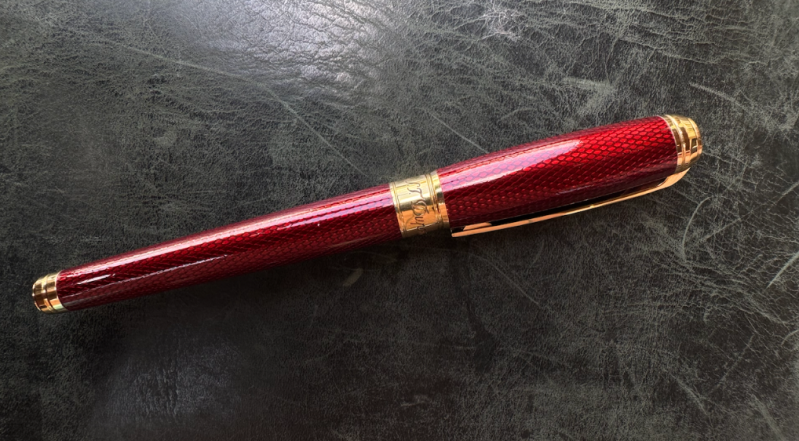
For a niche group of Houston collectors, pens are a gateway to connection, acting as an escape to the analog from the onslaught of technology. This hobby has been popularized in the US since the early 20th century, attracting enthusiasts because pens can be as unique as a person’s handwriting—they come in varying shapes and colors, and can even be made with precious metals and stones, like gold and diamonds. The fine pen industry has carved out an emerging community of collectors, aficionados, and artists in Houston, with dedicated stores like Dromgoole’s, clubs like Space City Pen Club, and a growing desire among younger fans to turn from the digital life to slower, more analog ways of living.
With newer generations experiencing technological oversaturation from constant exposure to screens and social media, pens offer a respite from the immediacy and overwhelming urgency of today’s digital age. These young people are turning to fountain pens as tools for journaling with self-regulation, as opportunities to carve out intentionality through craft, and as vehicles for collective connection and identity formation.
Peyton Vasquez, a Pasadena local and 24-year-old pen hobbyist, describes himself as an “amateur nibmeister,” or specialized artisan who repairs, tunes, and custom grinds the tips of fountain pens—or “nibs.” Vasquez, who previously worked at Dromgoole’s, has been interested in fountain pens for 13 years, and is now fixing pens on the side—for a decent price. Fine pen repair can cost anywhere from $60 to $150 or more from someone whose full-time job is to be a nibmeister. Vasquez has become vital to the local pen community for doing these repairs for as low as $20 in his free time—skills he learned from trial and error.
“ I help out people who really need the repairs, and I try to set good rates. I want this hobby to be accessible for people who aren’t able to afford those higher-end pens,” said Vasquez.
Some of those people who might not be able to afford steeper prices are younger collectors getting into this hobby for the first time, like students. It’s younger generations, like Gen Z, that are driving the pen industry right now.
“When I first got started in fountain pens, it was hard to find somebody that wasn’t 60 years old or older, but now you find people that are 20—or even the youngest I’ve seen is 5-years old—getting into fountain pens,” Vasquez said. “It’s this huge variety of people that are wanting to get into this hobby.
“ Young people want something to do away from technology. There’s been a huge push away from technology, away from AI stuff where young people just want to do their own thing,” Vasquez said.
One of the local places that pen enthusiasts—new and old—congregate is Space City Pen Club, Houston’s largest and primary fine pen club. Formerly known as Lone Star Pens, Space City Pen Club was taken over by Penelope and Mark Goode in January of 2020, and has changed a lot over the years.
”When I took over, it was the Lone Star Pen Club, and it was the old white guys’ club, and it met every other month on Wednesday night at a barbecue joint, and I was getting really frustrated,” said Mark Goode. “It really came down to what does the future look like and who should the future involve? And when I was looking around, I saw that the majority of people attending were old white guys because it’s a hobby of affluence. But that is changing. Fountain pens are getting cheaper or at least there’s cheaper options, and so that’s already inviting more people in.”
The Goodes have since worked to make Space City Pen Club a site of inclusivity, diversity, and unity. The turning point for the club was the murder of native Houstonian George Floyd and Houston’s subsequent Black Lives Matter rallies, when the Goodes decided to put out a letter to the club members reaffirming their support for the growing movement against anti-Black violence.
Since then, their club has grown in size and makeup, with every monthly newsletter ending in a statement titled “unity through diversity,” where the club reiterates its commitment to connecting people from different backgrounds over a shared interest: pens.
With a newsletter audience of 530, people attend Space City Pen Club from around the world. One Houstonian moved to an entirely different state, yet keeps coming to the regular Zoom meetings. Mike Green, a former West University resident, left for Minnesota, but never abandoned the Houston pen community.
“ Somehow it’s never enough. It seems like I could talk about pens all day long with these people and be back the next day,” said Green. “We have a similar interest in pens and we’re constantly learning from each other.”
Green regularly attends pen shows across the country, and is gearing up to travel to the Dallas Pen Show this fall. One thing he’s noticed is the changing crowds at these events.
“Twenty years ago, it was mainly white-haired guys sitting around at their tables trying to amass big collections. And those people are still there, but now they’re the minority. The vast majority of people are much younger, and they’re getting into stationery and buying new pens,” said Green. “ Some people say it’s the analog versus the digital. You have your screens, you have your digital life, but there’s a lot of people that want that analog life as well.”
Penelope Goode has also noticed an increase in younger pen hobbyists in the club, a development she attributes to pushback against AI.
“Gen Z is the one most affected by the rise of AI. They’re looking for ways to counteract some of those negative effects,” said Goode. “Something like a pen where you’re writing it down yourself and it can’t be faked is a way to push against some of this stuff.”
Studies have shown that Gen Z’s distaste for AI is increasing year by year, and while many agree it has utility, there is concern over impacts on learning, trust, the job market, and career readiness. Indeed, analog hobbies have seen a major comeback in 2026 as ‘doomscrolling”—endlessly scrolling social media—is being left by the wayside.
This push away from technology and toward person-to-person interaction has fostered a sense of community in Houston, with pens sitting at the heart of a growing collectors’ space.
“Everybody wants connection and authenticity, and we’re not finding it in the digital scape that we find ourselves in. It’s all about the other people, and the pens are ultimately just what allows that conversation to get started,” said Mark Goode. “It’s not for the pens themselves. It’s for journaling and self-discovery. It’s for writing letters and staying connected.”