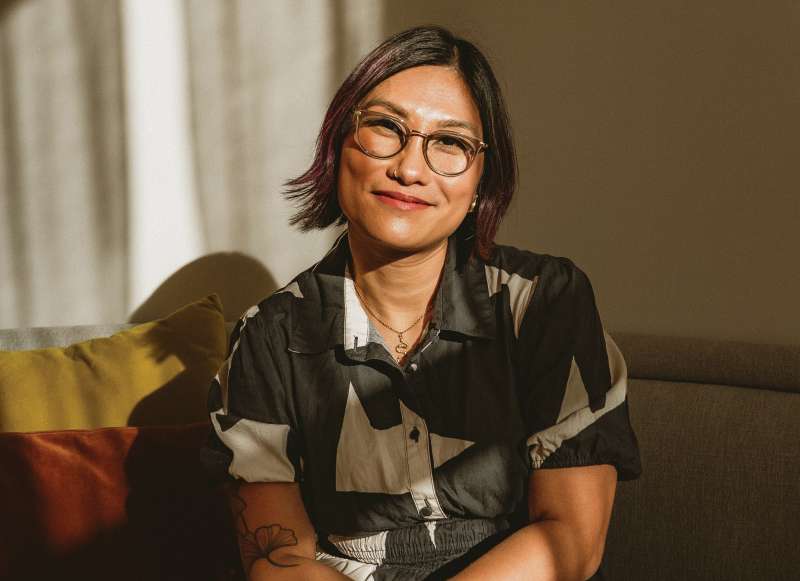
Dr. Han Ren knows exactly what it’s like to have a family fractured by political and ideological differences.
She hasn’t learned of this struggle solely through her clients as a clinical psychologist focused on anti-racist and anti-oppressive care. She’s lived it herself.
Ren’s mother, a Chinese immigrant who was apolitical for decades, became a MAGA and QAnon believer who has blamed everyone from Muslims to trans people for the issues in the US.
Given Ren’s life and work, it’s a painful contradiction, but she says her experience is far from rare.
“This is common, so common, and there’s so much anguish and it’s painful,” she said. “ I wish my mom was different. I wish I had a different relationship there and I could talk to her in a different way.”
As Americans brace for another Election Day—and the celebrations, disappointments, and arguments that are sure to follow—Ren’s experience is an increasingly familiar one.
Ahead of the 2024 election, an American Psychiatric Association survey revealed that 31% of Americans anticipated having heated political discussions with their families during the election, and 21% of people were already feeling estranged from a family member because of politics. This year, a University of California-Irvine study pointed to an increase in “political breakups,” with 18% of respondents saying that the 2024 election was the catalyst for at least one of their relationships ending.
Ren, an Austin-based practitioner and author, has been working through the issues with her mother since the 2016 election.
As her newly retired mother began spending more time isolated at home, Ren says WeChat conspiracy theories and pro-Trump church sermons became increasingly influential in her life. At the same time, Ren was becoming more deeply involved in anti-racism and liberation work. The two grew further and further apart.
”There (have) been plenty of times in my relationship with my mom that I’ve considered no contact or that she’s even considered that with me,” Ren said. “And in those times, we have had months where we didn’t talk, and we just took breaks from each other.”
Eventually, Ren decided to use this challenge to strengthen her work. At the start of the COVID-19 pandemic, Ren, like so many others, started recording videos in her backyard. She began teaching her social media audience about relationship dynamics and therapeutic practices while sharing her views as a first generation American navigating the intersection of her psychology work and the conflicts within her own family.
She built a following on TikTok and Instagram in part off the relatability she says is central in liberation psychology.
Some followers are surprised to learn that through the hurt, Ren still has a relationship with her mother, while others understand and want to learn similar coping mechanisms.
“ I have deep collectivist roots. I was raised in a Chinese household where we just don’t do that,” she said. “ I could accept who she is and I don’t have to let it impact my decisionmaking, how I live, and what I wanna do, as deeply. And because of that, I got to actually see the relationship mature and grow.”
Here’s Ren’s advice for navigating complicated feelings around election outcomes and the relationships that can suffer because of them.
How to cope with disappointment over election results
Ren said managing disappointment over an election outcome is all about giving yourself space to grieve while still finding joy.
“I think we are terrible at grieving as a society,” Ren said. “When we’re not grieving, we get stuck. We get stuck in the energy. We get stuck in the ruminations and the despair of it all.”
Grieving might include taking a break from the news and spending some time off social media. It could also be as simple as resting, going on walks, making art, or finding another outlet that helps you process what you’re feeling.
Finding joy again might involve some of those same activities, along with spending time with like-minded people.
“ We still gotta live within the system as we’re dismantling it, so save your energy,” she said.
How to manage a relationship with political differences
For Ren, continuing a relationship with her mother was less about changing her mother and more about changing her own reactions.
“I’ve continued to do my own healing work with my own therapy and my own community and building my chosen family to a point where the weight of her words were not as heavy,” she said.
Ren had also watched her mother endure an abusive relationship with her grandfather. When her mother eventually cut him off, Ren said, it didn’t resolve everything her mother was struggling with.
“ Her life was ostensibly easier, but it wasn’t more free. She just found conflict in other places,” Ren said. “ You have to heal yourself in order to truly be free from the grips of external pressure and expectation.”
Ending relationships when political differences are too different
Sometimes, maintaining a relationship no longer feels possible. If you decide to end one, Ren said, that doesn’t mean the grief disappears with the person.
She recommends accepting that the relationship and its loss are now part of your experience—and allowing yourself to be sad about that.
Much like processing an election outcome you didn’t want, Ren said you’ll have to let the grief metabolize in your body. Later, you can decide to let that grief inspire you.
”Let grief change you. That’s what it’s supposed to do,” Ren said. “It’s love that has nowhere to go and also everywhere to go.”