When Rice University alumni Amy Lin and Lulu Fang opened Honey Art Cafe in 2016, the goal was to build an unconventional way for artists to earn a living—and it worked. For nearly nine years, Honey Art Cafe hosted artist workshops where local artists taught classes, like intro to embroidery. The shop served drinks and baked goods and welcomed visitors in the heart of Houston’s Montrose neighborhood. But after a popular coffee shop chain moved in next door, everything changed.
Independent restaurants and cafes—places that can’t compete with chain prices—are struggling to keep up with rising costs. Bigger chains often have the ability to navigate this change by absorbing increasing rent prices and food costs, whereas smaller, independently or family-owned businesses struggle to do the same. Small business owners in the Montrose and Rice Village areas say that rising rent costs and lease issues are common struggles for them, with many popular neighborhood spots facing closures this summer.
When finances aren’t the problem, Houston’s parking issues are. Limited parking spots mean a loss in customers, and that’s enough to tank a business.
So, when a popular chain moved into their already-packed strip mall, Lin knew she’d have to move to keep her business alive.
Now, just a few blocks from West 19th Street, the new Honey Art Cafe venue is open and breathing easier—for now. I sat down with Lin to talk about what pushed her out of her old space, the challenges of being a small business owner in Houston, and her vision for the cafe.
This interview has been edited for length and clarity.
Anna Raj: Your social media is so refreshing because you’re talking about the realities of being a business owner. Can you tell me about what made you want to share that with the world?
Amy Lin: It helps because when you’re offering a product that’s a little bit weird or new, you have to explain yourself and give people the opportunity to understand what they’re getting into.
It’s weird that it’s called a cafe when you have to book an appointment. One of the reasons why I changed from walk-ins to sessions is because everybody used to come in at the same time. We had a really hard time with that because there were only so many seats and people weren’t just drinking a coffee or eating a meal—they were making art. I didn’t know if they were going to be there for 30 minutes or if they were going to be there for five hours.
So it’s a little different, and I’m trying to format it in a way that’s simpler to people. It’s not super cheap, but it’s not expensive. Once you pay and come in, everything is unlimited. Raid the fridge, it’s yours while you’re here. I’m trying to provide a place that is the most accessible it could be.
Raj: Tell me about your recent move.
Lin: Anybody who’s been to the old location knows that the parking’s super cramped and it’s really hard to get in and out. We had a lot of struggles with the landlord, as well as the neighbors that moved in next door. It was a constant uphill battle.
Raj: Did the new neighbors worsen parking struggles?
Lin: Once La La Land opened, all of their customers were parking in our lot. Our parking lot was completely filled. We were getting bad reviews because people’s cars got towed, even though we didn’t call the tow company—it’s the landlord’s towing company. It was a constant fight every single day and a huge headache.
Raj: Were you the only business negatively affected?
Lin: It wasn’t just the business residents. We knew a couple of the people that lived on the street right next to La La Land and they were all having a really bad experience. Customers were parking all up and down the street. Residents were telling me, ‘our trash isn’t getting picked up. People are blocking my car into my driveway.’ One of the ladies that lived there told me, ‘I’m trying to leave to take my dog to the vet, and this guy’s just blocked me in and I can’t leave.’
Raj: What has your experience been like as a small business owner?
Lin: The business is kind of like your baby. Don’t come for me, people who have children. It’s similar in that you’re investing a lot of time, energy and resources into it.
When we first started building the shop, it was about building a way for artists to make money and earn a living that was a little bit different than everything else. Now, I’d really love to bring back the shopkeeper, where it’s a solo owner and manager. If you go there, it’s always them.
Raj: What’s it like being that familiar face that every customer knows?
Lin: At the old location, we had other employees so I rarely dealt directly with the customers. In the new place, I get to talk to the people more and help them with their artwork.
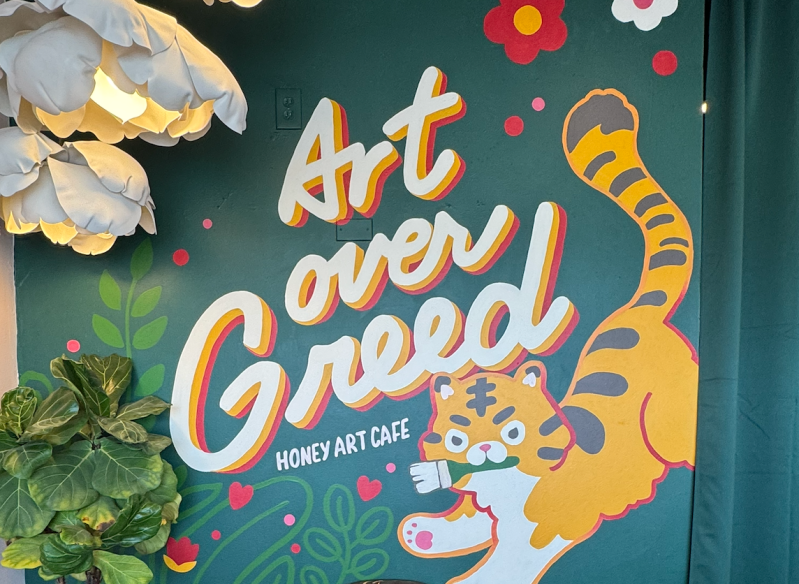
Raj: What do the words on the shop’s mural mean and why did you choose a tiger?
Lin: It’s not actually a tiger, it’s an orange cat who paints on his own little stripes. With the words ‘Art Over Greed’, I’m saying that I was trying to continue this little art shop in the face of franchises and landlords trying to ruin my life, not to be dramatic. That was kind of top of mind for me, as well as the spirit of running the shop.