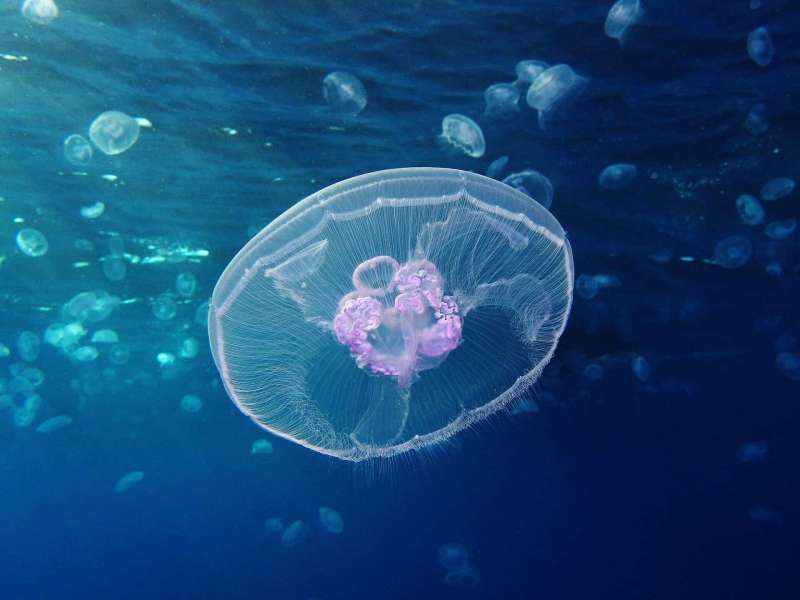
A new species of moon jellyfish, Aurelia profunda, was discovered in the Gulf of Mexico. Here’s everything you need to know.
Discovering a new species is a rare yet monumental experience. Not only are you witnessing something truly unique, but you’re doing so with the knowledge that what you’ve just found is going to have a broader impact on the world around you. Texas A&M University at Galveston doctoral student Alexandra Frolova Ruthenbeck learned this for herself when she came across a new moon jellyfish species in the Gulf of Mexico.
Moon jellyfish get their name from the moon-shaped bells that sit atop their bodies. The bells are translucent and look like small celestial orbs when the creatures are swimming through the ocean waves. The latest species discovered by Ruthenbeck are to be called “Aurelia profunda.” The A&M doctoral student said she first spotted them while on an expedition off the shore of Louisiana. “I saw something pulsing in the water column near the boat lights. We scooped it up, and it was a beautiful moon jellyfish carrying many larvae,” she said. Dr. Maria Pia Miglietta, an associate professor, helped Ruthenbeck identify this specific type of moon jellyfish.
Both Miglietta and Ruthenbeck agree that the discovery—which fittingly came amid NASA’s Artemis II mission to the moon—is an enormous step forward in the field of science. Miglietta told Houston Public Media, “We’re still discovering new species in this very well-studied group and so this indicates how little we know about the biodiversity in general of these animals and probably a lot of animals.” She added, “It indicates that we still need to explore the ocean, especially the Gulf of Mexico.”
This is now the fourth recorded species of moon jellyfish
Prior to Alexandra Frolova Ruthenbeck and Dr. Maria Pia Miglietta’s discovery of the Aurelia profunda, only three other species of moon jellyfish had been previously recorded. The newest addition to the crew is identifiable by two specific features: One, it’s smaller than other moon jellyfishes, even in adulthood; and two, Miglietta said, “It was also in the middle of the Gulf of Mexico. You usually find these animals close to the coastline.” They’re commonly seen in aquariums throughout Texas and across the country as well.
According to Miglietta, “Aurelia are probably the best-studied group of jellyfish because they’re easy to keep in the lab. They’re also everywhere around the world and look very nice, so they’re the ones that you often see in aquariums.” In terms of keeping them in a lab, it is precisely this course of action that allows her, Ruthenbeck, and a team of researchers at Texas A&M University at Galveston to cultivate larvae, grow polyps, and produce new jellyfish to help obtain additional information about the various species, their life cycles, and their life expectancies. Miglietta said that, “It’s beautiful to know that there are new species out there that we are still discovering and it felt like a responsibility and the right thing to do to put the effort to describe it.”
If you happen to see one of these beauties out in the wild, or another species of jellyfish, it’s best to observe the delicate creatures from a distance. Jellyfish are known to sting, and while the Aurelia species tend to produce a milder reaction than others, it’s best to avoid touching them altogether for your safety as well as theirs. Additional information on jellyfish stings and how to identify and treat them can be found here.
This article first appeared on Good Info News Wire and is republished here under a Creative Commons license.
Related: Blue dragons are washing up in Texas. Here’s why you shouldn’t pick one up