Punching In is a bimonthly series about the people who make Houston work, highlighting interesting jobs, industries and careers across the city.
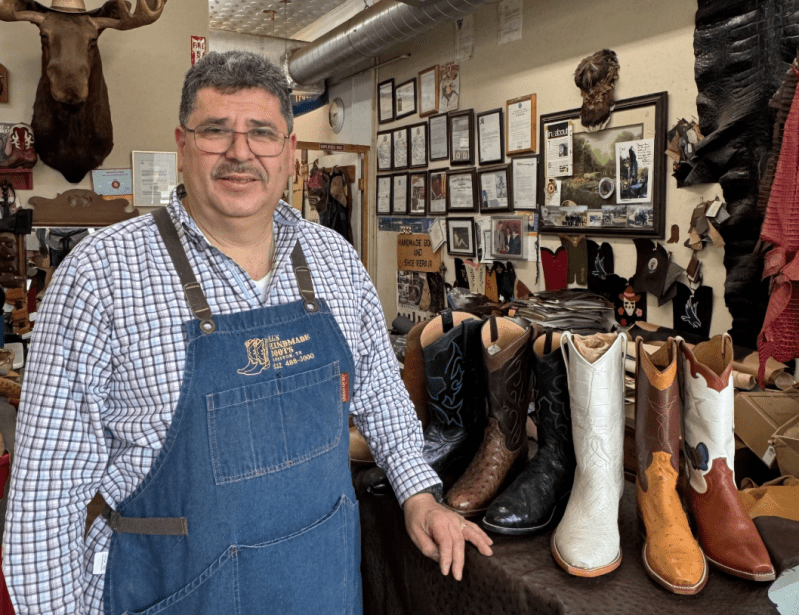
Standing in the interior of Al’s Handmade Boots in Midtown, Houston, you wouldn’t know if it was 1950 or 2026. Not a computer or tablet in sight. The rich smell of leather hangs in the air, and boots crowd every available surface. The back of the shop where the workers toil is separated from the front by a narrow doorway, and once you step back into the maker’s space, you’re transported to another time.
Boot-making mechanisms from nearly 100 years ago sit on tables and loom over workshop areas. The steady sound of a sewing machine and a cobbler’s hammer are the only noises in the shop besides the murmur of Spanish and the occasional ringing of the doorbell signaling the arrival of a customer.
Alvaro Rivera has been a master bootmaker for over 30 years, and has been at the helm of Al’s Handmade Boots for 16 of them. Rivera learned the craft of bootmaking in Mexico from his father, who learned it from his own father. The craft goes back for five generations in Alvero’s family. Alongside his workers—Eduardo, Nelson, Marco, Raul, Elmer, and his wife, Diana—Rivera turns animal hides into wearable works of art for his customers.
We spoke with Rivera about what it takes to be a bootmaker in an age where less and less shoes are made by hand.
Anna Raj: What can you tell about a customer from just looking at their boots?
Alvaro Rivera: If they take good care of the boots or not. If it’s their first pair or if it’s something that they wear frequently. We get all kinds of customers over here. From people that actually love boots to people who are wearing them for the first time.
Raj: What are people actually paying for when they come here and they buy handmade boots?
Rivera: If you go to boot stores like Cavender’s and Lucchese’s and all that, they’re well-made boots. But when you’re going for the custom-made, handmade boots, then you have to consider that it’s gonna take about 55 to 60 hours to make them. And right here in the shop, we don’t use any computers, no 3D printers or embroidery computers or anything computerized. Everything is done by hand. We use all machines from the ’50s and ’60s. We trace the foot of the customer and we trace the designs on it by hand. We take the measurements of the foot and transfer that to a shoe last, which is a mold of the foot. Then we make the boots around the last. We try to not cut corners and to make them the way that they used to make them 100 years ago.
Raj: What kind of designs do you make?
Rivera: Sometimes it’s not good to put too much on the boot, especially when you wanna wear it. I mean, if you want to put it in the museum, that’s another story. But sometimes, if you want to wear it, they’re gonna be yours and personalized to you. We do all kinds of designs on the boot. University logos, company logos, names, birthdays, family names, dogs, and horses. People actually love their pets or their animals on boots. Whatever the customer asks, we go in that direction and try to accomplish what the customer is expecting.
Raj: How much would it cost to get a handmade pair of boots and who do you sell them to?
Rivera: We start at about $1,800 and up, but it goes all the way to $8,000. It depends on what you like. But usually a couple of thousand dollars. We get all kinds of customers. Professionals, people that wear boots every single day, boot lovers, businessmen, physicians, athletes. You name it, we’ll make it. We have customers from Louisiana, Oklahoma, Arizona, Ohio, and New York. People love boots and when they come to Houston they hear about us and come to the shop. We have customers that have been here with us since we opened, and before that, customers we’ve known for a long, long time.
Raj: Is there a special Texas or Houston style boot that is different from boots found elsewhere?
Rivera: When I first learned to make boots, I learned it in Mexico, and there’s a big capital of boots over there in Leon. It’s different in the way that it’s put together in Mexico versus here, in the way that it’s built. Here, the top of the boot is sometimes a little more complex than what we usually make in other states or in other countries. Also, when we make boots for ranchers, they have to be real long-lasting boots instead of just regular wear on the asphalt, like for busy professionals downtown. We also make boots for the people that actually ride horses. But either way, the boots we make were born here, on the border of Mexico and Texas.
Raj: Are there enough bootmakers to meet demand?
Rivera: We used to have many boot makers back in the ’70s and ’80s. But most of them retire or die. There’s some new, young guys that are actually learning, and some ladies too, thank God. There are some female bootmakers that do magnificent, beautiful work in Austin, Oklahoma, and New Mexico. But it’s still not that many. I have bootmaking friends who have so much work that they’re five or six years behind. So by the time you order and by the time they deliver it to you, a lot of things can happen. Right now we’re about 8 to 12 months behind. Sometimes people ask for something sooner than that, so we try to accommodate, especially for weddings or events.
Raj: Why are boots so popular in Houston?
Rivera: Texas has never left [its] love for boots behind. From Thanksgiving all the way to after Houston Rodeo time, we’re packed on repairs and new orders. People want their boots for events, and rodeo season gives us more work.
Raj: Is there any part of making boots that you can’t teach but you just have to learn on the job?
Rivera: Even when you learn it, you have to have it in you. But we try to teach as many guys and girls as possible. There are some bootmakers whose job it is to teach this trade, and we refer people who want to learn bootmaking to them. Even with regular shoe repair, it’s hard to find good cobblers nowadays.
Raj: If I came back here in 30 years to this shop, what do you hope I would see?
Rivera: That our shop will have actually grown and have brought in new faces. That we’re still delivering the work with passion and with compromise, and that we’re still being honest with customers. My dad used to tell me a saying that he learned from his dad. He said, “Son, as long as the people are still getting born with feet, you will have work.”