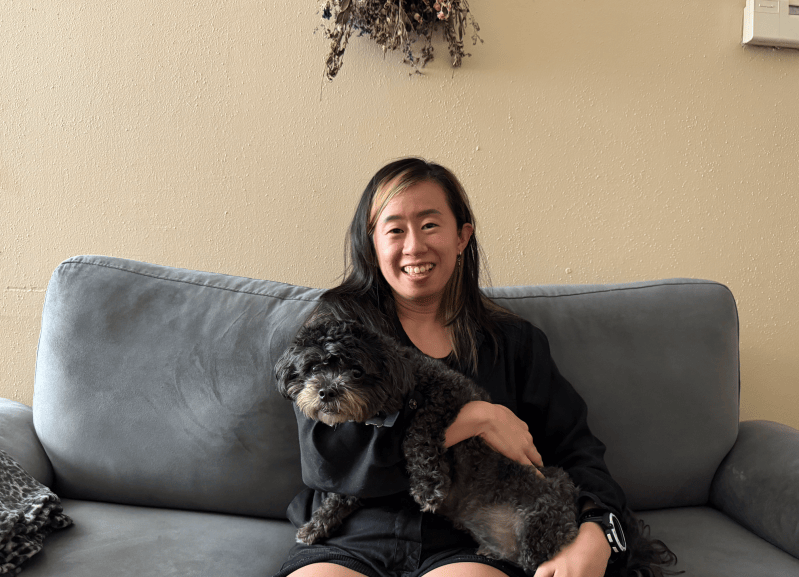
Dr. Quỳnh-Hương N. Nguyễn started a Houston-based life coaching practice four months ago, when they realized they could help marginalized communities that face barriers to healthcare access. The premise of the practice is in the name: Patterns Pivot. Nguyễn helps Houstonians identify and change life patterns that hold them back from achieving their goals, addressing mental health issues, neurodivergence, and trauma.
As a former nonprofit worker in immigrant rights, Nguyễn blends their personal experiences as the child of refugees with community advocacy work and trust-building to provide specialized care to immigrant communities.
Nguyễn talks about what providing mental healthcare looks like in the wake of increasing immigration enforcement and violence.
Raj: What’s the difference between life coaching and therapy?
Nguyễn: Typically, when we think about therapy, we often think about how we identify patterns and understand the past. Whereas life coaching is meant to take what we’ve identified with those patterns, and choose how to make a difference in our lives. I know that for a lot of people that may not be very clear, but we make sure that we have those conversations with clients to be able to understand where they’re coming from. Then we’re able to identify action steps that could help them learn how to take care of themselves when they’re burnt out, navigate career transitions, or make changes when they feel like their life isn’t aligned with what they want to do.
Raj: Your business is brand new, what have the first few months been like?
Nguyễn: I had to go through a lot of conversations with my own therapist and my own coaches, and say things like, ‘I’m so sad because I wanna help so many people, and no one’s knocking on my door just yet.’ It was the first couple of weeks that I had to realize it’s not a moral failure on my part. I’m just starting, right?
I’m starting to plant the seeds, and I might not see growth just yet. I’m learning that nothing is going to happen overnight and I’m still learning as I’m going. I’m learning about what resonates with people. I’m learning about building trust and building relationships. I’m learning about referrals and all the administrative stuff.
Raj: Why did you start Patterns Pivot?
Nguyễn: Patterns Pivot started from my own experience. I am neurodivergent myself, and I realized that many people were struggling figuring out how to get support when they don’t see themselves in other life coaching or therapy practices. My goal is to create more of those services with an intersectional lens so neurodivergent people, people of color, women, and immigrants are able to be seen and find support. I’m able to use a lot of my own personal experience and the knowledge that I have in psychology to help people understand that they’re not broken.
Raj: What other experiences help inform your work?
Nguyễn: I’m the eldest daughter of the eldest daughter of the eldest daughter. My mother came to the US as a refugee after the Vietnam War, and so did my dad. They raised me through poverty. Because I was the first of my family to go to school and get all my degrees, I also had to be able to support my family and be their case managers in certain ways, and be their translator and interpreter. I know a lot of children of immigrants understand what this means. I also went through domestic violence and domestic abuse. I’ve experienced sexism and racism in ways that I didn’t think I would. Through these things, I learned very early on that this world was very difficult. Those experiences taught me why mental health resources are so important.
Raj: A lot of your work focuses on breaking patterns associated with the inherited trauma of marginalized and immigrant communities. What does that entail?
Nguyễn: Generational trauma can last for three generations. So with my grandmother [fleeing to the US], it means that it’s going to take until my children for her trauma to be gone. My mom has experienced it and now it’s been passed on to me. When generational trauma is being passed, it can be stored in the body, and we don’t even realize that it’s happening. Sometimes it’s even stored in our brains, and we don’t even realize that these triggers are there.
Generational trauma impacts a lot of immigrants, and we’ve seen it in studies about PTSD impacting the growth of our brain, particularly if you experience trauma at a very young age. My mom and dad were kids when the Vietnam War started. Their brain development would be drastically different if we were to scan them, and this is the case with many more immigrants, too. Their brains develop differently because they choose to take that really difficult step of leaving the country they called home for so long. They’re leaving because they have to make this difficult choice for their safety, for their needs, for their family. And so I do see it in immigrant folks that I talk to.
Raj: How does this trauma show up?
Nguyễn: Perfectionism, hyperfocus, hypervigilance. Sometimes it’s masking and other times it’s memory loss. Other times it’s trembling because it shows up in their bodies as well. There are so many different ways it shows up. And even depression, outbursts of, like, anger, mood changes. It shows up in so many different ways and if you’re not careful, you might perceive it as them not trying to get along or being difficult, when in reality they are just trying really hard to understand why the world is the way that it is.
Raj: What are you hearing from immigrant communities amid the current immigration enforcement and ICE climate?
Nguyễn: A lot of people are scared. They don’t know who or where to turn to. They don’t know who they can talk to. I have a client who is working multiple jobs just to make sure that she’s able to feed herself and her child. I have another who asked me, “Should I continue to stay in the US?”
The resources that are available lack clear guidelines or clear direction. Oftentimes, my clients are turned away. The resources that are low cost or considered ‘free’, they can’t access because there’s a long wait list. Because of that, they’re losing faith in the system. They’re not sure what the next day will look like as they’re trying to also navigate what we consider ‘normal life,’ like trying to figure out job security and if they can afford groceries or gas.
That’s the reason why I set up my practice the way it is. Hopefully, I can be the bridge for folks who fall through the cracks.
Raj: Are your clients changing their everyday lives to avoid ICE?
Nguyễn: There’s a lot of us who are visibly immigrants and we don’t go outside as often anymore, or we don’t go to get groceries, or we don’t go to free community events anymore because there is that fear that ICE will come out of nowhere and take one of us. It’s getting scary for a lot of people, and they don’t know where to turn. The system is super confusing, and oftentimes we lose contact with our people who do get picked up and we’re not sure if we’ll be able to see them again.
Raj: Why is healthcare so difficult for immigrants to access?
Nguyễn: Oftentimes, immigrants don’t access healthcare because of the language barrier and how difficult it is. And so they would rather just skip out on a doctor’s visit, even if they’re experiencing a lot of pain. If they themselves don’t understand the materials in front of them, it’s harder for them to understand the value of the treatment. And if there is a financial barrier, they’re gonna be like, “Oh, it’s, it’s not worth it. Why should I continue going forward with this?”
Because Texas is one of the states that has Spanish and Vietnamese as the most common languages being spoken, you would think that there are more materials that would be translated into those languages, but unfortunately, there aren’t. There is no law that requires healthcare systems to provide materials in peoples’ native language. That creates more of that gap when it comes to health literacy.
Raj: You mentioned financial barriers to healthcare. How do you balance providing accessible care to people who can’t afford it and paying your own bills?
Nguyễn: I have three pay rates. One is the pay-it-forward for those who can offer a little bit more at $250 per session. The standard rate is $150 per session. Then I have the community rate, which is meant to hit the in-between for both of us. It’s really good practice for the client to develop those financial communication skills and ask for what they need. Because that’s the first step for anybody who is marginalized, is always asking for what they need. So we go back and forth and practice that skill of ‘what is reality for you?’.
Raj: What keeps you going when filling that healthcare gap seems so emotionally demanding?
Nguyễn: I am my family’s and my ancestors’ wildest dreams. I’ve done everything I can to achieve their dream, and now it’s my turn to achieve my own dream, which is to have this practice to help other people.