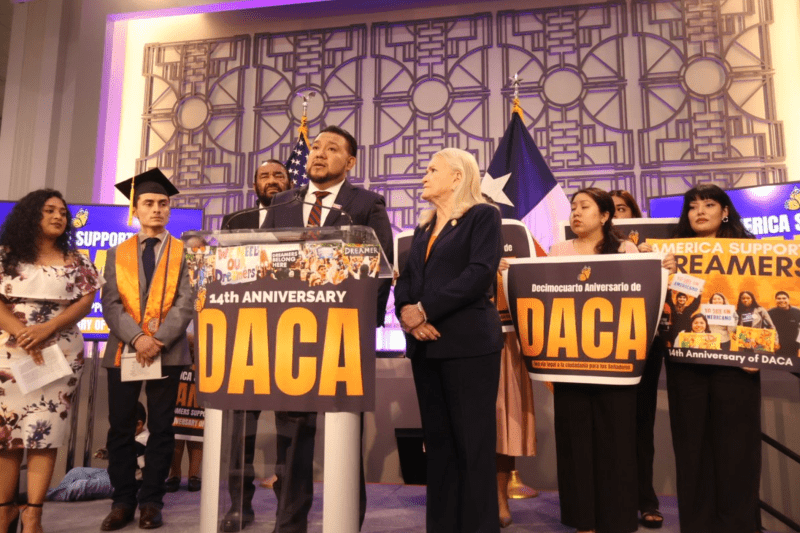
On Monday, 14 years after the Deferred Action for Childhood Arrivals program was created, local leaders and DACA recipients gathered at Houston City Hall to call for permanent protections as the program faces mounting uncertainty.
Rep. Sylvia Garcia, Rep. Al Green, Harris County Attorney Christian Menefee, and several DACA beneficiaries marked the anniversary by highlighting delays, lost work permits, and the threat of deportation that many recipients say are reshaping their lives.
Garcia said the program’s instability has grown more severe.
“Under this president, that uncertainty has even become more cruel,” she said, adding the administration is detaining and deporting DACA recipients, delaying renewals, and creating gaps that cost people their livelihoods. “This is not by accident. It is by design.”
Area Congress members urged other lawmakers to pass permanent protections, including the American Dream and Promise Act, arguing the program’s temporary nature leaves hundreds of thousands vulnerable to job loss and detention.
“America needs young workers to support a system that has been efficacious since its inception,” Green said. “But we find ourselves with an administration that is pushing back on the very foundation of Social Security, which is these young workers.”
Menefee criticized current federal immigration policies, calling them inhumane.
“We have a president, we have his direct advisors and Stephen Miller, who has no problem admitting to this country White immigrants from South Africa,” Menefee said. “They have no problem admitting immigrants who look like the President and his family.”
For many Dreamers, the stakes are deeply personal. Marco Antonio Cruz Linares said he could lose his job and the income he uses to support his family if his renewal is not processed by the 25th.
“Due to the current administration’s policy toward DACA recipients, I could potentially be detained indefinitely or deported,” he added.
Wendy Flores, a DACA recipient who arrived in the United States at age 7, described the program as transformative. Since receiving DACA in 2012, she earned a bachelor’s degree in psychology and is now pursuing a master’s degree in applied behavior analysis while working as a registered behavior technician.
According to the 10th Annual DACA Survey, data from the past decade shows a steady rise in homeownership among DACA recipients. In the 2024 survey, 26.3 percent of respondents said they bought their first home after receiving DACA, up from 17.7 percent in the 2022 survey. Those homeowners contribute millions in mortgage and property tax payments that help fund public schools, roads, fire departments and other essential local services.
In addition, according to the Center for American Progress, nearly 600,000 DACA recipients live across the United States, raise 300,000 U.S.-citizen children, and pay $9.4 billion in taxes each year. Close to 400,000 DACA recipients serve as essential workers critical to US infrastructure, healthcare, education, and food supply chains. In the construction and housing sectors alone, an estimated 40,000 to 58,000 DACA workers are employed, providing vital labor that keeps these industries functioning.
“These numbers tell a simple truth: our presence strengthens the country economically, socially, and morally,” she said.
But Flores said ongoing renewal delays have created a “constant mental battle” for many recipients. “The uncertainty we face isn’t just logistical. It weighs heavily on our mental well‑being,” she said.
As the anniversary was marked, speakers said the program’s future remains unclear. Many called for a long‑term solution that would allow young immigrants to live without fear of losing their jobs, their stability, or their place in the country they consider home.