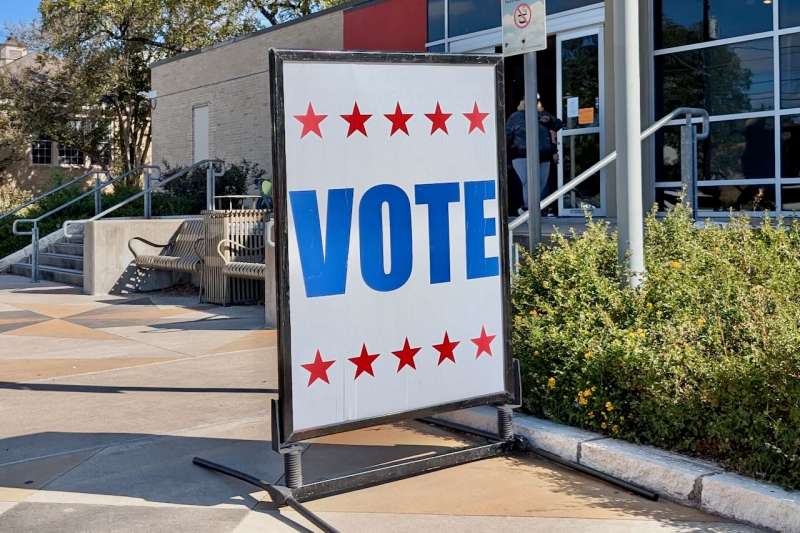
The Texas midterm election is fast approaching, so now’s the time to make sure you have all the information you need to guarantee your voice is heard.
Every Texan’s ballot will include statewide races, like attorney general, US senator, and governor. You’ll need to look up your specific ballot to see a list of your local races. You can find a ton of information about different races and candidates across the state here. But before we get there, let’s make sure you’re registered to vote. If you think you should be, double check here.
If you can’t confirm your status, it’s time to register.
Qualified voters must:
- Be a US citizen
- Be 18 years old before or on Election Day (but you can preregister to vote if you’re turning 18)
- Meet Texas’ residency requirements and are a resident of the county where you’re submitting your application
- Be registered before the deadline (Oct. 5, 2026)
The registration form can be found online, but you’ll need to print it. You will be asked to provide a valid Texas driver’s license number or Social Security number. If you’d like to have a voter registration form mailed to you, fill out this form and you will receive a paper application. You can then return the form with the included envelope or by taking it into your local voter registrar office. Use the registrar as a one-stop shop by filling out an application on-site and returning it immediately. Find your local voter registrar in your county using this directory.
According to Texas law, you must be registered 30 before Election Day to be able to vote. That means your local registrar has to receive the form by Monday, Oct. 5, 2026.
Once you’re registered, there are three ways to vote: through a mail-in ballot, in-person during early voting, or in-person on Election Day.
Voting by mail
You can vote before Election Day through the mail or by physically dropping off your ballot early, but you must qualify to get this accommodation. To qualify, you must meet one of the following requirements:
- Be 65 years of age or older by Election Day
- Be sick or disabled
- Be expected to give birth within three weeks of Election Day
- Be out of the county on Election Day and during the early voting period
To complete a vote-by-mail application, you’ll be asked to provide a valid Texas driver’s license number, a Texas PIN, an Election Identification Certificate Number, or a Social Security number.
Here’s how to get your application:
- Online: Download and print your application form here OR directly request a form through the Texas Secretary of State website.
- In person: Identify your local early voting clerk’s office, where you can pick up an application. You can either fill it out on-site or return it later.
Completed applications can be returned by mail, through email, or in person to your local early voting clerk. For the 2026 general election, all vote-by-mail applications must be received by Friday, October 23 at noon or at the end of business hours—whichever occurs first.
Once you receive your ballot, fill it out, and mail it back, it must be received by your local early voting clerk by 7 p.m. on Election Day OR by 5 p.m. the first business day after Election Day (Nov. 4) if sent by mail and postmarked from within the US. If you’re sending it by mail from outside the US, ballots must be received by Nov. 8, the fifth day after the election.
Voting early
Texas allows all registered voters to vote early in person. There are no special requirements necessary to take advantage of in-person early voting. For the 2026 general election, early voting will be available from Monday, Oct. 19 through Friday, Oct. 30.
Early voting hours and locations vary by locality. Find your polling information using this hub.
Voting on Election Day
Texas’ Election Day is Tuesday, Nov. 3, 2026. Polling locations are usually open 7 a.m. to 7 p.m., but it’s best to check the times of your specific polling location. Input your address and find that here.
Before you leave for the polls, don’t forget to bring a valid, unexpired ID, such as a driver’s license, state ID card, or US passport. A full list of acceptable IDs can be found here.
Get in line and stay in line—even after the polls technically close. If you’re in line before the polls close, you have the right to vote.
When you arrive inside your polling location, a poll worker will ask to see your photo ID. If you do not have an ID, you may provide proof of residency by filling out a Reasonable Impediment Declaration and providing a utility bill, bank statement, or other document. If you have no proof of residency or ID, you can request a provisional ballot. In this case, you will be asked to provide proof of ID within six days after Election Day at your county registrar.
The poll worker will then hand you a ballot. Take this ballot into an empty voting booth and completely fill out each bubble with your choices. You’ll then be instructed to take your ballot to the tabulation machine, where you’ll simply slide it into a slot or other designated ballot return box.
Important polling place rules
At the voting stations, no phone usage is allowed. You shouldn’t have your phone out at any point. You also can’t wear any political swag such as candidate buttons, hats, or t-shirts. If you violate these rules, you will be asked to leave.
Also, most states have laws against political campaigning within a certain distance of a polling location. In Texas, the limit is 100 feet.
Now finally, let’s answer some frequently asked questions
If I mailed in my ballot, how can I check to see if it was received?
The Texas Secretary of State offers a ballot-tracking tool. Find it here.
I’m a college student, should I vote with my home or school address?
This is a personal decision. You may either register to vote at your school address or remain registered in your home state/county. Just remember that you can only be registered to vote in one location at a time. If you can’t make it home to vote and choose to remain registered in your hometown, request a mail-in ballot ahead of the appropriate deadline and return it on time so your vote is counted.
What if I don’t have a ride to the polls on Election Day?
Be sure to check your public transportation options. Alternatively, there are usually many organizations willing to help get you there. One option is RideShare2Vote, a multi-state organization that connects voters with drivers to coordinate transportation to the polls. Check out their website for details.
What do I do if I make a mistake on my ballot?
As long as you haven’t submitted your ballot, you’re able to start over. Ask your poll worker for a new ballot sheet.
What if someone is trying to stop me from voting?
Attempting to interfere with someone’s ability to freely vote is called voter intimidation and it’s prohibited under federal law. This can look like displaying false signs about voter requirements, impersonating a poll worker to spread false information, or aggressively questioning voters regarding their citizenship or voting right status.
If you experience voter intimidation, report it to your local election office and call the Election Protection Hotline at 1-866-OUR-VOTE (English) or 1-888-VE-Y-VOTA (Spanish). You can find more information, including hotline options for additional languages, here.
Voting is a right so many people around the world are still fighting for, and you can honor those people by taking the time to do some research and show up to the polls. Send this guide to someone who needs to make their voting plan.