Texas’ 28th Congressional District runs from the border in Laredo through Webb and Zapata counties north toward the outskirts of San Antonio—and it has been reliably Democratic territory for most of the past two decades. But the same dramatic shift in Hispanic voter sentiment and redistricting that has reshaped South Texas politics is now threatening one of the region’s longest-serving incumbents.
The district was redrawn in August 2025 on Trump’s orders as part of a statewide redistricting effort designed to flip five Democratic-held congressional seats to Republican. The new map added voters from Hidalgo County to the district while stripping out more moderate precincts near San Antonio. A federal court found the maps likely constituted racial gerrymandering and blocked them, but the Supreme Court allowed them to stand for the 2026 midterms in a 6-3 decision.
The result: a district that runs from the border in Laredo through Webb and Zapata counties and into South Texas that is measurably more Republican than the one Cuellar won just two years ago.
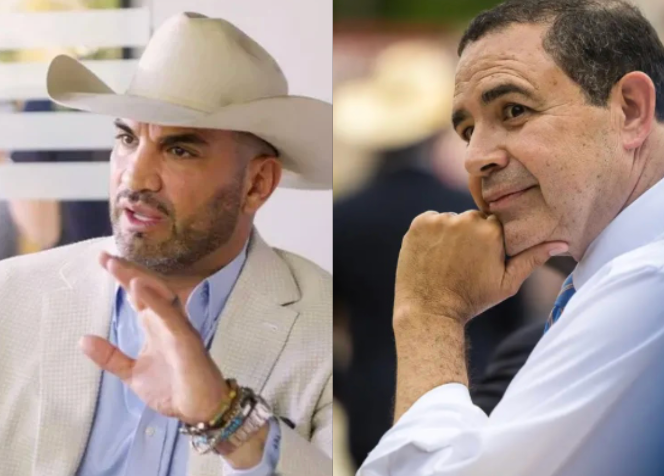
The Democrat: Henry Cuellar
Henry Cuellar, 69, is the incumbent congressman and one of the longest-serving members of the Texas congressional delegation. A Laredo native and former Texas secretary of state, Cuellar has held the seat since 2005, building his profile as one of the most centrist Democrats in Congress—frequently breaking with his party on immigration enforcement, energy policy, and border security to align more closely with the views of his constituents.
His tenure has been defined by a focus on border trade, public safety, and federal investment in South Texas infrastructure. He has leveraged his seniority and bipartisan relationships to secure federal dollars for the district and has long argued that his experience and relationships in Washington are irreplaceable for a district that depends heavily on cross-border commerce.
His campaign has not been without turbulence. In 2024, Cuellar faced charges that he bribed a foreign government and acted as a foreign agent. But President Donald Trump pardoned Cuellar and his wife, who was also charged, in December. Trump expressed frustration for pardoning Cuellar and not seeing him flip to become a Republican.
More recently, a Laredo pastor turned to Cuellar for help after two Mexican pastors were detained by ICE, which Cuellar voted to fund, breaking with his party.
See where he stands on the issues here.
The Republican: Tano Tijerina
Tano Tijerina is the former Webb County judge who served as one of South Texas’s most prominent Democratic officials before announcing in 2024 that he was switching parties and becoming a Republican—a move that came directly in the wake of Trump’s historic gains in Webb County and across the South Texas border region. Now he is making his first run for Congress, positioning himself as a South Texas conservative who understands the region’s culture and priorities better than a Washington incumbent.
His campaign centers on border security, law enforcement support, economic growth, and family-centered conservative values. He argues the district’s political shift toward Trump reflects a genuine realignment—not a temporary fluctuation.
See where he stands on the issues here.
What to watch
Laredo was one of several South Texas border communities that moved sharply toward Trump in 2024, with Webb County recording a swing of more than 50 percentage points in his favor since 2016—even as voters there continued to support Democrats in some down-ballot contests. That split-ticket pattern suggests the district’s political realignment is real but complicated, and Cuellar’s personal brand and incumbency advantages could still matter. Though Tijerina’s party switch, name recognition, and South Texas roots make him a more formidable challenger than Cuellar has faced in years.