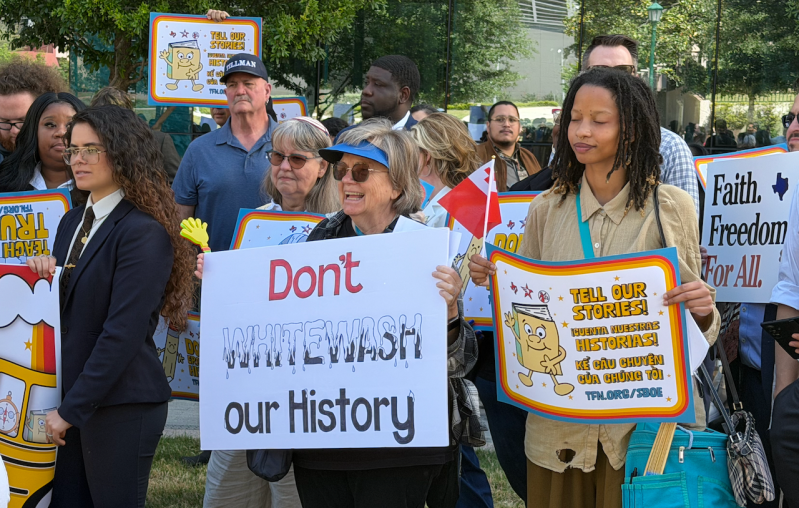
The Texas State Board of Education will meet from June 22-26 in Austin to vote on a social studies rewrite for the state’s Texas Essential Knowledge and Skills (TEKS) standards.
The proposed curriculum changes have faced controversy and pushback for leaning too heavily into “Texas-centric” and white Christian teachings while ignoring other religions and cultures.
As the vote approaches, education advocates are sounding the alarm and breaking down why the proposed changes across multiple grade levels are problematic.
According to an analysis conducted by the The Social Studies Advocate and the Texas Freedom Network (TFN), the changes are developmentally inappropriate, overloaded with too much content, rely on memorization over understanding, contain historical inaccuracies, oversimplifications, and myths, show religious favoritism toward white Christian teachings, and are missing a variety of perspectives.
Developmentally inappropriate
In kindergarten through second grade, the phrase “with adult assistance” appears 35 times, and that standard is never clearly defined.
If you can’t define what that assistance looks like or what success looks like, then you can’t measure it, according to the TFN.
In the proposed TEKS, third graders are expected to describe Moses as a Biblical figure who led the Israelites out of slavery in Egypt, and directly correlate that story to African Americans held in slavery in America and Texas.
Content overload
According to the Texas Education Agency’s own calculations, the content proposed in seventh and eighth grade is too much to reasonably teach in a single school year.
Some standards also require substantial background knowledge of a topic that hasn’t been previously taught.
The content is also described as repetitive: third graders are asked to explain how citizens in ancient Greece used voting to make decisions and describe how these ideas influences self-government in Texas; describe Greek ideas about citizenship, liberty, and responsibilities and explain how these ideas influence rights and duties of citizens in Texas’ and explain Greek ideas about the rule of law, separation of powers, following rules, and serving on juries compare to the laws and government in Texas today.
Memorization vs understanding
Another example The Social Studies Advocate and the TFN give on curriculum not only being developmentally inappropriate, but also putting a stronger emphasis on memorization over understanding, is the expectation of first graders to “understand how free enterprise shaped Texas in the past.”
According to the proposed TEKS, first grade students are “expected to (A) identify oil and natural gas as valuable natural resources; (B) explain that the discovery of oil in Texas led to new towns, transportation, and products; (C) describe Patillo Higgins and Anthony Lucas as wildcatters who found oil at Spindletop Hill in 1901; (D) describe Henry O. Flipper as an engineer who worked in Texas on land and oil projects; (E) describe William P. Hobby as a governor who supported business during the early oil years.”
Historical inaccuracies, oversimplifications, and myths
Much of the newly proposed curriculum also relies on myths or oversimplifications.
Third graders are asked to compare the founding of Rome by Romulus with the story of the founding of the Roman Republic by Brutus, and explain what each story teaches students about leadership and government—despite historians considering both to be mythology, not fact.
“Asking students to study these lessons without noting there is no historical record of either is extremely problematic,” according to the TFN.
Sixth graders must identify how innovations like steamboats and the cotton gin influenced Westward expansion, but the curriculum fails to not only acknowledge how slavery made Western expansion possible, but also that the cotton gin increased the demand for slave labor.
Sixth graders would also have to explain how the Trail of Tears impacted tribal relations along the Northern border of Texas, something the TFN says is an “incredulous oversimplification of an event which saw the forced removal of tens of thousands of Indigenous people from their homelands” and “fosters no critical understanding of what the US government did to cause those interactions.”
Christian-centric teachings
Critics have slammed the rewrites for including Bible stories and white Christian nationalist teachings while not mentioning any other religions.
Under the rewrites, the only time students would learn about the basic beliefs of all other major religions would be during high school World Geography, which isn’t a required course. (The new social studies framework eliminates World Geography and Cultures in sixth grade.)
Third graders would be asked to “describe how Christian beliefs, including valuing every individual, doing what is right, and showing compassion for others, helped shape American ideas about equality, rights, and treating people with dignity.”
They would also be expected to identify the Biblical character Abraham as an “ancient Hebrew leader whose story is important to Abrahamic religions,” and “describe Moses’ contributions as a law-giver through the Ten Commandments.”
The TFN argues that these standards inadequately separate history from religious narrative, and even goes as far as to conflate the two.
Missing perspectives and content
Between kindergarten through fifth grade, only eight women are named across any curriculum standard. Abigail Adams, wife to second President John Adams, is the only woman named in all of the fifth grade teachings.
Sixth graders are also asked to identify how interactions between American Indians and settlers were both peaceful and violent, which the TFN argues is incredibly vague.
Seventh graders are asked to explain how modern Israel was established in 1948 and how later conflicts in 1967 and 1973 contributed over time to peace treaties with Egypt and Jordan, while ignoring the war of 1948 and any mention of the Palestinian Arabs who were displaced.
“If students aren’t taught about this well-documented historical event, then they won’t have a comprehensive understanding of the conflicts, negotiations and peace treaties this standard asks them to explain,” the TFN argues.
Some topics are missing or have been removed. The Civil Rights Act of 1964 and the Voting Rights Act of 1965 are missing from seventh grade standards focused on Civil Rights.
The members behind the vote
The 15-member SBOE tasked with rewriting the curriculum is made up of 10 Republicans and five Democrats. One SBOE member supporting the rewrites, Julie Pickren, took part in the January 6, 2021 insurrection and holds far-right, conservative views.
Texas Education Agency Commissioner Mike Morath—who was appointed by Republican Gov. Greg Abbott in 2015—is also providing assistance.
The board also appointed nine content advisors critics have touted as “hyper-partisan” to help guide the curriculum, and only one has experience working in a Texas public school. Three others—David Barton, David Randall, and Jordan Adams—hold far-right views, and the Texas Freedom Network previously launched a petition calling for their removal.
Following the board’s meeting in April, Democratic members raised concerns over public federal tax filings showing the Texas Public Policy Foundation, a far-right conservative think tank based in Austin, awarded $70,000 to the Texas Center at Schreiner University, which is led by another content advisor, Donald Frazier, for the “Development of Texas Essential Knowledge & Skills (TEKS) Standards.”
The Democratic board members called for a “comprehensive and independent investigation” into what conditions were tied to the grant between Frazier and the conservative think tank, and how the money may have influenced his decision making surrounding the TEKS rewrite.
No motion has been taken in response.
If passed, the new social studies curriculum (TEKS) will remain in effect for roughly 15 to 20 years.
The State Board of Education will also vote on a required reading list proposed by the Texas Education Agency that includes multiple passages from the Bible.