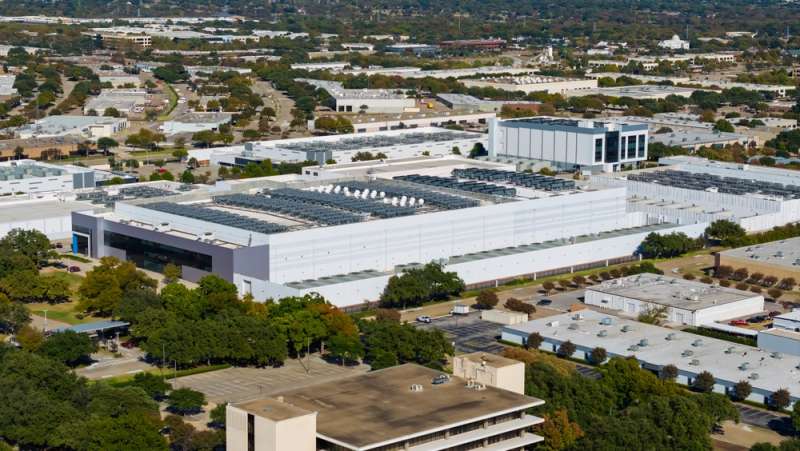
When more than 520 environmental, labor, and advocacy organizations sent a letter to Congress last week demanding a national moratorium on new data center construction, it landed in Washington as a policy ask. In Texas, it landed as a description of what residents have already fought for.
The letter, sent on June 11 and facilitated by the national environmental group Food & Water Watch, was signed by organizations from 48 states—including Greenpeace, Friends of the Earth, Americans for Financial Reform, Good Jobs First, and Honor the Earth. It warned “the rapid, largely unregulated rise” of AI- and crypto-driven data centers already threatens “Americans’ economic, environmental, climate, and water security,” and announced the launch of a new national coalition aimed at supporting local fights against data center construction. But while the letter is national in scope, the fight it describes has been playing out in Texas for months—in county commissioner meetings, courtrooms, and increasingly, on ballots.
The letter warns that a tripling of data centers over the next five years would consume as much electricity as roughly 30 million households and as much water as 18.5 million households—water used solely for cooling servers. It also notes 56% of the electricity powering data centers currently comes from fossil fuels, and that average US residential electricity prices rose 31% from 2020 to 2025, compared to just 4% in the previous five years—a jump the letter attributes largely to the data center buildout.
For Texas—a state already managing chronic drought, a strained power grid, and explosive population growth—those numbers aren’t abstract.
The data center industry argues the economic upside outweighs the costs. Earlier this year, Dan Diorio, vice president of state policy for the Data Center Coalition, an industry membership association, told Texas Tribune data centers supported more than 363,000 jobs in Texas and generated $3.2 billion in state and local tax revenue in 2023. Those figures have become a standard talking point for officials weighing new projects—and a point of contention for critics who say they don’t capture the downstream costs to ratepayers and water systems.
Several recent episodes illustrate how this debate is unfolding on the ground in Texas—and how differently it can go.
Earlier this year, in Hood County, west of Fort Worth, residents organized against a proposed data center project, packing commissioner meetings with hours of public comment over concerns about water use, air quality from backup diesel generators, and the strain on local infrastructure. Despite that pushback, commissioners ultimately declined to even adopt a temporary pause on new development, after a state senator sent a letter to the attorney general that claimed counties did not have the authority for such a pause. It’s a sign of how difficult it can be for local opposition to translate into policy, even when it’s well-organized and vocal.
In May, the city council in Red Oak near Dallas voted to approve the rezoning of 830 acres for a proposed data center despite hours of public testimony in opposition. The council also voted 4-1 in favor of a tax abatement for the project. Their decisions on both spurred the community to action, and nearly 2,500 signatures were gathered on a Change.org petition against rezoning.
Just last week, in El Paso, nearly 200 people showed up to City Hall to demand their council kill a sweetheart tax deal with Meta—and lost. The council voted 5-3 to keep the agreement, which gives Meta an 80% break on city taxes for 25 years on a $10 billion data center being built in Northeast El Paso.
Hill County took the opposite approach—briefly. Commissioners there passed what was apparently the first data center moratorium in Texas history, intended to give the county up to a year to study the issue before approving new projects. It lasted 14 days. A developer sued for $100 million, arguing the moratorium exceeded the county’s lawful authority and threatened contracts tied to more than 800 acres of land slated for development. Commissioners voted to rescind the moratorium and replace it with a checklist of development requirements instead.
The legal vulnerability at the heart of the Hill County case points to a structural issue that runs through nearly all of these fights: Texas counties generally lack zoning authority. Cities can restrict or condition development within their limits. Counties, where nearly half of all planned data centers in the state are headed, mostly cannot—leaving them with few tools beyond public pressure and informal agreements with developers.
Texas isn’t alone. At least 14 states have enacted temporary pauses on data center development, and lawmakers in New York, Georgia, and other states have introduced bills aimed at slowing the industry’s growth. Last year, more than 200 environmental groups made a similar call for a national moratorium, a push later endorsed by Sen. Bernie Sanders (I-Vt.). This month’s letter, with more than double that number of signatories, suggests the movement has only grown.
The pressure has reached the governor’s office, too. On June 10, Gov. Greg Abbott (R) directed the Public Utility Commission of Texas (PUC) and the Electric Reliability Council of Texas (ERCOT) to ensure data centers fully fund their own electric infrastructure costs rather than passing them on to residential ratepayers, instructing both agencies to submit a joint memo on further consumer safeguards by July 17. He also called on lawmakers to tighten regulations on data centers’ water use and repeal certain tax exemptions benefiting the industry—a notable framing from a governor who has spent years boasting Texas’ business-friendly policies as the very thing drawing data centers to the state in the first place. “Texas is the epicenter of AI development,” he famously said just last fall.
The timing is hard to ignore: Abbott’s directive landed the same month Hill County rescinded its moratorium under legal threat, El Paso’s council voted to preserve Meta’s tax break over resident objections, and the national moratorium letter circulated through Washington. Whether Abbott’s order reflects a genuine policy shift or an attempt to get ahead of a backlash before November’s election is a question Texas voters—and the legislators he’s asking to act—will have to answer themselves.