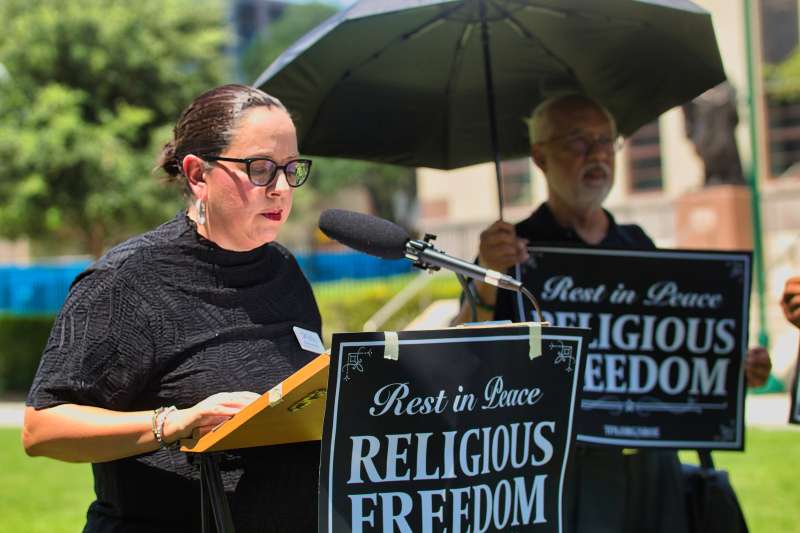
Updated 6/26/2026: The State Board of Education voted on Friday, June 26, to pass new social studies teaching standards for kindergarten through grade 8, but postponed their vote on high school courses, including US History, World History, and World Geography. The board is scheduled to meet again at the beginning of September.
The Republican-dominated, 15-member State Board of Education is meeting from June 22 to 26 in Austin to deliberate and vote on new social studies teaching standards that would go into effect for Texas’ 5.46 million public school students starting in 2030.
The rewritten standards have been slammed by students, teachers, and education advocates for relying too heavily on Texas-centric, white Christian nationalist teachings, and for excluding other world religions and cultures.
As written, the standards invite students to compare the Biblical figure Moses leading the Israelites out of slavery in Egypt to the Underground Railroad and African Americans held in slavery in America and Texas, and Islam is not mentioned often in the standards. The only time students would learn about the basic beliefs of other major religions would be during high school world geography, which isn’t a required course.
While a final vote will take place Friday, the board has already given initial approval to elementary, middle school, and some high school standards—but not before adding additional provisions and cutting others.
During Tuesday’s meeting, the board discussed elementary standards. Keven Ellis (R-Lufkin) proposed an amendment to add Bessie Coleman, who was born in Texas and was the first African American woman and the first Native American to earn a pilot’s license, to kindergarten standards, which passed with no objections.
Other Republican members, including Julie Pickren (R-Pearland), tried, and failed, to insert even more Christianity into the standards with an amendment that would have added a standard about the Wampanoag Indians converting to Christianity after contact with the Pilgrims.
Around 2 a.m. Wednesday morning, the board gave preliminary approval to the elementary standards in a 10-2 vote. Democrats Marisa Perez-Diaz of San Antonio and Gustavo Reveles of El Paso voted no. Democrats Staci Childs of Houston, Tiffany Clark of DeSoto, and Rebecca Bell-Metereau of San Marcos left the meeting before the vote.
On Wednesday, the board discussed middle school standards, along with US History and World History standards.
Brandon Hall (R-Weatherford) proposed an amendment to high school US History that forces teachers and students to “evaluate the negative effects of the counterculture movement of the 1960s through the 1970s, including changing attitudes toward marriage, changes in rates of divorce, and the difference between the rate of poverty in married households and divorced households.”
After deliberation, the amendment passed in an 8-6 vote.
The board also revised world history standards with an amendment from Hall to include a new provision asking students to explain Islam through “the Prophet Mohammed’s brutal military campaigns,” and voted to remove language stating that the beliefs of Islam are found in the Quran, which would have been one of the only neutral mentions of Islam as a world religion in the world history standards.
All five democrats on the board voted against the provisions.
In US history standards, the board approved a provision that forces teachers to explain the role Southern Baptist minister Billy Graham played in fighting communism, and explain the use of “under God” as a “way to highlight America’s moral and spiritual foundations distinguishing the US from atheistic communist governments.”
The board also cut provisions that had specifically acknowledged that African Americans were enslaved in the US “because of the color of their skin,” and that Southern states seceded from the Union to preserve the practice of slavery.
Members gave preliminary approval to standards for grades sixth-eighth, as well as US History and World History, around 1 a.m. on Thursday morning.
On Tuesday, the board also gave preliminary approval to a new required reading list, which includes nearly 200 literary works that public school students would begin reading as soon as 2030. Some Bible stories were removed, such as Noah’s Ark in first grade. However, about a dozen remain, including David and Goliath in second grade and Bible passages beginning in fourth grade.
Watch Tuesday’s or Wednesday’s meeting.